• Thanks for stopping by. Logging in to a registered account will remove all generic ads. Please reach out with any questions or concerns.

New Canadian Shipbuilding Strategy

  • Thread starter Thread starter GAP
  • Start date Start date
I think if the CDC program grows legs we will see them displace RCD numbers.

I am betting we end up with this:

6 - RCDs (TG Command)
12 - CDCs (Work Horses)
6 - Subs
3 - AORs
I think this is plausible, without being preferable…except for the AOR number. I’m really hoping for 1or 2 more
 
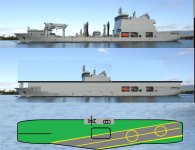
Saw a post on Reddit today about a kid's idea of how Canada could get an aircraft carrier again - modify a container ship, add a flat-top, a couple of elevators, then operate some Harriers, Sea Kings and Hueys. I decided to *** with his idea, and put this together....how about, when we get the 2x AOR's online, we get Federal Fleet Services to do some modifications to the Asterix for us....and we can then use it as a light carrier, with space for a few helos (SH-60...? Please?) and some fixed wing UAS.

Feel free to laugh....I was giggling as I did it.

NOT A SERIOUS IDEA IN ANY WAY.
 

Attachments

  • Asterix the Carrier.jpg
    Asterix the Carrier.jpg
    178.4 KB · Views: 23
@Gordon Dundas/

Can you expand on this ?
The 280s had a lot of automation for it's time, with a lot more integrated machinery systems compared to ships at the time. With the retrofit of the version of IMCS it got, it was far more integrated than even Arleigh Burkes are today (and in certain ways, the T26). The IMCS we developed got turned into the IPMS on the CPFs that is now being exported by L3 and used on multiple commercial and warship platforms (Including QE aircraft carrier).

Similarly, CCS 280 was way ahead of it's time, and integrated a lot of ops room things that is now pretty standard.

Re the replacement ships, lots of LL on a lot of older ships, but in general lot of things have changed on hull form and some other basic life safety and environmental things that would require massive redesign of any old design (including CPFs), so at a certain point you have to just start fresh. Lot of pretty good existing modern hull forms to choose from, including FREMM and Type 31 as well as some smaller ones, but the cost will be driven by things like combat recoverability requirements and the weapons platforms. Everything else is pretty minimal by comparison, but major decisions like wanting a quiet ship for ASW impacts AAW/destroyer related capabilities, and anything that adds major top weight (like a big AAW radar) impacts the entire ship design, so bolting stuff on means you need to look at everything else.

 
The contemporaries of the 280's were the Batch I Type 42 in the UK, the Suffren class in France, the Tromp class in the Netherlands, the Audace class in Italy and the Batch I Spruance class in the US. Other than the weapons systems available to the American captain, I don't feel that the 280's had anything to be ashamed of compared to the others. As Navy_Pete pointed out, there was more automation and systems integration in the 280's than in any of the above mentioned vessels of these other nations.

One of the vessels we looked at for the CSC was the FREEM frigates. Setting them aside, the French Navy just started a new class (Amiral Ronarc'h) of frigates to replace the La Fayette class. They are considered front line capable (unlike the La Fayette's) and pack as much punch as the FREEMs but in a much smaller hull and with very interesting twist on systems. They have an integrated bridge, combat control system and IPMS, but all of the software running all these systems are located in two similar shipboard "data centers" from which all software updates can be run in one shut for all of them, making it both easy to provide security patches and providing for cybersecurity (less potential points of attack).

Anyway, it is a vessel that is just a little smaller than a Halifax, packs as much of a punch as a Halifax, and runs on a crew of 125, including the 15 members of the air group. I strongly suggest people should look at that vessel carefully - it would be a good model for the CDC.
 
FREEM frigates for the CDC, will cost us, most of the RCD's and then we will be close to the same number of hulls as we have with the Halifax's and no replacement for the roles that the MCDV did or was designed for and for what the CDC was envisioned for.
 
The 280s had a lot of automation for it's time, with a lot more integrated machinery systems compared to ships at the time. With the retrofit of the version of IMCS it got, it was far more integrated than even Arleigh Burkes are today (and in certain ways, the T26). The IMCS we developed got turned into the IPMS on the CPFs that is now being exported by L3 and used on multiple commercial and warship platforms (Including QE aircraft carrier).

Similarly, CCS 280 was way ahead of it's time, and integrated a lot of ops room things that is now pretty standard.

Re the replacement ships, lots of LL on a lot of older ships, but in general lot of things have changed on hull form and some other basic life safety and environmental things that would require massive redesign of any old design (including CPFs), so at a certain point you have to just start fresh. Lot of pretty good existing modern hull forms to choose from, including FREMM and Type 31 as well as some smaller ones, but the cost will be driven by things like combat recoverability requirements and the weapons platforms. Everything else is pretty minimal by comparison, but major decisions like wanting a quiet ship for ASW impacts AAW/destroyer related capabilities, and anything that adds major top weight (like a big AAW radar) impacts the entire ship design, so bolting stuff on means you need to look at everything else.


Adding stuff to a vessel only requires a redesign of the vessel if it has been built close to its design tolerances.

If you build a ship with a heavy displacement of 4500 tonnes and then load her to 4450 tonnes in the yard then you don't have many options.

On the other hand if you put those 4450 tonnes into a 6000 tonne hull then you have lots of room to rethink and refit to meet the needs of the moment.

A lightly armed 6000 tonne hull may not only suffice for peacetime but may, in fact be a better, more flexible solution for war time in that it can be easily adapted to requirements.

Cheaper to build and operate in peacetime as well. And in war time the challenge seems to be finding enough suitable hulls fast enough.
Not just the weight, it's were it goes. Adding 10 tonnes 7 stories up needs far more weight in ballast to keep the ship stable. Similarly putting heavy stuff on one side needs a counterbalance.

The SPY 7 on RCD just killed the weight margin with all the offsets, and the inservice costs for some of the maintenance on exotic metals and bimetallic connections used to cut weight is going to be a lifetime issue.

On the 280s, the water compensated fuel tanks were required to keep it from flipping upside down for the same reason with all the top weight, and that only really topped out at 5000 tonnes, which is lighter than the CPFs now at more or less the same length, width and draft.
 
Back
Top