• Thanks for stopping by. Logging in to a registered account will remove all generic ads. Please reach out with any questions or concerns.

Continental Defence Corvette

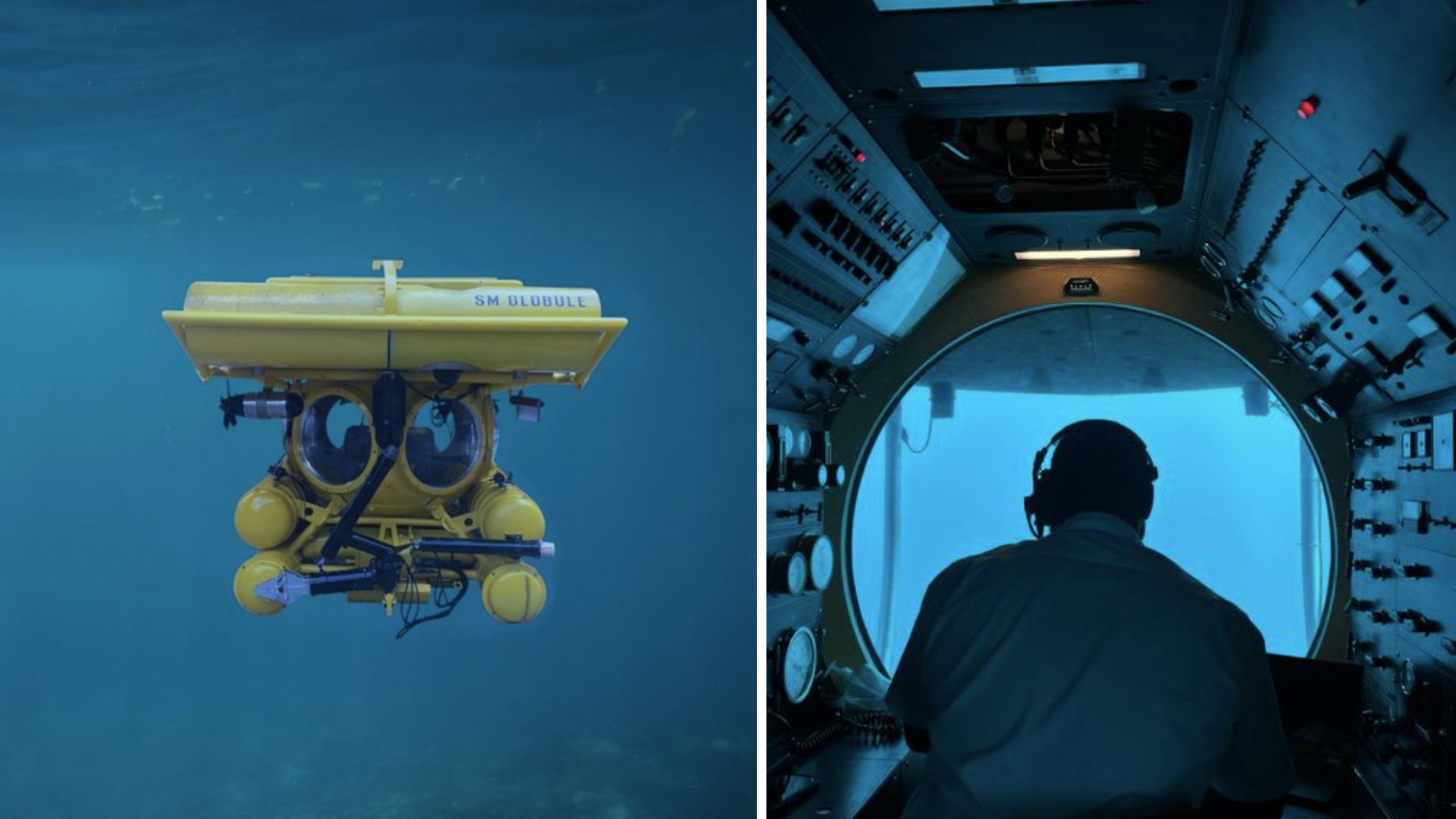
If a surface vessel were operating in co-operation with uuvs and neede to communicate with them would the r/t facility look like a sonar dome?

And these corvettes, are they to operate in the ice or are they just supposed to survive in the slob at the ice edge?
St. Laurence all year round is the ice thickness and type you are looking for. That's "ice edge" in the arctic as you'll bump into stuff but hopefully never need to break anything.

Has anyone thought that one through yet? Strictly from watching the series put on TV for northern freight delivery there seems to be no clear dividing line. One day they are operating at the edges in the slob as you termed it but the next day the wind has come up and they are struggling to get clear of the ice. Will an ice strengthened hull give you the safety margin or do you have to go one better and have the ability to maneuvre in at least first year ice?


The actual "ice edge" is probably a marketing term for the land lubbers. There isn't a dividing line especially as currents and wind get involved. I suspect the Corvettes will act like so many migratory animals, following the advance and retreat of the ice as it comes and goes.

I'm sure someone is discussing what that is supposed to look like but I think that St. Laurence in winter is the real target ice resistance.
 
Has anyone thought that one through yet? Strictly from watching the series put on TV for northern freight delivery there seems to be no clear dividing line. One day they are operating at the edges in the slob as you termed it but the next day the wind has come up and they are struggling to get clear of the ice. Will an ice strengthened hull give you the safety margin or do you have to go one better and have the ability to maneuvre in at least first year ice?

I know northern trawlers that fished in Okhotsk for pollock and Baffin Bay for shrimp were taken out of the water and retrofitted with additional ribs and plate to make them fit for the ice edge. It has been a while since any boat has been trapped and crushed. Skippers tend to take weather forecasts pretty seriously.

And the slob is what the skippers called the slushy icy water that preceded the actual ice when the winds, tides and currents brought the ice down from the north into their fishing grounds off St Lawrence and the Pribilofs.
 
If a surface vessel were operating in co-operation with uuvs and neede to communicate with them would the r/t facility look like a sonar dome?

And these corvettes, are they to operate in the ice or are they just supposed to survive in the slob at the ice edge?


"energy and data to travel more efficiently through underwater environments."

"Underwater laser-based power transmission system

"The project represents the first concrete application emerging from a recently signed agreement between NUBURU and SunCubes. It aims to develop an underwater laser-based power transmission system capable of delivering energy wirelessly to autonomous underwater vehicles (AUVs) and other subsea systems, potentially transforming the way underwater assets are powered and operated.

"The DEEP LIGHT platform is designed around a high-power laser transmitter and receiver architecture that enables contactless energy transfer underwater. Unlike traditional underwater charging methods that require physical docking or cable connections, the system seeks to transmit power over distances of several tens of meters using laser beams operating in the blue-green optical spectrum.

"This wavelength range is particularly important because blue and blue-green light experiences lower attenuation in water than many other wavelengths, allowing energy and data to travel more efficiently through underwater environments. By leveraging NUBURU’s expertise in blue-laser technology, the collaboration aims to improve the efficiency, reliability, and scalability of underwater wireless power systems."

....

A UUV would still have to approach within "10s of meters, may be a kilometer or so for data only, but it wouldn't have to surface.

And if the surface vessel were working with a swarm of similarly equipped UUVs then line of sight relay, together with actual physical displacement of the UUVs to get within communicating distance of each other, could result in near real time comms over extended distances.
 
Sorry,

Originally posted in the wrong thread

I am going to indulge my predilection for toys this morning.

These are cheap solutions available today that can be deployed from and with any existing vessel, naval or commercial, large or small.


First is the Manta - an autonomous Bras d'Or that can submerge.
Like the Bras d'Or it rides fast over the waves on its wings, it can survive in high sea states with its wings supplying stability, it can loiter on the surface in drlft mode and it can sprint away from threats and towards new locations or targets.
Unlike the Bras d'Or it can also loiter and navigate submerged.

It comes in lengths ranging from 18 ft to 54 ft. The 54 ft Manta has a payload bay with a 5000 kg capacity. The 18 ft has a payload of 50 kg.
As a reminder a Mk48 torpedo and a Tomahawk missile weigh around 1600 kg, so three per 54 footer.
Kratos builds a 90 kg cruise missile with a 926 km range and a 36 kg warhead


.....


Next is the V-Bat UAV, a VTOL tail-sitter that can take off and land on any surface and that has all the range and endurance benefits of a fixed wing aircraft. Unlike a copter it can glide and reduce fuel consumption.

....


And finally the Canadian BAE Herne XLAUV

....

These are the places where money should be spent today.

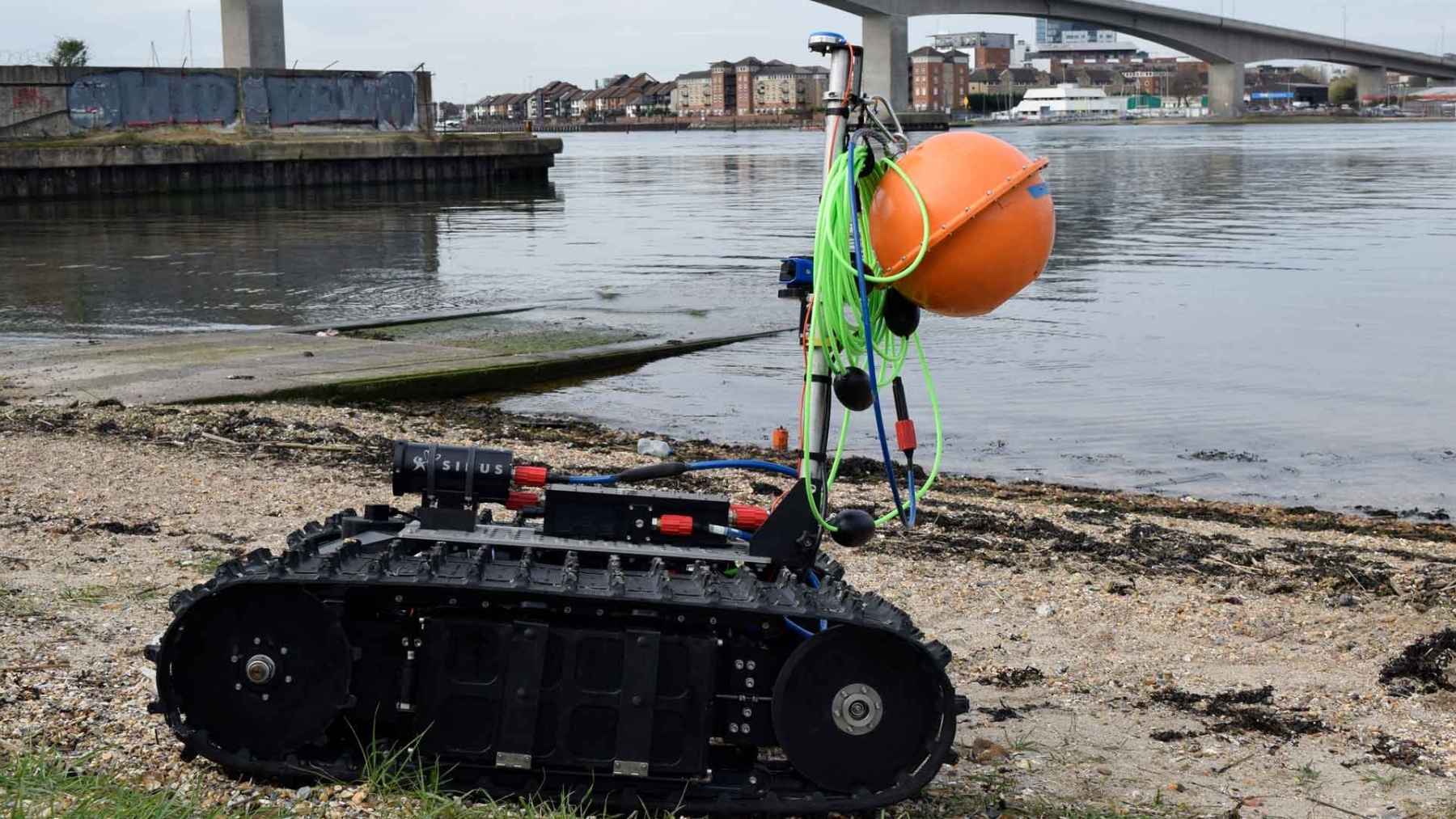
And one more toy for the surfline and tidal zone

 
Sorry,

Originally posted in the wrong thread
Russians had tank track subs for years in the baltic, crewed though. Baltic is a unique environment for that is the subsurface is well mapped and not overly rugged.
 
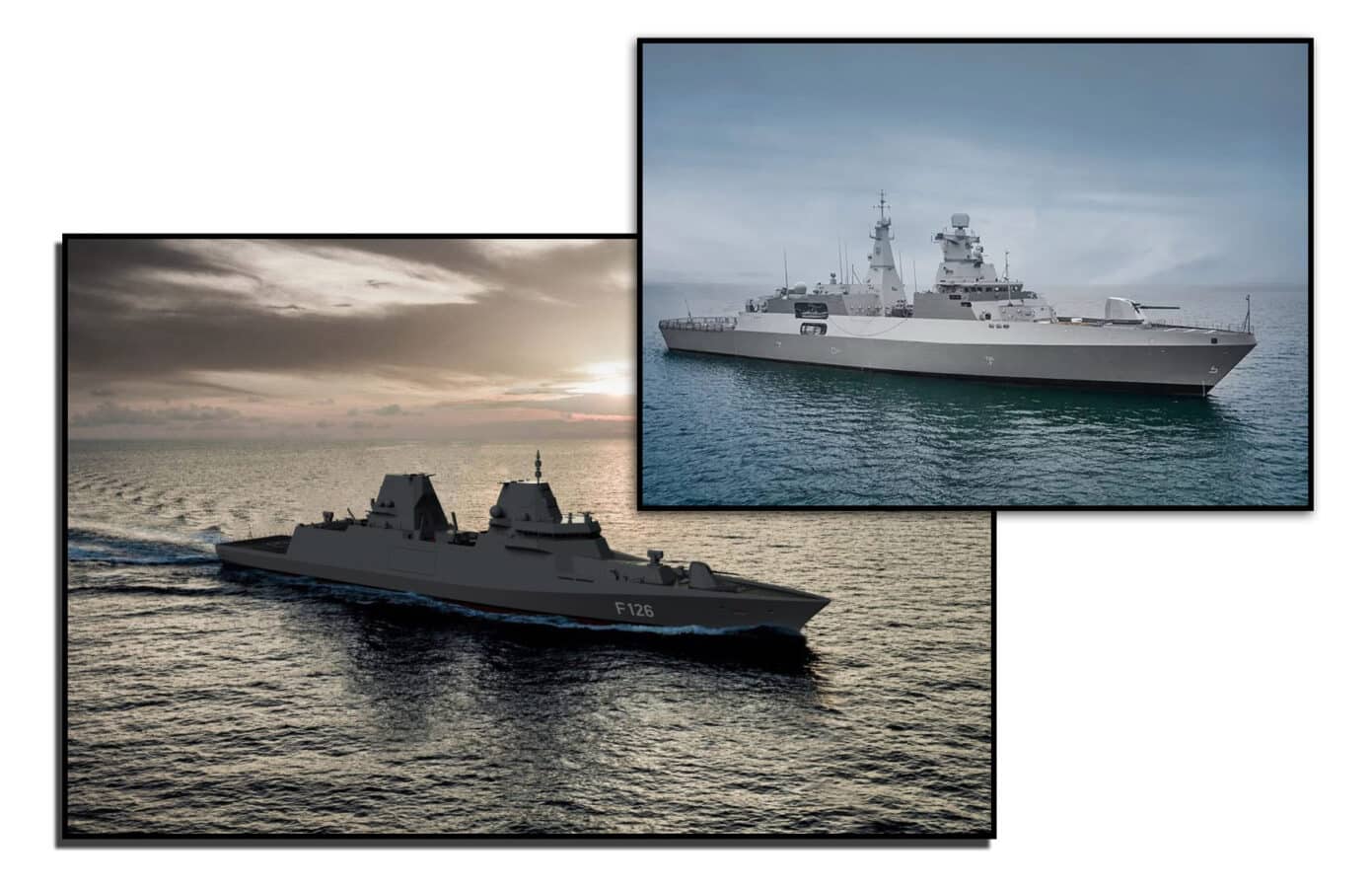
Germany swapping theF128 programme for 8 MEKOs.


Apparently (AI sourced)

There are approximately 33 MEKO 200 frigates and 6 MEKO 140 frigates currently active across eight different navies worldwide.

Developed by the German shipbuilder Blohm + Voss (now ThyssenKrupp Marine Systems), the modular MEKO family of warships is highly exported.

The active MEKO 200 and MEKO 140 fleets are distributed across the globe:

MEKO 200 Operators

Turkey: 8 ships (4 Yavuz-class and 4 Barbaros-class)
Australia: 7 ships (Anzac-class)
Greece: 4 ships (Hydra-class)
South Africa: 4 ships (Valour-class)
Portugal: 3 ships (Vasco da Gama-class)
Algeria: 2 ships (Erradii-class / MEKO A-200AN)
New Zealand: 2 ships (Anzac-class)
Egypt: 3 ships (Al-Aziz-class)


...

how quickly can meko modules be replaced and is the engine and gearing considered as a replaceable module +9

In naval shipbuilding, the MEKO modular concept is a design philosophy allowing shipyards to construct vessels while leaving standardized slots for weapons and electronics. The time it takes to replace these modules ranges from a few hours to several weeks, depending on whether you are doing a rapid mission payload swap or an in-depth shipyard repair.

Are Engines and Gearing Considered Replaceable Modules?Yes, but with critical distinctions in how they are serviced:

In-situ module exchanges:

Major propulsion elements (like specific turbines or generator sub-assemblies) are designed as replaceable hardware modules. In modern MEKO platforms (such as the MEKO A-200), large gas turbines are assembled in a way that allows the gas generator and power turbine to be separated. This enables crews or technicians to swap out the broken part of the engine in a matter of days rather than weeks.

Gearing and alignment: While main reduction gearing units are mechanically designed for removal and overhaul, replacing an entire gearbox is a major industrial undertaking. It requires the physical lifting of massive machinery, intricate shaft realignments, and heavy structural hull work.

The "Built-in" Caveat: Unlike the plug-and-play weapons or combat system modules, engines and gearing are tightly integrated with the ship's foundation. You cannot simply slide a main engine or gearbox out of an upright wall slot; it requires opening large structural hatches or removing hull plating, making it a deep-maintenance shipyard task rather than a quick dockside swap.

....

I asked the questions in light of an article posted on this site recently where the French were targetting 80% availability rates on their fleets. It was suggested that this was in large part due to modular construction.

 
Germany swapping theF128 programme for 8 MEKOs.


Apparently (AI sourced)

There are approximately 33 MEKO 200 frigates and 6 MEKO 140 frigates currently active across eight different navies worldwide.

Developed by the German shipbuilder Blohm + Voss (now ThyssenKrupp Marine Systems), the modular MEKO family of warships is highly exported.

The active MEKO 200 and MEKO 140 fleets are distributed across the globe:

MEKO 200 Operators

Turkey: 8 ships (4 Yavuz-class and 4 Barbaros-class)
Australia: 7 ships (Anzac-class)
Greece: 4 ships (Hydra-class)
South Africa: 4 ships (Valour-class)
Portugal: 3 ships (Vasco da Gama-class)
Algeria: 2 ships (Erradii-class / MEKO A-200AN)
New Zealand: 2 ships (Anzac-class)
Egypt: 3 ships (Al-Aziz-class)


...

how quickly can meko modules be replaced and is the engine and gearing considered as a replaceable module +9

In naval shipbuilding, the MEKO modular concept is a design philosophy allowing shipyards to construct vessels while leaving standardized slots for weapons and electronics. The time it takes to replace these modules ranges from a few hours to several weeks, depending on whether you are doing a rapid mission payload swap or an in-depth shipyard repair.

Are Engines and Gearing Considered Replaceable Modules?Yes, but with critical distinctions in how they are serviced:

In-situ module exchanges:

Major propulsion elements (like specific turbines or generator sub-assemblies) are designed as replaceable hardware modules. In modern MEKO platforms (such as the MEKO A-200), large gas turbines are assembled in a way that allows the gas generator and power turbine to be separated. This enables crews or technicians to swap out the broken part of the engine in a matter of days rather than weeks.

Gearing and alignment: While main reduction gearing units are mechanically designed for removal and overhaul, replacing an entire gearbox is a major industrial undertaking. It requires the physical lifting of massive machinery, intricate shaft realignments, and heavy structural hull work.

The "Built-in" Caveat: Unlike the plug-and-play weapons or combat system modules, engines and gearing are tightly integrated with the ship's foundation. You cannot simply slide a main engine or gearbox out of an upright wall slot; it requires opening large structural hatches or removing hull plating, making it a deep-maintenance shipyard task rather than a quick dockside swap.

....

I asked the questions in light of an article posted on this site recently where the French were targetting 80% availability rates on their fleets. It was suggested that this was in large part due to modular construction.


So question for the Navy folks -- could CMS330 work on these?
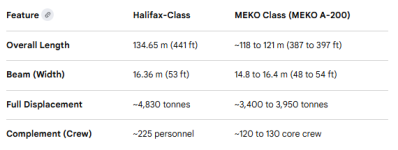
Would the MEKO 200 design be close to the RCN’s new Light Frigate idea?

As I suspect this may be a bone thrown to TKMS if the Sub contract goes to SK.
 
CMS330 is scale-able as I recall.

CMS330 is proven to integrate with the following systems that are common to both Halifax Class and Meko:

  • Phalanx CIWS
  • MK41 VLS/ESSM
  • Harpoon
  • Raytheon CW MK73

Also, compatible with the Rheinmetall MASS (already installed on HFX)

I would say that it's likely that they could make it all talk together.

 
Back
Top