• Thanks for stopping by. Logging in to a registered account will remove all generic ads. Please reach out with any questions or concerns.

2026 FIFA World Cup

Meanwhile, on the West Coast...

Interesting point ...

Mayor Chow's administration has pledged not to draw from our existing municipal property tax base to cover the cost of hosting .

The City will be re-selling tickets to corporate sponsors, and increasing hotel taxes.

Sounds like no chance of a Downsview Park repeat . So , it's gonna be one of the best summers we've ever had.
 
Just did a back of the envelope calc, for those interested.

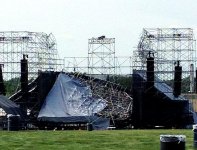
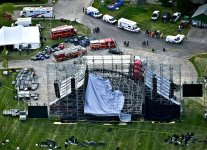
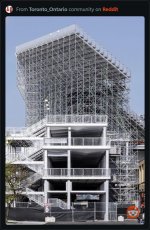
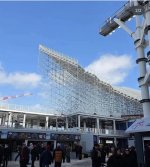
First: The legs you see in the picture of the stands are likely standard heavy commercial scaffolding ones, rated to take down up to 20 tons of weight each. for each of the five sections, I can count 14 legs back to front and ten on the face. That's 140 legs per section. The temporary stands can take 17,000 fans: that's 3,400 per section. Allowing for an average weight of 200 pounds, that's 340 tons of fans. For each seat and the fraction of the section weight attributable to each seat, I'll use the same 200 pounds, which I feel is generous.

That brings us to a total of 680 tons. Again, I'll throw in a safety factor by adding 20 tons, to bring each stand section full of fans to 700 tons. Divide that by leg and you get 5 tons per leg: That's only a quarter of their rating.

You'd need the stand to be full with two members of the "quarter ton" club on each seat, in a hurricane, to bring that thing down.
đź§ 

OGBD, you’re taking me back to my first year Strength of Materials course, before we even hit Young’s Modulus. People often underestimate strength of structure and materials, for example, if troops actually saw the single 7/8” bolt that holds a CH-146 airframe to the entire rotor system, they’d likely be less excited to get a lift from the chopper, but a grade 8 bold made from 150kpsi steel is more than capable. That stand structure has crazy compression, tension and sheer force in it and also flexibility to absorb and distribute any “crowd-induced harmonic motions.” 👍🏼
 
đź§ 

OGBD, you’re taking me back to my first year Strength of Materials course, before we even hit Young’s Modulus. People often underestimate strength of structure and materials, for example, if troops actually saw the single 7/8” bolt that holds a CH-146 airframe to the entire rotor system, they’d likely be less excited to get a lift from the chopper, but a grade 8 bold made from 100kpsi steel is more than capable. That stand structure has crazy compression, tension and sheer force in it and also flexibility to absorb and distribute any “crowd-induced harmonic motions.” 👍🏼

Glad to have helped you reminisce. :)

When I was still in the Navy, we used to have a classic question for boatswain to test their trade knowledge. We would tell a Leading Seamen (that's what they were called then): "You have a work party of ten seaman, now you have to go and pick up a five tons shackle on the jetty and bring it on board, how do you proceed?"

The answer of course is you tell the smallest seaman in the group to go get it and bring it onboard. A five tons shackle fits in one's hand's palm: five tons is the rating, not its weight.
 
That means nothing.

First of all, not meeting safety standard does not equate being unsafe. I have an engineer friend who once explained to me that safety standards are developed by using safety factors calculated on top of actual capacities. He called it the Ignorance Factor. For instance, you'll say" this beam can support a load of ten tons, + or - half a ton 99.99% of the time. So to make sure it won't break, we rate it at 9 tons, which is half a ton below the lowest expected failure point, but to this, you add a safety factor and voila, you are now just rated for 8 tons, just in case of an impossible outlier. Now, you do the same thing with the columns, and the braces, and the stringers, and suddenly, your bridge built to a capacity of say 100,000 tons won't fail even if you put 200,000 tons on it.

Also, second of all, you may fail to meet safety standards because they have been changed and it's too costly to modify to meet the new standards. That does not mean that the old standard was unsafe, just that the new one takes new matters in consideration and requires modification in order to be met.

Finally, you may fail to meet safety standards because, like everything else, your structure or system ages. Metal will rust (yes, even aluminum, we just call it something else), fatigue or wear down. It will not keep its strength forever and at some point has to be replaced or torn down. Similarly, wood putrefies and needs replacement. Concrete and mortars disintegrates over time and if cracked will be attacked by freeze and thaw cycles. Again, after a while, it does not meet the safety standard anymore and has to be redone.

Except, this is Canada, they decide afterwards, that "Hey we like all this extra seating" and keep it. Except now there is no money to maintain it and it gets used for years, till hopefully someone notices that corrasion has set in, or something bad happens.
 
Back
Top