• Thanks for stopping by. Logging in to a registered account will remove all generic ads. Please reach out with any questions or concerns.

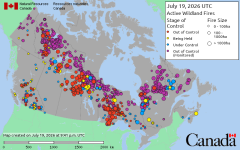
2026 Wildfire Season

It doesn't seem to matter with these legislators that a Canadian helicopter pilot died fighting an American wildfire in Colorado last week. Or is just "expected" of us?

Maybe after the next major hurricane in the southern states we won't be able to send any line crews because they will be busy cleaning up the forest floors
 
It doesn't seem to matter with these legislators that a Canadian helicopter pilot died fighting an American wildfire in Colorado last week. Or is just "expected" of us?

Maybe after the next major hurricane in the southern states we won't be able to send any line crews because they will be busy cleaning up the forest floors

It would be a terrible shame if anything happened to the critically important water the USA gets from Canada.

A terrible shame...

 
It would be a terrible shame if anything happened to the critically important water the USA gets from Canada.

A terrible shame...


Yes.

Nature has no political boundary that it respects. So really, it's up to political entities to figure out how to best deal with nature so as to profit political entities as best as possible.
 
Maybe this could be an opportunity to educate the public on the importance of letting certain wildfires burn, and not putting out any and all fires. The result is a ton of fuel that should have burned off naturally that instead built up over decades, on top of the weather getting more and more out of what we'd consider "normal".
 
Maybe this could be an opportunity to educate the public on the importance of letting certain wildfires burn, and not putting out any and all fires. The result is a ton of fuel that should have burned off naturally that instead built up over decades, on top of the weather getting more and more out of what we'd consider "normal".

'The public' thinks the stupid Linus tree on the corner of their block needs to be saved, or the world will die.

Meanwhile, this guy...

 
Maybe this could be an opportunity to educate the public on the importance of letting certain wildfires burn, and not putting out any and all fires. The result is a ton of fuel that should have burned off naturally that instead built up over decades, on top of the weather getting more and more out of what we'd consider "normal".
When I was back home on PEI this summer, there was an expert on the radio talking about how all the deadfall from Fiona wasn't a problem, because it had been four years, and all the dead wood was rotted away...

He clearly hadn't spent much time outside of Charlottetown, where there are still tons of dead and dry trees off the ground, leaning on one another, or against living trees.
 
When I was back home on PEI this summer, there was an expert on the radio talking about how all the deadfall from Fiona wasn't a problem, because it had been four years, and all the dead wood was rotted away...

He clearly hadn't spent much time outside of Charlottetown, where there are still tons of dead and dry trees off the ground, leaning on one another, or against living trees.
This is the same official that stated the fire load had not changed after Fiona as there were the same number of trees. Many of the old roads and trails are blocked with deadfall making access a challenge. This year we've had one 'forest' fire that required multiple depts ... lots of dragging hoses through the woods. We expect more and our fire dept just bought a wildland truck.
 
An American FB page is claiming that Canadian wildfire smoke is forcing sasquatch out of the forests in the northern Adirondack mountains..
"First they came for the sasquatch, and I did not speak out—because I was not a sasquatch ..."
 
It would be interesting to do a comparetive GIS overlay and show how much of their forest is within, say, five miles of any sort of road, compared to ours.

Privately owned largely = logging = accessible and actively managed. Ours is just woods that for much of it no human has ever touched.

I remember driving from Vancouver to the Yukon many years back. At one point we were stopped at some outlook, I feel like it was up past Fort Nelson, and I was looking out northeast and just marvelling at how much utterly untouched wilderness there was out there. Same feeling driving up across the top of Lake Superior a couple years ago. Canada’s really big.
You probably need to fly over it on a day without much cloud cover to appreciate the size of some of the cut blocks in those regions too. Not making ugly cuts where the people travelling major highways can see them has been a habit, if not formal policy, for decades.
 
It would be interesting to do a comparetive GIS overlay and show how much of their forest is within, say, five miles of any sort of road, compared to ours.
One version I've heard (third hand from a geologist who's worked in both the U.S. and Canada) is that any bit of land in the U.S. is something like an average of 13 miles from a road, while any bit of land in the Canada is something like 110 miles from a road.

Another version I've seen online over the past few days is that ~80% of the U.S. is within a kilometre of a road, while ~80% of Canada's Boreal forest is more than a kilometre from a road.
 
which taken together makes Canada one giant carbon sink sequestering far more CO2 than we could possibly produce. The figures floored me.
  • CO2 Absorption: With 594.7 billion trees absorbing approximately 14.87 gigatonnes of CO2 annually, Canada’s forests are a formidable carbon sink.
  • National Emissions: Canada emits roughly 559 megatonnes (0.559 gigatonnes) of CO2 equivalent each year.
  • The Net Effect: When comparing these figures, Canada’s trees are absorbing carbon dioxide at a rate 26.6 times higher than the country’s total greenhouse gas emissions.
Every single tornado that hits southern and central Ontario is spawned from a weather system that entered Canada from the US, primarily Michigan. And they don't seem to care. The rotters.
 
So far despite the heat, drought and lightning, things in BC seem to be holding. There have over 100 fires started since last Thursday and most are being held, or out, or under 1 hectare.
Still 60% of fires have been human accident caused including all of the major fire complexes.
Most of our wildfire smoke seems to have origins in the US, principally Idaho and Oregon.
 

Attachments

  • IMG_0451.jpeg
    IMG_0451.jpeg
    256.6 KB · Views: 2
  • IMG_0452.jpeg
    IMG_0452.jpeg
    226.5 KB · Views: 2
Back
Top