GK .Dundas
Army.ca Veteran
- Reaction score
- 2,908
- Points
- 960
Should read Chemtrails and did when I postedAnd it's being done by using chemicals....


Should read Chemtrails and did when I postedAnd it's being done by using chemicals....
If you look at the purple - out of control/monitored fires - it also highlights how many fires are in areas where there are little to no values to protect.It's like a sash of 940 fires ...
View attachment 101352
Canadian Wildland Fire Information System / Système canadien d'information sur les feux de végétation
Canadian Wildland Fire Information System / Système canadien d'information sur les feux de végétationcwfis.cfs.nrcan.gc.ca

The formulation of which lessens the presence of dihydrogen monoxide in the air, allowing the fires to spread.Should read Chemtrails and did when I posted
Absolutely!The formulation of which lessens the presence of dihydrogen monoxide in the air, allowing the fires to spread.

If I recall the Ontario MNR policy, they will 'monitor' only any fire north of 51* unless a community is threatened. There is virtually no timber value and much of the area is far too remote.If you look at the purple - out of control/monitored fires - it also highlights how many fires are in areas where there are little to no values to protect.
Red (and the now BH and UC fires) are usually only actioned due to values at risk - could be people, communities, wildlife values etc.

 www.ctvnews.ca


 montanafreepress.org

Cost recovery is mostly done via CIFFC and pre-signed contracts. As I understand it each province or international agency will "price" resources based upon type and qualification. The contracts involve both a review of each others qualification process/certification standards and what roles they can or can not fill. Goal is no surprises and easy accounting when a resource request for assistance goes out.P.S. - Re: earning "commercial rates," all I could find in the public domain this quickly is that (in Ontario, anyway) "there are costs associated with deploying provincial resources (to California), but ... there a number of agreements that will assist with cost recovery for this work." Happy to hear from those way closer to the sharp/hot end about how such cost recovery works.

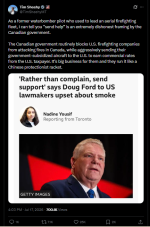
Also shared via POTUS47's Truth Social: Montana senator disses Canada "block(ing) U.S. firefighting companies from attacking fires in Canada."
View attachment 101365
P.S. - Re: earning "commercial rates," all I could find in the public domain this quickly is that (in Ontario, anyway) "there are costs associated with deploying provincial resources (to California), but ... there a number of agreements that will assist with cost recovery for this work." Happy to hear from those way closer to the sharp/hot end about how such cost recovery works.
P.P.S. - That would be this Tim Sheehy ...
A U.S. Senator pushed to cut firefighting aircraft inspections the same month his former company failed one
In the Senate, Tim Sheehy has sought to cut regulations and expand the government’s use of private aircraft on wildfires, while still owning stock in Bridger Aerospace.Senator Pushed to Cut Fire Aircraft Inspections His Firm Flunked
“U.S. Sen. Tim Sheehy previously ran an aerial firefighting company. After joining Congress, he proposed ending Forest Service inspections of those aircraft. The same month a draft of his plan to end Forest Service inspections leaked, an aircraft at his former company failed an inspection...www.sej.org

Coulson I should note has very limited control on their products. To their credit they have patented a version of the USAF MAFF's for their C-130 conversion aircraft...but getting more C-130's is an issue. Nobody in Canada is using 737's as airtankers...only in the US and NSW Australia.The whole method of contracting air tanker assets for wildfire management is insanely complicated and shot through with crazy politics and questionable business practices.
There is no shortage of aircraft, as I understand it, it's just who gets access to the work.
But yeah, let's buy a bunch of government water bombers because it makes us feel good about a very politically charged, emotional subject...
e.g.,
Sask. government paid $100M too much for new firefighting planes, B.C.-based manufacturer says
Coulson Aircrane asks court to overturn $187M contract, alleging tendering process was flawed, biased
Coulson Aircrane says the Saskatchewan government has agreed to pay more than twice what it should have for four firefighting aircraft — a decision the B.C.-based company says will cost Saskatchewan taxpayers an extra $100 million.
Coulson, one of the leading companies in the world for retrofitting planes for firefighting, made the claim last month in an application to the Court of King's Bench.
"We are concerned the government of Saskatchewan has awarded a very large (over $187,000,000) contract for forest fire airplanes, without affording any reasonable opportunity to Coulson or any other competitor to bid on the contract," says an affidavit filed by company president Britt Coulson.
If you have a large scale crown fire it's really tough to understand how much energy is being released. Let alone heat and other aspects. And then multiply that by kilometers or tens of kilometers wide front.And lets be very clear…
Wildfires on the scale of Northern Ontario are only put out by one thing: extended rain or snow.
You can throw every water bomber and fire crew in the world at a fire that size and it laughs at our puny human efforts. At best, you might be able to shape it’s direction somewhat.
This hard for intelligent people to understand (much less US politicians).
 . This was the best of the group...and seeing a major fire cook off is impressive but something I could skip again moving forward.
 www.latimes.com
Yup -- U.S. Nuclear Defence Agency worked with MNR and Forestry Canada in 1989 on a biggish burn to sorta-kinda simulate, I don't know, other big burns?If you have a large scale crown fire it's really tough to understand how much energy is being released. Let alone heat and other aspects. And then multiply that by kilometers or tens of kilometers wide front.
It is my understanding that NORAD uses forest fires to help calibrate nuclear bomb sensors (in case of an explosion) due to the energy released.
As @SeaKingTacco indicated you need the weather to cooperate. What good is a guy with a bucket of water going to do if you have 50-60m tall flames coming at you...except get in trouble.
A quick google search did not find much other than some opinion pieces/reddit on cross checking energy release of nuclear bombs vs. fires. For some reason a lot of this information appears to be unpublished
Wildfires can release more energy than an atomic bomb. No wonder they look apocalyptic
Uncontrolled wildfires can be powerful enough to generate their own weather.



Basically, nowhere near where 99% of the population lives; therefore, in typical Canadian fashion, minimal resources are allocated to combating the issue.It's like a sash of 940 fires ...
View attachment 101352
Canadian Wildland Fire Information System / Système canadien d'information sur les feux de végétation
Canadian Wildland Fire Information System / Système canadien d'information sur les feux de végétation
Bang on +95% of the time, but this year, the fires are also affecting (in Ontario, anyway) 1) more small towns than usual (compared to usually being way further north affecting remote First Nations - and their evacuations mostly due to smoke has been an annual event for some time), and 2) resorts and privately owned camps/cottages way more than other years. Hence more people being up in arms in general re: "why aren't they putting out all those fires faster?!?!?!?Basically, nowhere near where 99% of the population lives; therefore, in typical Canadian fashion, minimal resources are allocated to combating the issue.
Basically, nowhere near where 99% of the population lives; therefore, in typical Canadian fashion, minimal resources are allocated to combating the issue.
Waterbomber fleet is basically the same size it's always been but planes are all significantly older, require significantly more maintenance and downtime, and no new production has been happening.
It's a sovereignty issue tbh, we can't exert control over our own territory; therefore, the question becomes, does it actually belong to us?

 globalnews.ca
This wasn't quite the map I was thinking of but this paper 100% supports your comment:Basically, nowhere near where 99% of the population lives; therefore, in typical Canadian fashion, minimal resources are allocated to combating the issue.
Waterbomber fleet is basically the same size it's always been but planes are all significantly older, require significantly more maintenance and downtime, and no new production has been happening.
It's a sovereignty issue tbh, we can't exert control over our own territory; therefore, the question becomes, does it actually belong to us?

It's a sovereignty issue tbh, we can't exert control over our own territory; therefore, the question becomes, does it actually belong to us?
What do you propose to do about the forest fires that is actually within current human technology?100% correct.
I hope Canadians are hoisting in what is being pointed out as actually important and what is not if we want to remain a sovereign country.


