• Thanks for stopping by. Logging in to a registered account will remove all generic ads. Please reach out with any questions or concerns.

All Things AB Separatism (split fm Liberal Minority Government 2025 - ???)

Is there anything the people at Centurion Project or those 23 people can be charged with?
I don’t want to speculate on that. There’s too much I don’t know, and if there’s a criminal investigation then in my position I shouldn’t speculate anyway.

I do expect a lot of stuff is being carefully looked at, and I expect there are some novel jurisdictional questions given the mix of provincial and potentially criminal law. I’m definitely really curious how it plays out.
 
I don’t want to speculate on that. There’s too much I don’t know, and if there’s a criminal investigation then in my position I shouldn’t speculate anyway.

I do expect a lot of stuff is being carefully looked at, and I expect there are some novel jurisdictional questions given the mix of provincial and potentially criminal law. I’m definitely really curious how it plays out.
Id say the only thing we can say with confidence, is since the list came from the republican party of AB, they are getting charged under the elections act.
 
Just a point of observation. Data mining companies have collected and compiled more personal info on internet users than any voter roll could contain.

In summary, the Alberta voter roll on an individual generally includes:
Full name
Residential address
Eligibility to vote in Alberta provincial elections

Data Miners have a lot more info on most people than that, but it's not a reason to break the law with Voter Rolls.
 
Just a point of observation. Data mining companies have collected and compiled more personal info on internet users than any voter roll could contain.

In summary, the Alberta voter roll on an individual generally includes:
Full name
Residential address
Eligibility to vote in Alberta provincial elections

Data Miners have a lot more info on most people than that, but it's not a reason to break the law with Voter Rolls.
Data miners cant get your unique elector number, electoral district, or polling location, till now. Elections Alberta today confirmed over 500 cease and desist letters were sent out. 23 of them were people with centurion.

Data miners, the FSB, and everyone else has our data now

1000033360.png
 
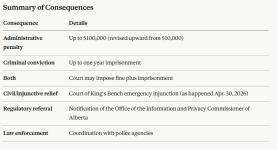
At the bare min, violation for unauthorized possession and usage. Under s.163, $100,000 fine and/or 1 year in jail. Depending what they do with that data it could go other ways.


EDIT:
Provincial and and federal privacy laws apply to, and if they used the data for fraudulent purposes then we can be looking at

Fraud,
Identity Theft,
Identity Fraud,
Unauthorized Use of Computer if systems/accounts were improperly accessed,
Forgery if signatures or petition records were falsified,
Mischief in Relation to Data in some cyber-related scenarios.

Hopefully Mrs Lich and friends get hammered with all of the above.
 
The Alberta voter roll (or electoral list) typically contains personal information about eligible voters such as their names and addresses. Recent news reports indicate that the list includes nearly three million eligible voters' names and addresses. This information is used for electoral purposes but has also been subject to privacy concerns due to leaks.

In summary, the Alberta voter roll on an individual generally includes:

  • Full name
  • Residential address
  • Eligibility to vote in Alberta provincial elections
This information is maintained by Elections Alberta and is used to manage and verify voter eligibility during elections.

Can anyone access this list?


Access to the Alberta voter roll is regulated and not open to just anyone. According to official guidelines from Elections Alberta, the use and disclosure of the list of electors are governed by provisions in the Election Act. These guidelines specify who can access the voter roll and under what conditions.

Key points about access to the Alberta voter roll:

  • The list is primarily used for electoral purposes to verify voter eligibility.
  • Access is typically granted to political parties, candidates, and certain authorized organizations for election-related activities.
  • Unauthorized public access or use of the voter roll is restricted by law.
  • There are strict rules about how the information can be used and shared to protect voter privacy.
  • Recent incidents involving unauthorized posting of the voter list online have led to investigations and legal actions.
In summary, the Alberta voter roll is not publicly accessible to just anyone; access is controlled and limited to authorized entities under specific legal guidelines to protect personal information.


What happens if someone shares it illegally?

If someone shares the Alberta voter roll illegally, there are serious consequences including legal actions and investigations. Recent events show that unauthorized distribution or use of the voter list can lead to:

  • Court injunctions to stop the illegal use or sharing of the data.
  • Investigations by Elections Alberta and privacy authorities such as the Information and Privacy Commissioner of Alberta.
  • Potential legal penalties for those responsible for unauthorized distribution.
  • Public safety concerns and reputational damage for involved parties.
Elections Alberta treats unauthorized sharing of the voter roll as a breach of privacy and election laws, and it actively pursues enforcement to prevent misuse of this sensitive information.


What’s the worst penalty for this?

Specific information about the worst penalty for illegal sharing of the Alberta voter roll is not explicitly detailed in the recent search results. However, generally, illegal sharing or misuse of voter information can lead to severe legal consequences including fines, injunctions, and potentially criminal charges depending on the severity and intent of the breach.

In Alberta, such offenses would likely be prosecuted under privacy laws and election-related statutes, which can include penalties such as:

  • Significant monetary fines
  • Court orders to cease and desist
  • Possible criminal charges if the breach involves fraud or malicious intent
For precise penalties, one would need to consult the Alberta Election Act and related privacy legislation or legal precedents, but the consequences are serious and enforced to protect voter privacy and election integrity.

Sources

Alberta separatist group ordered to pull down list with millions ... - CBC

cbc.ca
Alberta voter list leak is a potential public safety disaster - Global News
icon

globalnews.ca
List of names and addresses of millions of Alberta voters posted online
icon

youtube.com
Alberta voter info database shut down amidst probes of alleged data ...

thecanadianpressnews.ca
Voters lists - Canada.ca

canada.ca

 
Data miners cant get your unique elector number, electoral district, or polling location, till now.
Data miners can get whatever they can breach, or persuade a person to provide (bribery, blackmail). The only guaranteed way to protect information is to not collect it in the first place. A prudent way to live today is to assume that some of your personal information has already been compromised somehow, somewhere, and it's just a matter of time and probabilities before your information is misused, and to simply avoid using any services which might be vulnerable to compromise in the first place. This does mean sacrificing some conveniences, but the bottom line is people do have mitigation choices (tradeoffs).

We cannot simply never collect any information, but we can minimize collection. For some time, longer ago, it was fashionable to "collect everything, in case we need it later". For some time, more recently, it has been fashionable to question every item: what is our reason for collecting this datum? I am confident there are lots of places that still need to strip things down from the earlier era.

Because information security can be breached, pre-emptive/proactive mitigation is necessary. Misuse of peoples' personal information is difficult to mitigate because each potential misuse has different mitigation. For example, it's probably much too easy for people to open accounts for various services on the basis of not much more than information an applicant provides online or on paper.

In the case of voting, a lot can be achieved by restricting voting to in-person, with picture ID, on paper.
 
"Access is typically granted to political parties, candidates, and certain authorized organizations for election-related activities."
In short, a laughably ridiculous number of people without any particular clearances have access. Any government or gang that has people willing to maintain silence and do the time for the crime (if they get caught) can probably get access.
 
In the case of voting, a lot can be achieved by restricting voting to in-person, with picture ID, on paper.
And when you know exactly who goes to what polling station, what securities can we put in place to ensure election fraud and ballot stuffing doesnt happen by separatists on a referendum?
 
Back
Top