• Thanks for stopping by. Logging in to a registered account will remove all generic ads. Please reach out with any questions or concerns.

All Things First Nations - CF help, protests, solutions, residential schools, etc. (merged)

Yes. I've even seen the awkward case somewhere in Ontario where a land acknowledgement was made to an indigenous group who had displaced another group from that land. Who do you acknowledge there?

On the other hand, in this case, we have a specific entity, the Government of Canada, that still exists and can still be held to account for actions. That is what makes this different than trying to go back and point the finger at Ghengis Khan or the Roman Senate.


And that's the million dollar question. What next? What is a realistic course of action? We aren't turning back the clocks here, and it must be accepted that the solution isn't going to look like any past. This is where some shared vision is required.
Could see an extension of the reserve governments into surrounding Crown land as a good first move, with a "figure it out between yourselves" approach to boundaries between Indigenous jurisdictions. Look at it as analogous to the Canadian Rangers, but for land management.

On a more blue-sky front: turn the infrastructure, authorities, and headaches of the Indigenous part of "...and Northern Affairs" over to e.g. the Assembly, including a Cabinet seat. Figure out a healthy budget, startup funding to deal with things like the drinking water problem, and a balance between providing trained civil service types out of the common pool and opportunities for Indigenous people in "their" chunk of the national government.
 
I am all for renovating the Indian Act. Remember, however, that PM Harper offered and was torn apart for doing so by the AFN. So, there are layers and competing interests, even within 600 odd First Nations, who all have different ideas about what reconciliation looks like.

I, too, find the “settler/colonizer” language spectacularly unhelpful. It places everyone, by virtue of their skin colour, into a box that they can never escape from and sets up an “us/them” narrative that does not further reconciliation. I was born in Canada and had no choice in the matter- just like everyone else that was born in Canada, be it in the year 2000, 1900, 1800, or 1000AD.

I find no other alternative than to turn over vast amounts of tax dollars to First Nations, no strings attached, for about a generation. Kill Indigenious Service Canada as a Dept and let local First Nations spend how they want. Build houses, buy more land or businesses, build schools, etc- up to the First Nations to decide. Will there be mistakes, errors and outright theft along the way? You bet. However, don’t think for a second the young people on First Nations land won’t, very quickly, begin to hold their own leadership to account.
 
... Will there be mistakes, errors and outright theft along the way? You bet. However, don’t think for a second the young people on First Nations land won’t, very quickly, begin to hold their own leadership to account.
This seems to be my day for being contrary for some reason.

Sorry to disagree with the last piece. I think you have to look no further than the CAF to see the model. Does the CAF membership hold its leaders to account for the massive bureaucracy it has become and the misspent funds. No! Universally it blame the government for not ponying up 2% of the GDP.

I've worked with First Nations, most of which are small entities, and like any small community, are rife with conflicting interests and mismanagement. Often in such communities the majority of members are affiliated with one particular family group and if you belong to the family in power your circumstances for jobs and housing may be significantly better than your neighbour who doesn't belong.

There will always be a need for oversight and and transparency. IMHO the transparency needs to be in the form open and audited books (which many FNs stubbornly refuse to provide to both the government or their membership). There is, however, room to create an overarching oversight bureaucracy that is fundamentally operated by FN members so that individual FNs are accountable to a national FN organization. That may be problematic under existing treaties but if possible might go a long way to taking some of the friction with the government away.

Unfortunately, I think from the Canadian government's point of view its more convenient to keep the FNs mostly divided and controlled by an Ottawa based bureaucracy that the government is comfortable with.

🍻
 
This seems to be my day for being contrary for some reason.

Sorry to disagree with the last piece. I think you have to look no further than the CAF to see the model. Does the CAF membership hold its leaders to account for the massive bureaucracy it has become and the misspent funds. No! Universally it blame the government for not ponying up 2% of the GDP.

I've worked with First Nations, most of which are small entities, and like any small community, are rife with conflicting interests and mismanagement. Often in such communities the majority of members are affiliated with one particular family group and if you belong to the family in power your circumstances for jobs and housing may be significantly better than your neighbour who doesn't belong.

There will always be a need for oversight and and transparency. IMHO the transparency needs to be in the form open and audited books (which many FNs stubbornly refuse to provide to both the government or their membership). There is, however, room to create an overarching oversight bureaucracy that is fundamentally operated by FN members so that individual FNs are accountable to a national FN organization. That may be problematic under existing treaties but if possible might go a long way to taking some of the friction with the government away.

Unfortunately, I think from the Canadian government's point of view its more convenient to keep the FNs mostly divided and controlled by an Ottawa based bureaucracy that the government is comfortable with.

🍻
Oh, I am well aware of the family/clan politics/corruption/lack of transparency within a significant number First Nations. The thing is: they can always point the finger and “blame whitey”. Most times, they are at least partially right.

I am saying this- give them the financial resources and let them figure it out. Right now, no non-native can give any criticism or suggestion to improve FN life without it being taken the wrong way.
 
Having been involved in FN-government consultation for 20 years, I would say that things on most of the BC Reserves are steadily getting better. I personally get the feeling that the Coastal FN culture was more technology and culturally adaptive than the Prairie/Canadian interior Bands and that plays out in how they engage with the rest of the world. You will find some that want to cling onto the victim mentality, but others purely want acknowledgement and then move onto the future opportunities.
 
I see the results of the residential school system daily. FASD, cognitive dysfunction, mental retardation, physical issues that actually makes you wonder how they actually can survive.
 
There is residual damage from that and we are obligated to help. However a lot of solutions also must come from within. I see that that happening in the coastal communities, I think though the remote communities are going to continue to suffer as the circle of issues is hard to break with no other options. The reality is that a number of the remote communities are not really sustainable, due to our ham fisted methods of relocation in the past, the decision needs to be theirs and then we help facilitate it. I would like to see a Federal indigenous police force, that is part of the RCMP (admin, training, etc), but separate with a different uniform. Their role is to come into troubled communities and deal with some of the problems in ways the RCMP can't at the moment. I would like to see an expanded Ranger program giving more training, support and opportunities for these communities, with foreign exchange programs with other Arctic Nations with similar units.
Building up more access to the communities both physical and electronic will help. I was utterly shocked at how little Northern infrastructure Ontario has, someone should be lined up and shot for that. BC has very few completed isolated communities and it make a big difference.
 
.... I was utterly shocked at how little Northern infrastructure Ontario has, someone should be lined up and shot for that ...
(y)

Expensive putting roads & wires in those areas (one figure I remember from the distant past is something like $1M/km), so provincial & federal governments of all mixes of Red/Blue didn't seem to want to spend that scale of money.
 
Most remote FNTs in n/w Ontario are policed by the Nishnawabi Aski Police Serice, which free-standing with joint federal-provincial funding (the adequacy of the funding is subject to much debate). They are supported by the OPP like any other police service. It was offered to all but a few opted to be policed by Band Special Constables under the OPP.

I don't know how long ago, but access choice was between year-round roads or provincially-operated air strips - the decision was air strips. I don't recall a real ground swell of demand for year-round roads - many in the communities fear social encroachment because they would be public roads to the reserve boundary. Maintaining a year-round road on muskeg is astonishingly expensive, and the FNTs, some as small as a few hundred residents, are scattered all over the north.

With the proposed haul road to the Ring of Fire chromite deposit, there is a range of opinions; some want it to go through their community, others don't.
 
... I don't recall a real ground swell of demand for year-round roads - many in the communities fear social encroachment because they would be public roads to the reserve boundary ...
Another good point: there is no consensus on full-time road connection. And those that oppose all-season access also worry about the bad things that might come in - not that the bad things stay out now, but it would only accelerate.
 
It's not going to get cheaper the longer you wait to build. It take a very long time to reach many of them and if you plan the road right you make air transport cheaper and faster to the non connected ones as goods can be trucked closer.
 
Oh, I am well aware of the family/clan politics/corruption/lack of transparency within a significant number First Nations. The thing is: they can always point the finger and “blame whitey”. Most times, they are at least partially right.

I am saying this- give them the financial resources and let them figure it out. Right now, no non-native can give any criticism or suggestion to improve FN life without it being taken the wrong way.

I would prefer to provide support payments to individual people rather than band governments, as many of the latter are very corrupt as has been noted.

The bands could then tax their people to pay for services. The desire of the people to enforce accountability should improve as it should be much more obvious that they are being ripped off and who is ripping them off.

Property rights should help, as well, as then people would have ownership of and incentive to maintain and improve their houses as they could no longer be displaced at the whim of a corrupt band council.
 
I would prefer to provide support payments to individual people rather than band governments, as many of the latter are very corrupt as has been noted.

The bands could then tax their people to pay for services. The desire of the people to enforce accountability should improve as it should be much more obvious that they are being ripped off and who is ripping them off.

Property rights should help, as well, as then people would have ownership of and incentive to maintain and improve their houses as they could no longer be displaced at the whim of a corrupt band council.
Good luck with that.

There is a well connected, vocal group at the top of most band structures that jealously guards their power.
 
And there are limits as to what the Federal government can do, legally and morally, under the various treaties it has entered into with FNs.

🍻
 
It's not going to get cheaper the longer you wait to build. It take a very long time to reach many of them and if you plan the road right you make air transport cheaper and faster to the non connected ones as goods can be trucked closer.
Sounds like you're making way too much sense for any realistic government solution there, bud .... Not to mention the concept of "it only costs $x million to fix up the diesel generating station this time, but we'll have to find $xxxM to get power lines up there."
 
Giving a large sum of money to every FN could have some unintended consequences.

If teenagers and young adults started abandoning the reserves and the north to head to the big city it wouldn't take long for the government to get accused of trying to pick up where the residential schools left off by those left on the reserves with a dwindling population and workforce.

Many of us have seen some of the negative effects of what a large influx of cash can do to CAF members suffering from substance abuse problems or mental health issues. If there are alcohol and drug problems on certain reserves a large influx of cash in everyone's pocket could be pretty detrimental.
 
It's not going to get cheaper the longer you wait to build. It take a very long time to reach many of them and if you plan the road right you make air transport cheaper and faster to the non connected ones as goods can be trucked closer.

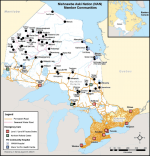
If it were only "the road":

Map-of-Nishnawbe-Aski-Nation-member-communities-road-access-and-nearest-emergency-care (2).png

This is just northwestern Ontario.
Sounds like you're making way too much sense for any realistic government solution there, bud .... Not to mention the concept of "it only costs $x million to fix up the diesel generating station this time, but we'll have to find $xxxM to get power lines up there."

Actually, that initiative is already under way:


It's a lot easier to build and maintain a pole line than a year-round road.

The upfront cost would reduce costs in areas such as transportation, consumer goods and housing; however, I'm still not convinced there is a consensus amongst the communities for road connectivity, but stand to be corrected.

These FNTs are located in their various traditional territories. One challenge is they are now living a non-traditional lifestyle. Short of resource royalties and some level of employment, there is simply no economic basis for these communities without government support.
 
Back
Top