• Thanks for stopping by. Logging in to a registered account will remove all generic ads. Please reach out with any questions or concerns.

Army Reserve Restructuring

Sorry @McG im trying to find an example of a "group" outside of the previously mentioned Canadian ones. Certainly army groups exist, or have existed, but im struggling to find any other examples. Can you point me to the NATO, or Canadian, doctrine source for a group?
Well, there are a several US Army numbered Special Forces Groups, and a few USAF numbered Special Operations Groups. The US Army also previously had many support groups (Corps Support Groups, Area Support Groups, and Region Support Groups), but most of those were upgraded to sustainment brigades over the last dozen years. There are the numbered CDSGs in Canada today, and the last time Canada had division level doctrine the divisional Engineers, CSS, and HSS were each organized into groups. Much like the Light Infantry Group being proposed today, a group in 1989 would not have had an integral Svc Bn for its own second line requirements -> the Log Bn & Maint Bn of the DISGP provided that support for units of groups within the division.

"Army Group" is a uniquely defined term completely unrelated to any other meanings of "Group" in doctrine. NATO doctrine has been using "Group" and "Regiment" as far back as I have access to, and I have seen similar US documentation supporting this usage going back even farther. The Birtish don't recognize that level of heirarchy, and non-English nations either use "Regiment" a word that bears no similarity to either Regiment or Group (Pulk/Polk is common in the east).

NATO Doctrine in 1986:
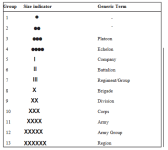
1765908441162.png

NATO doctine updated in 1998:
1765909249301.png

And continued to the 2023:
1765908878160.png

Since 2008 Canada has been providing this table to NATO as how we describe ourselves, and since 2011 all NATO nations have accepted the explanatory notes associated with each level as shown on the right:
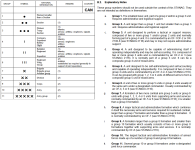
1765910795531.png
... I am surprised that we have gotten away with an English only submission given that the tables are submitted in a nation's native language and the Belgians have theirs in bilingual format.
 
Last edited:
I quite prefer having reserve units in a brigade rather than a district. A district is an administrative entity with no combat function. A "reserve brigade" should be structured and trained for combat. My preference is for combat capable brigades. That's aspirational. What we have now are misnamed and misleading districts that have the bones of being formed into a brigade with both a signals element for a headquarters and some CSS structure. We need to change the CBGs purpose and resources. Not their names.

Commando is a term borrowed from the Brits from WW2 and later the RM Commandos. It was used to make the Airborne Regiment "special". In size, airborne commandos started as very small two company battalions and quickly became companies. Don't even wind me up on 3 Mech Cdo.


It's just "Combat Group" with no "Canadian". We never called ourselves 1 or 2 "Canadian" Combat Group.

I don't have access to the CFOOs but here's a short history of 1 CG from Archives Canada


That wasn't always true. During my days in the 70s, both 1 and 2 Combat Groups were commanded by Brigadiers. Kip Kirby was my favourite by far. The whole brigadiers commanding brigades issues goes back to the long historical context that brigadiers in the UK, originally weren't really general officers. At times it was a temporary rank considered the highest field rank rather than the lowest general rank. I think that may be why "brigadier" and "Commodore" didn't have the "general" and "admiral" as part of the rank at that time. In time it migrated into its current usage. But, I digress.

🍻
My understanding was that the rank of Brigadier General existed in the British (and hence our) system until the end of the First World War, with the rank insignia of the crossed sword and baton, which we briefly resurrected when we returned to pips and crowns. In an attempt to reduce the number of general officers which had grown exponentially with the war the rank was eliminated and brigades were for a short while in the 20s commanded by colonels. For what ever reason though it was decided to bring back a rank level between colonel and major general styled brigadier but not as a general officer. Which is what we had until unification and which the British and Aussies et al still have. Similarly I don't believe commodores were ever considered flag officers pre-unification.
 
😄

I recognize jargon. I am amused at the efforts to codify jargon
Military "jargon" is essential to brevity and clarity.

Usage of "brigade" has become focused over the past couple of centuries. Uses of "group" have become less so, and are thus much more context-dependent. It has been a long time since people talked about "brigading" things together rather than "grouping".

I notice that at least informally in the recent past "brigade" tended to be used for armour and infantry and "group" for most other arms (eg. divisional engineer group, divisional service group, divisional medical group).
 
My understanding was that the rank of Brigadier General existed in the British (and hence our) system until the end of the First World War, with the rank insignia of the crossed sword and baton, which we briefly resurrected when we returned to pips and crowns. In an attempt to reduce the number of general officers which had grown exponentially with the war the rank was eliminated and brigades were for a short while in the 20s commanded by colonels. For what ever reason though it was decided to bring back a rank level between colonel and major general styled brigadier but not as a general officer. Which is what we had until unification and which the British and Aussies et al still have. Similarly I don't believe commodores were ever considered flag officers pre-unification.

I'm old but not that old. The sum total of my knowledge of this subject comes from Wikipedia here and here.

🍻
 
The definitions of "regiment" and "brigade" are to die for.

"Regiment: a formation larger than a battalion but smaller than a brigade."

"Brigade: a formation larger than a regiment, but smaller than a division."

A regiment could have 2 or more battalions; a brigade could have 2 or more battalions. Oh my. What to do? (I see an air force influence in there, as well.)

No-one would give up his favourite name(s) for the echelon between unit and division, so we're stuck with three of them, unless we decide to increase the friction of war and retard our decision cycles by actually having two levels of command in there.
 
It's easiest to understand "commodore" from the old RN promotion scheme: once you made post-captain, you moved up the list by pure seniority, eventually into and up the admirals' list. The only way to give a post-captain a temporary "flag" command without jumping the line was to give him a temporary "flag" appointment: commodore.
 
Military "jargon" is essential to brevity and clarity.

Usage of "brigade" has become focused over the past couple of centuries. Uses of "group" have become less so, and are thus much more context-dependent. It has been a long time since people talked about "brigading" things together rather than "grouping".

I notice that at least informally in the recent past "brigade" tended to be used for armour and infantry and "group" for most other arms (eg. divisional engineer group, divisional service group, divisional medical group).

I think that the mere fact this conversation is being had suggests that jargon may be as ephemeral as any other language.

The logic of the system works at the level of

1 to 3 dots
1 to 3 bars
1 or more X's.

It breaks down when ranks and names, capbadges, services, countries and languages get involved. Not to mention administrative and tactical.

Arguably with a reorganization as broad as this one appears to be you might as well throw out the existing system and redefine your terms anew.

Legions and Demi-Brigades anyone?
 
I think that the mere fact this conversation is being had suggests that jargon may be as ephemeral as any other language.
Sure, but so what? Use terms accurately for whatever period they are relevant. My days as a pam nerd are 20-30 years out of date, but much of what I learned has not really changed. For the parts that have changed, I try to pay attention to what active members have to say.
It breaks down when ranks and names, capbadges, services, countries and languages get involved. Not to mention administrative and tactical.
It's not a break down. Those who understand the context in which terms are being used and have sufficient professional interest (a real weakness in the Res F) will know what the glossaries state. There are echelons/levels of command and words to describe them in particular contexts.
Arguably with a reorganization as broad as this one appears to be you might as well throw out the existing system and redefine your terms anew.
Change for the sake of change isn't a worthwhile activity.
 
An Aussie perspective on their continuing restructuring efforts.
Apparently they are now down an Armoured Regiment.


I found the Aussie take on what constitutes and Armoured Brigade interesting:

"3 Brigade (Townsville) was designated in the Defence Strategic Review (DSR) to be an armoured brigade. It should, therefore, comprise: a tank regiment; a cavalry regiment; and a mechanised infantry battalion. The present organisation of 2 Cav Regt means that the brigade is short a tank squadron, a cavalry squadron and a battlegroup headquarters. "

A tank regiment
A cavalry regiment
A mech inf battalion

"the RAAC now has available 2 Cav Regt with two squadrons of tanks and two squadrons of recon vehicles; and 2/14 LHR (QMI) with three squadrons of recon"

2x tank squadrons
5x recce squadrons
 
An Aussie perspective on their continuing restructuring efforts.
Apparently they are now down an Armoured Regiment.


I found the Aussie take on what constitutes and Armoured Brigade interesting:

"3 Brigade (Townsville) was designated in the Defence Strategic Review (DSR) to be an armoured brigade. It should, therefore, comprise: a tank regiment; a cavalry regiment; and a mechanised infantry battalion. The present organisation of 2 Cav Regt means that the brigade is short a tank squadron, a cavalry squadron and a battlegroup headquarters. "

A tank regiment
A cavalry regiment
A mech inf battalion

"the RAAC now has available 2 Cav Regt with two squadrons of tanks and two squadrons of recon vehicles; and 2/14 LHR (QMI) with three squadrons of recon"

2x tank squadrons
5x recce squadrons

I would love to see how exactly the Aussie Army 3 Brigade plans to fight as a Bde with that construct of three non similar units or at least two units the same with a 3rd unit of different type.
Ie 2 Tank Bns and an Armoured Inf Bn
Or 2 Armoured Inf Bns and a Tank Bn with 4 Sqns.
 
Back
Top