• Thanks for stopping by. Logging in to a registered account will remove all generic ads. Please reach out with any questions or concerns.

British Military Current Events

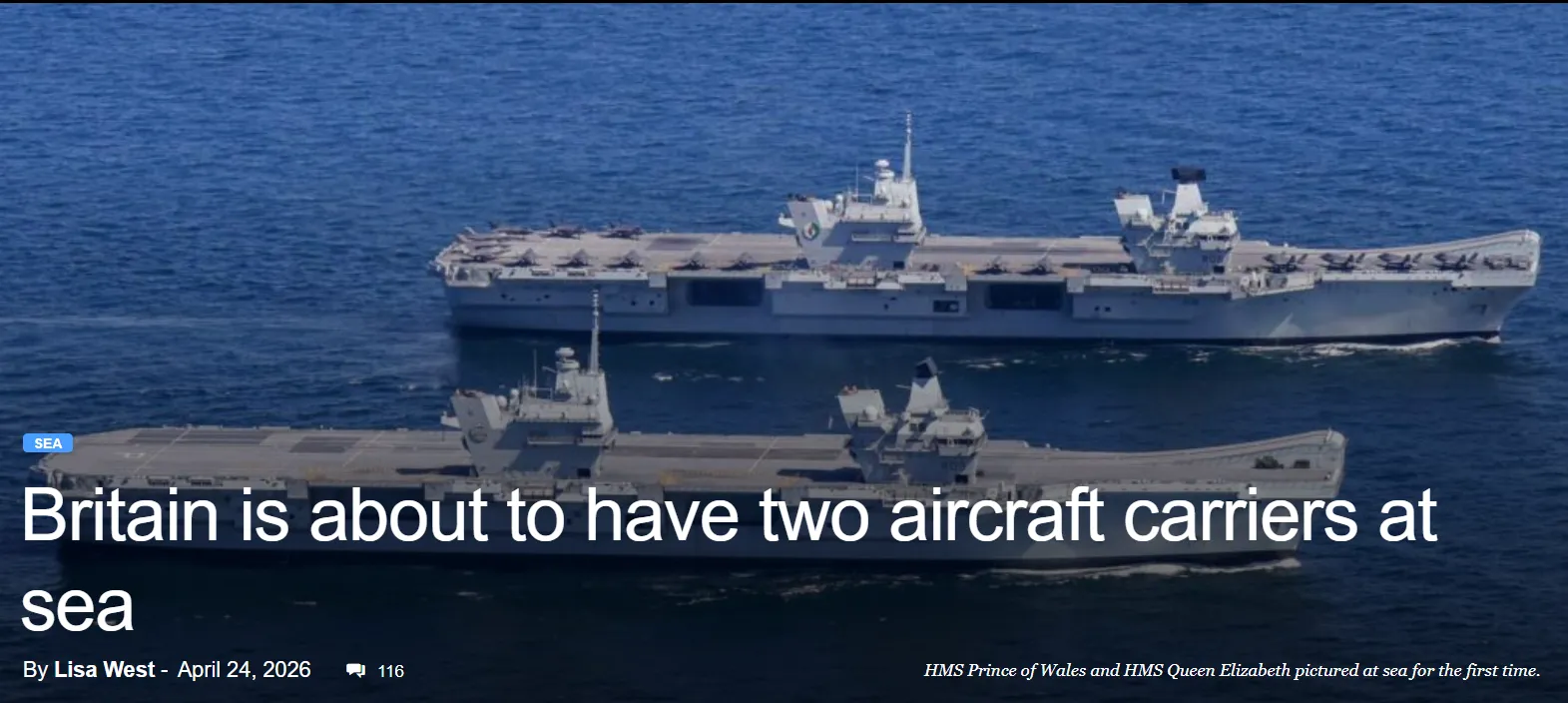
So both carriers have got their screws turning.

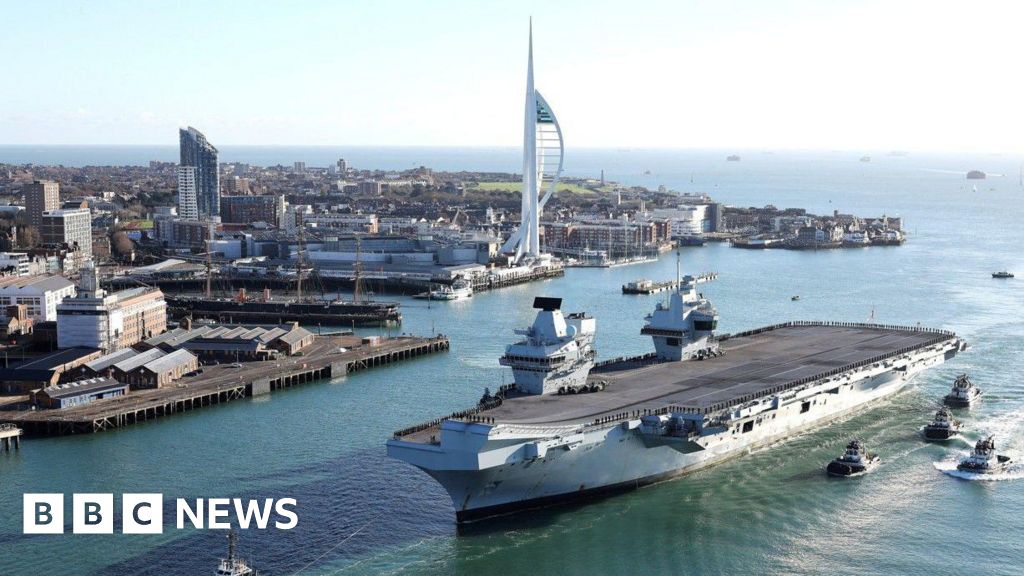
Prince of Wales leaving Portsmouth for the North Atlantic / High North
Queen Elizabeth leaving Rosyth for Portsmouth

 
A depressing read...


@Navy_Pete I suggest you don't read this one...
:oops:

Wow. She was launched in 1991 and commissioned in 1993. That puts her on a par with the latter part of our Halifax fleet.

I guess if you throw your money at two aircraft carriers something else has to give.

🍻
 
:oops:

Wow. She was launched in 1991 and commissioned in 1993. That puts her on a par with the latter part of our Halifax fleet.

I guess if you throw your money at two aircraft carriers something else has to give.

🍻

Understanding we are in the same boat roughly, I found this was a shocking metric:

The collective failure to order a single new frigate between 1996 and 2017 is having disastrous consequences.
 
A depressing read...


@Navy_Pete I suggest you don't read this one...

Meanwhile the First (Bootneck) Sea Lord continues to write cheques his Navy probably can't cash ;)


Advances Towards a Hybrid Royal Navy – First Sea Lord Speaks at RUSI​


General Sir Gwyn Jenkins, First Sea Lord and Chief of the Naval Staff, gives inaugural Lord Fisher Lecture at RUSI.


Technological development and rapid innovation are critical to the future capabilities of the Royal Navy and enhancing deterrence against Russia in the North Atlantic is a UK defence priority. These were the principal points in a speech delivered at RUSI today by the First Sea Lord, Chief of the Naval Staff in the UK.

General Jenkins said Russian incursions into UK waters had risen by a third in two years and that 'Russia remains the gravest threat to our security'. He announced the recent signing of a declaration of intent with allies from Nordic, Baltic and other Joint Expeditionary Force (JEF) countries to bring together a 'multinational maritime force' to help enhance deterrence in the region.

He said: 'We know that we have no time to lose, which is why by the end of this year, I want us all to have signed a formal declaration laying the foundations for what will be a vital and enduring partnership.'

General Jenkins also said that new uncrewed maritime systems were developing rapidly towards deployment and would be integral to the Atlantic Bastion programme which is designed to protect the UK’s northern approaches.

'The first of our uncrewed systems, which will patrol the North Atlantic to detect and monitor hostile activity, will be in the water for Atlantic Bastion this year. My aim is to have our first uncrewed escort ships sailing alongside our Royal Navy warships within two years. And to have jet-powered drones operating from a carrier next year.'

'We see our hybrid Navy as part of something greater. A new partnership of Northern Navies, a multinational maritime force to defend north-western Europe and the High North with the UK at the helm.'


It all made sense until this:

. . . with the UK at the helm

That rankled me. It's like "we have a problem in UK waters and we've f***ed up our own navy so we want everyone from around here to come under our command to fix things."

There are already NATO Standing Maritime Groups that Canada participates with from time-to-time, and a Joint Expeditionary Force (Maritime) which is the UK's contribution to JEF.

I know, I know. If not the UK then who better to lead - especially when you consider the size of other JEF and other northern NATO countries' maritime forces. But there are others and an automatic assumption of UK leadership and headquartering is off-putting.

It strike me that the former STANAVFORLANT (now NATO SMNG 1) should be beefed up for that role. Interestingly the group is currently headed by a UK commander but has no UK ships in it. Or a new and specifically oriented NATO SMNG be created. Just to be contrarian, I see Norway as a better location for the headquarters.

$0.02

🍻
 
Understanding we are in the same boat roughly, I found this was a shocking metric:
Two ships a year should be the goal. This build one big batch every couple decades is a terrible practice for sustainability. Results in poorly maintained fleets all at similar states of disrepair and large expenses to get ship building restarted again.
 
British army armoured assault demonstration

The British Army's 20-40-40 concept is mentioned here with a reasonable summary of what it means in practice:
Major General Olly Brown’s warning that the division must be ready to “pick apart and destroy” a Russian warfighting enterprise explains the strategic purpose of the exposition. The British Army is trying to compress the kill chain while protecting scarce heavy assets, and the 20-40-40 model openly acknowledges that not every battlefield effect should come from expensive armoured vehicles. Survivable armour gives staying power, attritable robots absorb risk, and consumable drones or missiles create mass at a cost the Army can afford.
Here's an AI summary of the 20-40-40 model:

The British Army's 20-40-40 strategy represents a transformative approach to modern warfare, emphasizing a shift towards unmanned systems and a redefined force structure.

Overview​

The 20-40-40 strategy was introduced by the British Army in May 2025 as part of a significant overhaul of its military doctrine. This new approach aims to enhance battlefield effectiveness by integrating advanced technologies and reducing reliance on traditional heavy armor. The strategy is structured as follows:

Implications​

The 20-40-40 strategy reflects lessons learned from recent conflicts, particularly the war in Ukraine, where the effectiveness of drones has reshaped battlefield dynamics. The British Army aims to create a force that is more agile, survivable, and capable of rapid deployment, allowing for effective operations with fewer personnel on the ground.
https://www.bing.com/ck/a?!&&p=42d0...XdpbGwtaXQtdHJhbnNmb3JtLWJhdHRsZWZpZWxk&ntb=1

Future​

The British Army plans to fully implement this strategy by 2030, as outlined in its Strategic Defence Review. This includes a commitment to invest significantly in drone technology and other emerging capabilities, with at least 10% of the defense budget allocated to these areas. The shift towards a predominantly unmanned force structure is seen as essential for maintaining operational effectiveness in modern warfare, where traditional armored formations may be increasingly vulnerable.
https://www.bing.com/ck/a?!&&p=3483...tbWlsaXRhcnktZG9jdHJpbmUtZHJvbmUuaHRtbA&ntb=1
In summary, the 20-40-40 strategy marks a fundamental shift in how the British Army intends to conduct warfare, prioritizing technology and autonomy to enhance combat effectiveness while minimizing risks to personnel.
 
British army armoured assault demonstration

It's interesting that this focused on the direct fire and manoeuvre capabilities of the force but didn't add one word about indirect fire or air defence elements.

Maybe I'm reading too much into that failure but the careful and frequently rehearsed integration of fires into the combat team/battle group is critical. This looks like the combat arms off on the usual peacetime frolic of their own.

🍻
 
It's interesting that this focused on the direct fire and manoeuvre capabilities of the force but didn't add one word about indirect fire or air defence elements.

Maybe I'm reading too much into that failure but the careful and frequently rehearsed integration of fires into the combat team/battle group is critical. This looks like the combat arms off on the usual peacetime frolic of their own.

🍻

With respect FJAG, in some respects I think the fire support area is going to be the least affected by changes.

Your primary role is still going to be to stand one pace to the rear and sling stuff over the heads of your own forces at the enemy.

You are already used to using remote sensing systems and long distance comms to achieve your ends.

You are also used to the other arms not understanding you.

For the Line of Sight arms however, this 20 40 40 thing is giong to be problematic

By the way is the 20-40-40 based on command elements or dollars.

2 tanks, 8 UGVs and 8 LAMs under control?

Or is that 20 MUSD of tanks, 80 MUSD of UxVs and 80 MUSD of LAMs and OWUADs?

A lot of work for 6 guys in two gun tanks.
 
With respect FJAG, in some respects I think the fire support area is going to be the least affected by changes.

Your primary role is still going to be to stand one pace to the rear and sling stuff over the heads of your own forces at the enemy.

You are already used to using remote sensing systems and long distance comms to achieve your ends.

You are also used to the other arms not understanding you.
And therein lies the coordination problem. Until we got to Afghanistan and people started working cheek to jowl with each other for a year, there was a distinct lack of understanding as to what the other guy brought to the table and how best to split the workload between them.

The 20% here includes SPs. That's well and good but that means there has to be training with that. The big issue though comes with the 40% expendables which are effectively effects or munitions. Some of those need to be carried around by the folks up front but most are delivered, or should be delivered and even guided from behind the lines. Add to that that many of the 40% of reusables also are launched and more than likely controlled from the rear.

When I see systems like a fourth seat in a tank for a UAV operator I immediately start to think that folks are missing the plot in order to find ways to notionally remain relevant. Cooperation and coordination through properly networked systems where controllers are kept out of the line of fire but their work product is directed and displayed to the folks who are dodging incoming rounds leads to a better "team."

The Brits, like us, are an infantry-centric army. The armoured brigades think too little about integrating with fires. I see a better future with deep recce strike. In large measure the problem comes from Afghanistan where the Brits, like us, grew a generation of officers (both combat arms and combat support . . . and signals) weaned on the battle-group without a firm understanding of how to integrate larger forces efficiently.

I always hate to be critical of a system based on an article where maybe the reporter just doesn't get it. 20-40-40 itself actually sounds like a move in the right direction once everyone figures out where the puzzle pieces need to fit together.

🍻
 
The Brits, like us, are an infantry-centric army. The armoured brigades think too little about integrating with fires. I see a better future with deep recce strike. In large measure the problem comes from Afghanistan where the Brits, like us, grew a generation of officers (both combat arms and combat support . . . and signals) weaned on the battle-group without a firm understanding of how to integrate larger forces efficiently.

Only since the end of the Cold War. Up to then they were definitely 'Artillery Centric'... a good thing IMHO...
 
And therein lies the coordination problem. Until we got to Afghanistan and people started working cheek to jowl with each other for a year, there was a distinct lack of understanding as to what the other guy brought to the table and how best to split the workload between them.

The 20% here includes SPs. That's well and good but that means there has to be training with that. The big issue though comes with the 40% expendables which are effectively effects or munitions. Some of those need to be carried around by the folks up front but most are delivered, or should be delivered and even guided from behind the lines. Add to that that many of the 40% of reusables also are launched and more than likely controlled from the rear.

When I see systems like a fourth seat in a tank for a UAV operator I immediately start to think that folks are missing the plot in order to find ways to notionally remain relevant. Cooperation and coordination through properly networked systems where controllers are kept out of the line of fire but their work product is directed and displayed to the folks who are dodging incoming rounds leads to a better "team."

The Brits, like us, are an infantry-centric army. The armoured brigades think too little about integrating with fires. I see a better future with deep recce strike. In large measure the problem comes from Afghanistan where the Brits, like us, grew a generation of officers (both combat arms and combat support . . . and signals) weaned on the battle-group without a firm understanding of how to integrate larger forces efficiently.

I always hate to be critical of a system based on an article where maybe the reporter just doesn't get it. 20-40-40 itself actually sounds like a move in the right direction once everyone figures out where the puzzle pieces need to fit together.

🍻

In our youth there was much talk about Smart rounds and Brilliant rounds, often to be delivered to the battlefield by 155s and MRLS rockets. The Brilliant Anti Tank or BAT round comes to mind - an early autonomous round.

Now I'm wondering about the relative cost of those things compared to these interceptor drones - 1000 to 3000 Dollars each, or roughly the price of a dumb arty or tank round.

But carried by hand or the truckload, launched without infrastrucure and reusable if they don't find a target.

20-40-40 - whatever the scalar is.

20 protected - the stuff with squshy centres.

40 attritable - UxVs that can break the bank if lost too frequently

40 disposable - UxVs? Brilliant rounds? Smart bullets?

Are dumb bullets a separate line item?

I am sure 20-40-40 briefed well when the Chief uttered it.


...

I agree about the 4th man in the tank.

How about this one?

Your starting 20 is 4 vehicles.

A gun tank
An arty projector ( gun or rocket)
A squad carrier
A command vehicle

If that then your next 40 is 16 UXVs for breaching, fire support, cuas, isr, evac and log? Maybe 32 if they are only half price? 64 if a quarter?

Either way, even if I only had to coordinate 16 autonomous soldiers to cover off all those support tasks while I was rolling and trying to concentrate on my day job I would be hard pressed.

And as to the final 40, the disposables, as you note how does that differ from regular ammunition and other consumables?

...

I don't think the people rolling are going to be the ones controlling all those UXVs, anymore than they would be directly controlling a recce squadrons vehicles, an engineer troop or a transport platoon's vehicles.

I suspect that many of those assets will be fairly autonomous but under supervisory control of people co-located with your fire control centres ... with the provision of services managed in a like manner.

Interceptor drone that can launch itself block and defeat a target for $1-3000. 120mm DU APFSDS apparently cost $10-20,000 in 2024.
And that while no doubt exquisite, is as dumb as it comes.

What does 20-40-40 mean?

 
Back
Top