Rainbow1910
Sr. Member
- Reaction score
- 2,491
- Points
- 810
L3Harris doesn't seem very happy getting blindsided by the GlobalEye announcement with zero heads up, I wouldn't be surprised if there's a lawsuit coming from them in the future.

 thelogic.co
Canada’s surprise plan to buy Saab command jets leaves competitors seeking answers - The Logic
Executives at L3Harris, which makes similar planes on Bombardier bodies, had been talking to Canada for months before being shut out
thelogic.co
OTTAWA — Prime Minister Mark Carney blindsided other potential suppliers when he announced Wednesday morning that Canada plans to buy new flying command centres from Saab, potentially handing the Swedish defence giant more than $5 billion in business without a bidding process.
Executives at L3Harris, a Florida-headquartered defence contractor that also offers “airborne early warning and control” (AEW&C, in military jargon) planes, learned what Carney was going to say just a few minutes before he took the stage at Cansec, the giant annual military trade show in Ottawa.
Canada secretly settled on Saab to supply six new command planes for the Royal Canadian Air Force, potentially giving the Swedish defence contractor $5 billion or more worth of business without a competition
Executives at L3Harris found out minutes before Prime Minister Mark Carney made the announcement Thursday, and told The Logic they had been building the case for their own jets in anticipation of a formal procurement
Richard Foster, the head of L3Harris’s Canadian subsidiary and a retired major-general who was deputy commander of the Royal Canadian Air Force, said he’d gotten wind that something was up, but knew nothing for sure.
“I did not sleep well last night,” he said hours after Carney’s announcement, in an open-topped conference room built into his company’s patch of the Cansec show floor. A display on one wall advertised L3Harris’s plane, called the Aeris X, which Foster and other L3Harris leaders were at the show partly to pitch
Feds must get their own house in order for defence industrial plan to work, sector leaders warn
Fighter jets and subs exempt from new defence industrial strategy, feds say
“We expected a full competition,” said Jason Lambert, the Texas-based president of the company’s intelligence, surveillance and reconnaissance division. “Not having a competition, I think it actually surprised not just L3Harris.”
Carney and the Liberal government have declared that they’re doing defence procurements differently as they rush to meet NATO spending targets and build up Canada’s military forces. That has included handing contracts to select companies without competitions, such as a nearly $3-million preliminary deal with MDA Space and Telesat that will almost certainly lead to a new multibillion-dollar satellite constellation for military communications.
MDA and Telesat are longtime pillars of the Canadian space industry; they have competitors, but not with their pedigrees. In the case of the AEW&C purchase, the government has picked a winner among foreign vendors, and there are unhappy losers.
Canada plans to buy about six of the planes, which are loaded with sensors and communications gear and serve as flying command centres.
Boeing was also promoting its early warning and command aircraft in Ottawa, parking a branded truck trailer with pop-out sides at the Cansec convention centre as a mobile display centre. When The Logic visited after Carney’s announcement, it was closed and unattended, and a roll-up sign in front of it had fallen face-down. Signs hung on two trailer doors said it would reopen at 1:30 p.m.; the time was 3:30 p.m. Boeing spokesperson Cynthia Waldmeier said by email that the trailer might have been closed because it was full.
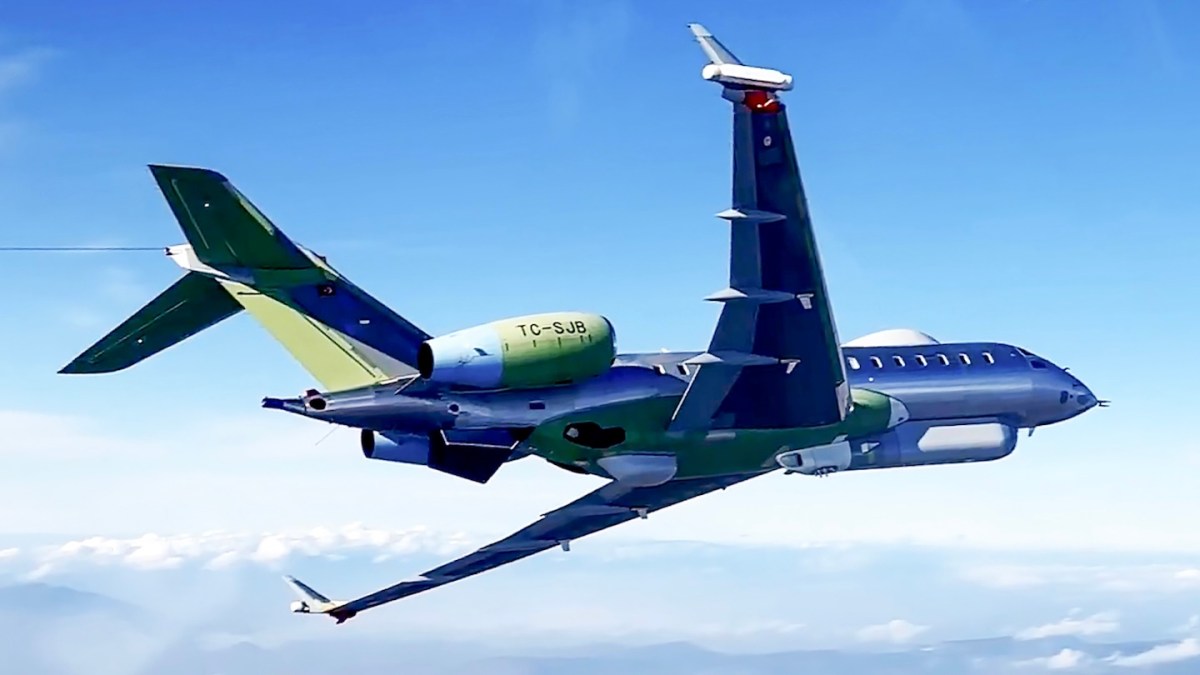
The domestic benefits of the Saab offer were a key part of the government’s decision, Industry Minister Mélanie Joly said in an interview. Saab’s offering consists of aircraft bodies built by Bombardier in Toronto through the two companies’ GlobalEye program, then outfitted in Sweden. Saab says it will start making finished planes in Canada, including for other countries—40 or more jets—and support 3,000 domestic aerospace jobs.
“This is the essence of what we’re trying to do when thinking of what will be strategic partnerships,” Joly said. Discussions began with Saab at the major air show in Paris last June, she said, and carried on behind the scenes for months.
L3Harris has been talking to different parts of the Canadian government about the AEW&C business, Lambert said, including the air force, National Defence more broadly, Joly’s department and Public Services and Procurement.
L3Harris’s planes are also based on Bombardier jet bodies. Lambert said L3Harris has promised 1,100 new Canadian jobs if Canada buys the Aeris X, a figure he said has outside verification.
He also argued that L3Harris’s final planes are superior to Saab’s, using a different radar design that allows the Aeris to fly over 10,000 feet higher—“You want to be above the threat and be able to get a broader perspective and range,” he said—and survey 360 degrees at once.
The merits of different options would have been aired in a formal competition among different proposals, like the one Ottawa is running for submarines. (At Cansec, Carney promised a decision on that procurement by the end of June.)
The prime minister’s revelation on the AEW&C craft was only that Canada would negotiate exclusively with Saab, so there’s a chance the government will change its mind, and L3Harris will keep pressing.
“We’re still in discussions with the Canadian air force, as recently as just this afternoon, to talk about the aircraft,” Lambert said—that is, even after Carney’s announcement.
L3Harris might not have the brand recognition of Boeing or Lockheed Martin, but it’s a multibillion-dollar corporation that does a lot of business in Canada. Among other things, it won major contracts in March to support Canada’s CC-330 Husky transports; maintains numerous other Royal Canadian Air Force planes; and is part of the preparations for Lockheed Martin F-35 jets (which Saab is simultaneously trying to convince Canada not to buy).
Joly said in the interview that she’s not worried that potential vendors will be reluctant to deal with Canada if they feel ill-used by abrupt decisions: “To the contrary,” she said. “I’ve never seen so many European companies and American companies interested in becoming strategic partners.”