• Thanks for stopping by. Logging in to a registered account will remove all generic ads. Please reach out with any questions or concerns.

Canadian River Class Destroyer Megathread

From listening to shipyards talk, experience and better design equipment allows them to push prefitting to higher levels, a French yard was able to push theirs from 65% to 80%. As these blocks are likely 1 to 1 as the UK's Type 26, I suspect Irving is getting coaching from BAE on what can be fitted early on. As we get into the Canadian specific blocks, likley the speed and the amount of prefitting will drop on the first ship.
 
I believe it's a reference to the piping you can see in the blocks (vice just being steel). Other blocks will have full bits of equipment pre-installed, but the RCD design isn't that fully completed to allow that yet. You'll see more of that from ships 2 onwards, but that's part of the assumed 'inefficiencies' you get with first of class when you are building before the design is 100% finalized and all the equipment is selected/purchased.

In the old style of laying the keel you would build the shell, bring the piping, cabling etc in and put it all together sequentially, which is basically how they still build houses. The prebuilt homes do the same kind of modular building and assembly because it saves time, and you don't have the normal thing with plumbers, electricians and drywallers all messing up each others work if the GC isn't managing it closely.

With the modular building you do a lot more installation at the block before you assemble them together. This includes breaking the equipment down into modules you can drop in, so you can preassemble things like compressors, engines etc and drop them into the blocks that already have the piping and other connection points built in.

Some things, like pulling the cabling through the water tight bulkheads still has to wait until the mega blocks are together, but for a lot they just bolt/weld pipe flanges together after you put the blocks together. For the electrical, you can do a lot of local runs from panels to equipment inside major compartments, so really just left with pulling extended cable runs that go through sections,.

That lets you do a lot of work concurrently, and also means you can setup the module and assembly lines much more efficiently, so saves a huge amount of work and actual labour hours. The later you do it in the build, the more work it takes to get things into place, and something like 7-10 times more labour hours to install things when the ship is together than doing it at the block/mega block level.

A pretty easy to visualize example is a big diesel engine; doing it as a module you can fully assemble the engine pretty much where ever you want, so you can easily stage it to make it easier, crane it into a mega block, bolt a few things in and connect some cabling and be more or less done. If you wait until the ship is together, you usually have to bring the engine in in pieces, assemble it in place, try and do final fitup of piping in situ, etc so basically the same as an inservice job where people are contorting themselves in the bilge to try and get to things.

Just in the piping side it saves a lot of rework, by letting you do it in a pipe line where you can jig things up without interference items; that's way easier for the welders, so aside from being faster, the quality is better and much higher pass rate the first time.

Splitting off where the work is done also avoids all the interference work, where you have 3 trades trying to all do work in the same area, so just generally makes workflows easier and cuts down on a lot of the planning/deconfliction you get with normal ship repairs.

Edit:

Not sure these are the right papers, but FMI is the company that does this kind of support to our NSS, and also in the US and other countries for improving shipbuilding efficiency. That's all part of the 'Target state' that is built into the NSS to develop the shipyards to be efficient at it (and competitive). One of those things that takes decades to develop it, as a lot requires experienced people. All of their SMEs worked in shipbuilding (including in the UK German and American shipyards that did warships and subs), so learned a lot shadowing them.

https://www.nsrp.org/wp-content/uploads/2015/08/FMI-First_Benchmarking.pdf

https://apps.dtic.mil/sti/citations/ADA466922

Thanks, my understanding is much better now..

This is why Preserver is catching up to Protecteur. The prefitting work amount done on Preserver is much higer particularly for the piping, and is why Protecteur is behind schedule.

That sort of experience is going to make all the CCG ships go faster as well.
 
Thanks, my understanding is much better now..

This is why Preserver is catching up to Protecteur. The prefitting work amount done on Preserver is much higer particularly for the piping, and is why Protecteur is behind schedule.

That sort of experience is going to make all the CCG ships go faster as well.
For sure, there are a lot of interesting articles about this is you look up shipbuilding learning curve.

There is an expected drop off everytime you switch from one design to another, but the general baseline increases over time, so it's less severe the more mature the shipyard is as general processes etc are pretty well understood. A good analogy is putting together Ikea furniture; the first time can be confusing, but a lot easier the more you put together the same shelving unit. Once you've done a few, and familiar with how to put together Ikea stuff, easier to put together some cupboards or something (compared to if you had never put together Ikea stuff before). For investments, there is a diminishing return on efficiency gains on the technology/process side, so why things where intended from a 'best practice' level vice cutting edge. Still pretty ambitious, but it's generally achievable, and sets them up to look at those kind of improvements in the future.

That's why the non-combat package was so brutal for a new yard; lot of concurrent design on different projects, and huge differences in complexity of the ship and sizes, with two different customers with very different requirements, and each ship was a short production run with a unique build, all while starting up a shipyard from scratch. Was like trying to put together an entire kitchen from Ikea, while you are building a kit house from an old Sears catalogue around it.

AOPs was actually less complex than the smaller CCG ships in a lot of ways, and the longer production run gave ISI a chance to really figure out a lot of that process side of things while building the experience side on people, so made their switch to building RCD a lot easier than what VSY had to work through to build JSS.
 
^^
The loss of expertise when Canada shut down Saint John Shipbuilding was monumentally stupid on the part of the Government of Canada.
Ironically, a lot of them went to BAE, and are either still there, or trained the BAE SMEs that improved the T26 modular build refinements that was applied (building on LL from T45 and some other UK ship builds).

So we're indirectly using improvements on a lot of the design and production engineering things learned from the CPF modular build, more or less by happy accident.
 
One nice thing about the new welding technology, particularly in piping and complex shapes is conformity and repeatability. That means better line up of the pieces when the modules come together and less adapting bodging to make it fit.
 
So we're indirectly using improvements on a lot of the design and production engineering things learned from the CPF modular build, more or less by happy accident.
Happy accidents should not be a COA. But then again we are Canada and we lost our common sense and ability to plan beyond the 5 year election cycle in and about 1968 with the election of a conscription dodging dilatant.
 
So. Shipboard design considerations are something I'm still learning...but....when making an R/C model boat, there's rules about buoyancy and weight that must still be followed.

During the initial 'hot tub' sea trials, I noted that the superstructure seemed a bit heavy -ish. Result was that the ship has a bit of heel and feels top-heavy.

I put the original print files into the slicer and determined that the overall weight of the superstructure models was 700 grams.

I am pursuing 2 options to save weight.

Option 1 - I went to the print files, deleted excess interior features, thinned up walls, and made things overall a bit lighter. This saved me about 130 grams or so - bringing the overall weight of the superstructure down to about 570 grams, which is a decent first step.

I printed Option 1 and have glued it together and will test it to see how it works.

Option 2 - Taking the lightened print files, I decided to try an exotic filament to print it called "ASA Aero" - used often by model airplane builders, it runs at a much higher temperature and prints much lighter - less dense. Think of a typical 3d filament printing like using a glue gun or a caulking gun. The ASA Aero is more like using a can of spray foam.

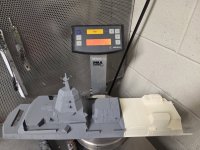
I printed the Radar fin first, and it came out in PETG at 77 grams.

ASA Aero printed at 33 grams. That's a 58% savings in weight.

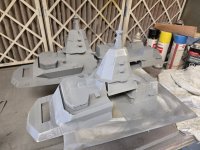
Overall, the total printed weight using ASA Aero is forecast to be just over 250 grams total instead of 700. So, that's a savings of over a pound of weight. That's spectacular.

My deep thought is to use the original superstructure for display purposes, and finish/paint the ASA Aero version to a lesser amount of detail and use it when I'm out on the pond with the model. Less need for accurate detail when the model is 25-50 feet away in the pond. :-)

The ASA parts are in the foreground. Rest are being printed.
 

Attachments

  • ASA Aero Superstructure.jpg
    ASA Aero Superstructure.jpg
    348.1 KB · Views: 11
"On April 27, 2026, Norway signed the Global Combat Ship User Group Charter in Halifax, Nova Scotia, formally entering a four-nation partnership with the United Kingdom, Canada, and Australia to coordinate the development, production, and future operation of a common class of surface combatants derived from the Type 26 frigate design. The programme covers a nominal total of 34 ships, distributed as 8 Type 26 frigates for the United Kingdom, up to 15 River-class destroyers for Canada, 6 Hunter-class frigates for Australia, and at least five Type 26s for Norway."

 
In keeping with these announcements


Funny timing.
The day before.


....

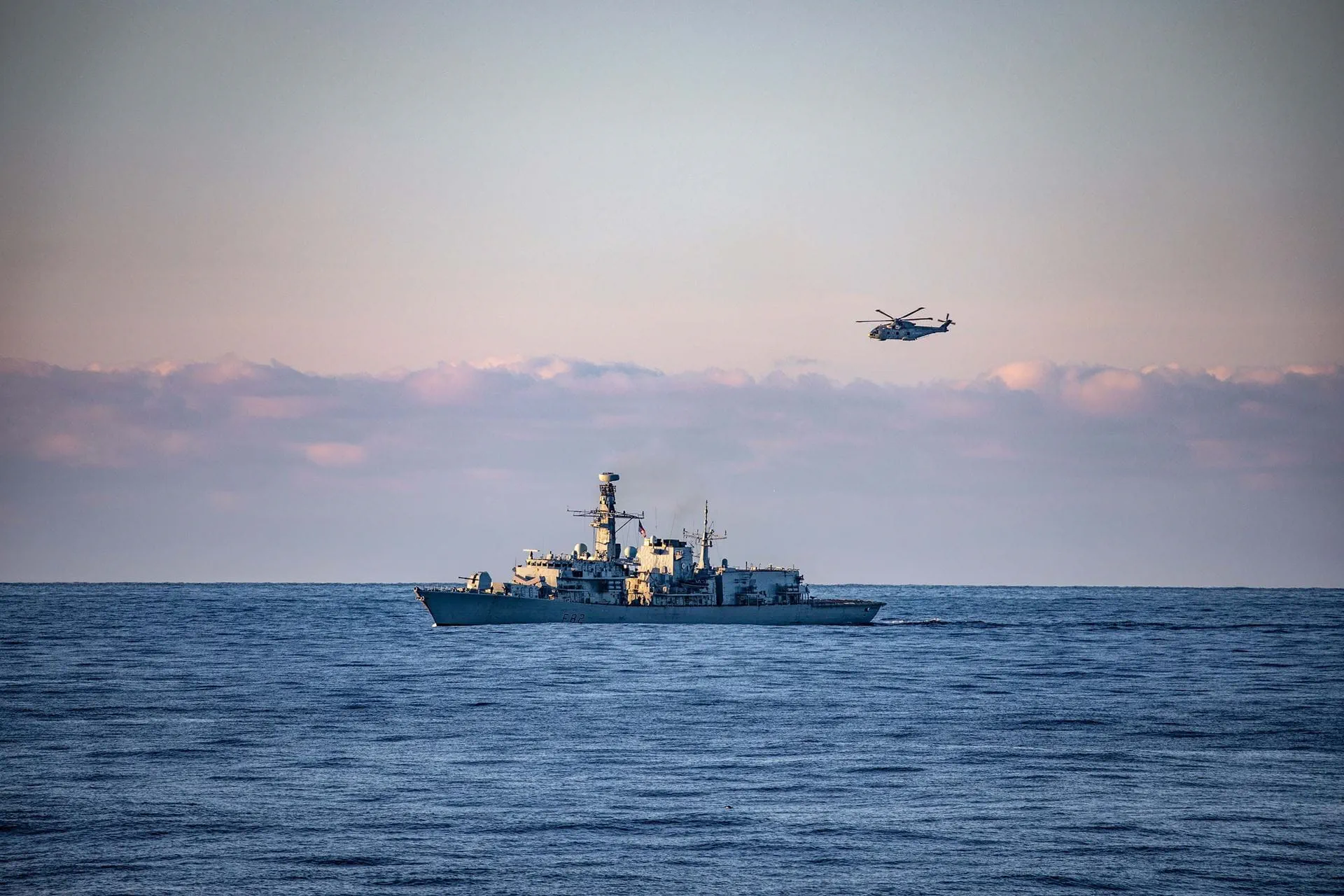
I note that Canada is mentioned in the UK article as being a fellow operator of the Type 26.
I note that another article mentioned that Canada was among the allies being consulted on Bastion.
And we seem to be pussyfooting around JEF's door.


First Sea Lord's update on Bastion developments.


The commentary suggests that UxVs cannot replace crewed systems.
The FSL doesn't seem to be suggesting that.
He seems to be explicit that the UxVs are adjuncts.

I would agree with that.

But.

Given the state of affairs I would be looking to find out just how much can be done in the short term with UxVs on their own.
Then figure out how the crewed assets, the ships, subs and aircraft, need to work in the new environment.
LInebacking the UxVs if you will.
Not Quarterbacking them.

Plugging the gaps.

I think that will get the best use out of the limited crewed resources available.
 
I noted that the superstructure seemed a bit heavy -ish.
The model railroad solution for stability of a car is to add metal weights close to the rails - usually a slab that is hidden within the carriage frame. It pulls the cars down onto the rails. My guess is added weight secured along the line of the keel should compensate for a heavy superstructure (at least to the point where buoyancy is lost. :giggle:)

🍻
 
The model railroad solution for stability of a car is to add metal weights close to the rails - usually a slab that is hidden within the carriage frame. It pulls the cars down onto the rails. My guess is added weight secured along the line of the keel should compensate for a heavy superstructure (at least to the point where buoyancy is lost. :giggle:)

🍻

It's been done since forever: It's called ballast.

Usually comes in two forms: the best known one, water, which can be pumped in or out as need be to compensate for the ship various states of loading, and the second, solid ballast, usually steel or iron (sometimes referred to as "pig iron") but some times cement, located in the lower parts of the ship's hull for permanent stabilization against top weight or to assist with the ship being upright (as opposed to having a permanent list) to compensate for heavy equipment that needs to be off center.

In the days of Nelson, stones in the bilges served the same purpose.
 
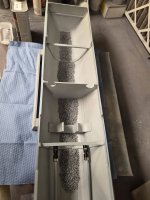
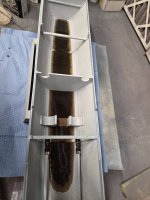
I put about a pound and a half of lead shot along the keel then epoxied it into place. That's about as low as I can get the weight, unless it was a sailboat with a skeg!

The problem is the weight of the superstructure. Lightweight material should help. :-)

Edit to add - I put about a pound and a half of lead in - that's about 680 grams of ballast. The superstructure as printed initially weighs about 700 grams. I see the source of my problem.
 

Attachments

  • Lead Shot 1.jpg
    Lead Shot 1.jpg
    317.4 KB · Views: 4
  • Lead Shot 2.jpg
    Lead Shot 2.jpg
    307 KB · Views: 4
Back
Top