• Thanks for stopping by. Logging in to a registered account will remove all generic ads. Please reach out with any questions or concerns.

CH-124 Sea King Historical Thread

I see a weird Caddy, CPF, 280 mix...

Can you post the document ?
I've never tried on here, let's see if it accepts it. I scanned it yesterday and rotated and cropped it last night. I was talking to the curator this morning about where the original might be to get a color scan.

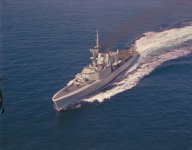
As was stated by FSTO, given this is a 1961 drawing, it's pretty close to what the St Laurents looked like:
st-laurent-1679.jpg
HMCS Laurent at Canada.ca

For those that are so inclined, the story of the St Laurent class, the fact that the Restigouces (all 7) were also supposed to be helo converted (but money got in the way), what the MacKenzies originally were supposed to be (which informed, eventually, the 280s), and how early the Navy realized that the carrier was probably not supportable in the long run (mid to late '50s), is interesting.
 

Attachments

I went down this rabbit hole because I was trying to relocated the early '60s requirement for the Sea King. As always, when you open up an archival banker's box or two you see distractions. In this case, it was trhe story of how the decision to acquire the Sea King came about.

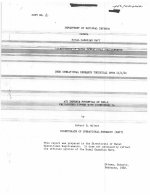
Luckily, when I spoke to Christine, the curator, she pointed out someone had already done the work:
IMG_1730.JPEG
It's much more of an academic treatment than a lot of the other works, with proper primary source references. As a matter of fact, the whole section on this in our archive is from his personnal records, as he unfortunately died in 2008 a couple of years after finishing this work.
 
Tow missions?
Yeah... and remember, these types of presentations are normally put together with a good understanding customers wants and needs. We does ask the question "what was the RCN thinking?"

The hint may come from "Minesweeping and Tow Missions." From the article on Wikipedia about the Bay Class Minesweeper:
In an effort to free up funding in the early 1960s for other capital projects, the remaining ten were placed in reserve. Four more of the class, Resolute, Quinte, James Bay and Fortune were paid off in 1964 and sold to commercial interests.
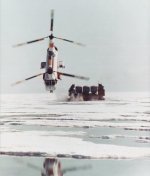
As well, Sikorsky did end up in the airborne towing business:
US_Navy_071112-N-1465K-005_An_MH-53E_Sea_Dragon,_from_Helicopter_Mine_Countermeasure_Squadron_...jpg
US_Navy_071112-N-1465K-005_An_MH-53E_Sea_Dragon,from_Helicopter_Mine_Countermeasure_Squadron(HM)_15,_performs_mine_countermeasure_training_using_the_MK-105_sled.jpg

So, it is in the realm of the possible that Sikorsky picked up on Canada having to put aside it's minesweeping capabilities in order to fund it's other priorities (which at the time were the Sea King and the DDHs to carry it), and threw a bone to them. I may have seem some reference to airborne mine "sweeping" in the references I have reviewed, but I'm not sure. The illustration of it towing a ship is to put it in context to other's in the room (ie civvies and politicians); for all we know, it may have caused the eye roles we as operators all know when we see something we think is stupid.

To be clear, I'm not stating this as fact, just that it's a logical explanation as to why it shows up there.
 
Another interesting tidbit I didn't know:
HMCS Ottaw Oct 1957 S-58 Trials.jpg
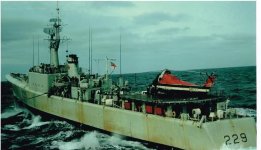
It's HMCS Ottawa in Oct-Nov '57, with the temporary flight deck that was originally on St. Laurant. That's a borrowed S-58 (H-34) from the RCAF. At the time, the S-58 (HSS-1, known as the Wessex in the RN) was the favoured candidate to replace the H-04S. The Sea King was still under wraps at Sikorsky.
 
Written as an adjunct to my post on the Continental Defnce Corvette thread.

When the Sea King was bought, and the DDEs converted to DDHs to carry it, the RCN had a full air staff, headed by an Assistant Chief of the Naval Staff (Air) [ACNS(Air)]. Within that staff they not only had reachback to the main flying base (Shearwater) and Squadrons, the technical authorities, the research and trials organizations, and the fleet (as part of the CNS Staff), but also "close" liaison with the RCAF. It does have to be remembered that they also had to staff, on behalf of the CNS, the work resulting from the "fight" with the RCAF over who controlled Maritime Air. It was not at all agreed that embarked helicopters on DDEs should by an RCN responsibility to start with; the RCAF's arguement was that there was a shore based need for ASW helos (which did not transpire), and therefore it should be one capability, controlled by them. Through good staff work by ACNS(Air) the RCN won that argument.

At Unification, these staffing functions became confused. A full examination of the staff mess that resulted from Unification is beyond the scope of what is needed here, but it was a mess.

The creation of Air Command in 1975 brought some stability to the issue, for better or worse. All Air Assets would be the repsonsibility of Air Command, exercised through groups. Martime Air Group (MAG) would be colocated with Martime Command in Halifax and would be responsible for embarked and ashore (MPA) maritime air. Within MAG, there was an Engineering and Requirements cell (MAG E&R) which became the center of staff excellence (?!?) for maritime air issues. It was the central point that Martime Command and Air Command converged.

As well, over time a robust structure of warefare committees was created, centered on the CFMWC but not ultimately reporting to them. The Martime Warfare Committee (MWC) reported to the Comds Air Command and Maritime Command, and briefed them once or twice a year. Under the MWC, one of the committees was the Maritime Air Warfare Committee (MAWC), and each community (MH and MPA) had separate committees reporting to that. The community committees were quite robust, consisting of the different trades standardization committees, plus the tactics committee. This whole structure represented authority for these functions, and an expectation of responsibility to perfrom them.

Two things happened to destroy that.

First, in the mid '90s, Air Command got rid of the groups to save money, and put all the functions in Winnipeg under one HQ. This resulted in three things, the first being a loss of staff excellence and depth. Secondly, the direct connection with Maritime Command was severed. Thirdly, the archival function was detroyed; literally, in that all the files that had been kept for reference were destroyed. HOTEF recently did it again by destroying all Sea King related records.

Secondly, the MWC was disbanded, without replacement, with similar results. 12 Wing for instance, struggled to find a home for tactics and standards without being "allowed" to replicate the committee. The authority and responsibility for maritime air tactics was lost. I personally asked the Comd RCN at a CFMWC brief what we were replacing them with (it proved to be nothing), and his answer was a long blah, blah about how the had become too resource intensive (they were), and needed to be streamlined (they did), but no plan on how they would be (they weren't, the function just disappeared).

The MWC disbandment occured when we were starting to try to figure out Cyclone tactics, which ground to a halt. As well, the TacNote functions of CFMWC, for MH at least, pretty much ceased. CFMWC can not tell the Wings to do anything, only suggest. The MWC, reporting to the Air Comd, could. The impacts of that persist to this day.

A tighter link between CFMWC and CFAWC, with direct ties to 434 (OT&E) Sqn, would help, but it's not there yet.

At this point, it's been so long since these structures existed, people don't even know what they don't know. Hnce, my lack of confidence that the RCN staff understand maritime air. Some recent statements by the Comd RCN have only served to reinforce that view, and I'm not the only one that holds it looking in.

As an interesting aside, but related, see this heavily redacted Evaluation Of Maritme Air Capabilities. It states
Although the Program consistently met Government of Canada (GC) and DND expectations and demands for the conduct of operations, over the past ten years these expectations have been reduced.
The actual capability assessed is redacted. But in effect, it's saying that the capabilites were decreasing, but that's ok because nobody cared. I'm convinced that the lack of maritime air staffing center of gravity is part of the problem. I'm also convinced that trend has not yet been reversed, notwithstanding the introduction of the Cyclone (hopefully the P-8 will fair much better).
 
Soo is the solution (1) restore MH operations under the RCN or (2) give up on ship-based staffed aviation?
 
No, I think the solution is to restore a Maritime Air Component Cell from 1 CAD back in Halifax - with both experts in fixed wing and rotary present. A small group..?..who can walk into the Maritime Warfare Center and explain to the NWOs what their aviation support can do, and how it's supposed to do it.

Without a headquarters interface, it is down to the Wing Commander at Greenwood and the Boss at Shearwater to try and do that, or, even further down the chain where the embarked Air Det commander tries to explain to a CO how they do their business.

Which is where I think it's at right now.

If I was guessing (and I am) I suspect that the integration of air assets into RCN activities is basically done at the exercise briefing for whatever event is happening now and there is little long-term interaction.

So, basically, before the fleet sails for the fall exercise (when we have/had a fleet to do them) they do a big brief, and the MPA coordinator shows up and says what the fixed wing types are going to do, then on a ship by ship basis, those with an embarked air det deal with the FLYPRO internally.
 
Soo is the solution (1) restore MH operations under the RCN or (2) give up on ship-based staffed aviation?
Neither, I think. The RCN does not have the airworthiness expertise for either of those options.

Unless the maritime force structure grows to a point that more robust measures can be taken, the answer lies in re-establishing the linkages.

Expand the role of Directorate of Air Requirements- Maritime (DAR-3 or whatever it is called now), by moving all weapon system functions up from the Div. Also, put all maritime UAV generation functions in it. Physically move it to collocate with the RCN staff. Make the RCN have direct input to their PERs.

Ensure the Air Cell at CFMWC is manned, and ensure there is MWO and NCIOps in it as well. Ensure there is RCN represented at CFAWC Maritime. Have those two cells tightly bound, and jointly report to Comd RCAF and Comd RCN, in person, at least twice yearly. Have them able to create tastings that are easily signed by both Comds. Also they have tight liaison with 434. Make part off the WComds (and equivalent in the fleet) measure of success being responsive to this joint tactical body.

In other words, force them to coordinate.
 
No, I think the solution is to restore a Maritime Air Component Cell from 1 CAD back in Halifax - with both experts in fixed wing and rotary present. A small group..?..who can walk into the Maritime Warfare Center and explain to the NWOs what their aviation support can do, and how it's supposed to do it.

Without a headquarters interface, it is down to the Wing Commander at Greenwood and the Boss at Shearwater to try and do that, or, even further down the chain where the embarked Air Det commander tries to explain to a CO how they do their business.

Which is where I think it's at right now.

If I was guessing (and I am) I suspect that the integration of air assets into RCN activities is basically done at the exercise briefing for whatever event is happening now and there is little long-term interaction.

So, basically, before the fleet sails for the fall exercise (when we have/had a fleet to do them) they do a big brief, and the MPA coordinator shows up and says what the fixed wing types are going to do, then on a ship by ship basis, those with an embarked air det deal with the FLYPRO internally.
I would agree with you if Maritime Air grows.

What was RACE (I think still is) is colacated with the Navy on both coasts and is supposed to do that. Measure their performance in doing so appropriately.
 
Back
Top