• Thanks for stopping by. Logging in to a registered account will remove all generic ads. Please reach out with any questions or concerns.

Continental Defence Corvette

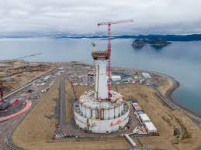
I am intrigued by this new entry into the arctic harbour sweepstakes,
Qikiqtarjuaq


It is on the east coast of Baffin Island, has a deepwater approach, unlike Iqaluit, and has a relatively short seasonal icefield to breach before it accesses open water.

It also advertises itself as a potential fishing port. I know that the Danes and Norwegians have shrimping those waters for years in factory trawlers, some of which are marginally ice-strengthened.

Port infrastructure build is to commence in 2026. It intends to compete with Nuuk and St John's for the fish trade.


Further to:

Danish report on the four season fisheries of Baffin Bay for Greenland Halibut and Northern Shrimp.
Halibut is taken at latitudes up to 72N and at depths of 1000 to 1200 m although it is found at latitudes up to 77N and at depths of 2000 m
Shrimp is found and taken in similar latitudes but typically at shallower depths, 150m to 500m.


The fishery has been conducted by Russian, Faroe Island and Greenlandic factory trawlers.
Nunavut is just entering into the field.

Royal Greenland fleet


  • Kaassassuk_Trawler_ 4

    M/Tr Kaassassuk - 2025​

    • Master: Linjohn Christiansen & Michael Dahl-Nielsen
    • Length/width: 83 x 18 m
    • Production capacity: 110 ton/day
    • Catch capacity: 7-10.000 ton/year
    • Hold Capacity: 1000+ ton
    • Crew: 22-24
    • Primary species: Cold-water prawns
    • Ownership: 100%
 
because of the CCGS Hudson thing?
Because at this point they don't have the experience to build a warship. No experienced workers etc... they would have to build them as well as a proper yard from scratch.

At some point it makes more sense to expand an existing shipyard, where you can have the workers never get laid off as they go from one ship to the next. Currently for example in Victoria the electricians get laid off in between the frigate work periods as they are not needed for months at a time. Same thing happens at the shipyards.

If you had say Seaspan electricians are outfitting JSS, then move straight onto the Polar Class Icebreaker then over to JSS2, then to Corvette 1, then back to MRSV 1 and 2, then Corvette 2 etc... with limited breaks in between.
 
Because at this point they don't have the experience to build a warship. No experienced workers etc... they would have to build them as well as a proper yard from scratch.

At some point it makes more sense to expand an existing shipyard, where you can have the workers never get laid off as they go from one ship to the next. Currently for example in Victoria the electricians get laid off in between the frigate work periods as they are not needed for months at a time. Same thing happens at the shipyards.

If you had say Seaspan electricians are outfitting JSS, then move straight onto the Polar Class Icebreaker then over to JSS2, then to Corvette 1, then back to MRSV 1 and 2, then Corvette 2 etc... with limited breaks in between.
Funny a lot of the guys at VDC don't like working on the JSS. The whole "Process is king" thing drives them nuts. They like VDC, as you never know what the next ship needs and what challenges it will present. So it's always something new.
 
That could mean a lot of stuff. Please expand?
Every bit of work on the JSS is logged and scrutinized and workflow is slow and methodical compared to the rather hectic schedule of VDC, where the customer wants their ship repaired and back into the water to make money yesterday. Along with many challenging problems that need a creative fix, right now that might be drawn out on a scrap of paper. Not trying to say they are all cowboys and don't care about the quality of work they produce. The majority actually take a lot of pride in the work they do and understand that producing, quality, fast and professional is critical to them actually getting more work from the civilian market. Compared to the government builds, things at VDC happen at lightspeed.
 
Every bit of work on the JSS is logged and scrutinized and workflow is slow and methodical compared to the rather hectic schedule of VDC, where the customer wants their ship repaired and back into the water to make money yesterday. Along with many challenging problems that need a creative fix, right now that might be drawn out on a scrap of paper. Not trying to say they are all cowboys and don't care about the quality of work they produce. The majority actually take a lot of pride in the work they do and understand that producing, quality, fast and professional is critical to them actually getting more work from the civilian market. Compared to the government builds, things at VDC happen at lightspeed.
Oh ok, that's good then. Makes sense.
 
A friend of mine was a carpenter that worked on the construction of the Olympic stadium, in Montreal in the 70's. He said that they were so afraid of losing control (not that they had it, as we now know) that they would issue them with 25 nails at a time, which they then went up to their work place (they were building forms for cement), quickly nailed in, and then came back down, lined up to the tool shed, got issued 25 more, etc, etc. for the whole day. All of that because they were afraid that giving each carpenter 25 lbs of nails in the morning so they could work most of the day continually meant that some of those nails would be "acquired' by the carpenters for their own personal purposes.

A control system that cost in time lost and control personnel two or three hundred dollars a day per carpenter to prevent a potential loss of three or four dollars a day per carpenter.

There are things for which too much control is counter-productive.
 
A friend of mine was a carpenter that worked on the construction of the Olympic stadium, in Montreal in the 70's. He said that they were so afraid of losing control (not that they had it, as we now know) that they would issue them with 25 nails at a time, which they then went up to their work place (they were building forms for cement), quickly nailed in, and then came back down, lined up to the tool shed, got issued 25 more, etc, etc. for the whole day. All of that because they were afraid that giving each carpenter 25 lbs of nails in the morning so they could work most of the day continually meant that some of those nails would be "acquired' by the carpenters for their own personal purposes.

A control system that cost in time lost and control personnel two or three hundred dollars a day per carpenter to prevent a potential loss of three or four dollars a day per carpenter.

There are things for which too much control is counter-productive.
A friend of mine used to be a Bosch Tools Rep here in Atlantic Canada. In the building of the first gravity based Oil platform in Newfoundland the guys were issued three Bosch grinders per day as the structure grew. When the grinding wheel was done the Grinder was turfed into the Ocean. It took too much time to go back down and get more disks and fuck around time to change them in the Cold North Atlantic winds.
 
Back
Top