We have had the good fortune, the time and space, to be able to make a clear distinction between what we choose to declare as civil missions and military missions. A lot of that was based on the military having access to government funds that permitted the purchase of technologies that were too expensive for smaller competitors, including individual civilians.
Now we are reverting to a time where effective forces can be generated with more affordable technologies, on the one hand, and there is an increase in the number of individuals who command financial assets greater than governments and who can mobilize those assets more rapidly and more responsively than governments.
Palmer Luckey can choose to build a submarine factory on spec to produce dozens of proprietary uncrewed vessels of proprietary designs. The USN and RN have been puttering around with the concept for decades.
Elon Musk doesn't go to governments to place his constellation of satellites. He mobilizes his own assets, borrows money as need be based on a business case, and creates Starlink.
Etc.
Looking back in time I find my analogies in eras where the troops of central governments were comparably armed and equipped to local forces, and even individuals. Oftentimes those local forces worked in concert with wealthy individuals, sometimes voluntarily, sometimes through coercion.
In those eras policing was done by well paid and equipped Dragoons facing off against local moss troopers, as an example. Or the taxman's revenue cutters were armed because merchantmen and fishers were armed, sometimes as heavily armed as government navies.
In Canada we have not really come to terms with that civil-military overlap. We did on shore in the west when we sent 300 cannon equipped dragoons west commanded by justices of the peace. Effectively Staff Sergeants and down were soldiers. Inspectors and up were civilian officers of the court. This was necessary because the threat was dispersed, motivated and well equipped. A person on horseback had virtually unlimited range with very few natural barriers to limit their movement.
....
Our navy grew out of the Provincial Marines and the Department of Fisheries and Oceans that spent peacetime dealing with armed smugglers. In most countries that was the first job of their navies. But in narrow seas where many government taxmen overlapped those little cutters and sloops needed back up so the taxman bought them larger ships dedicated to dominating all the sloops and cutters of the other taxmen.
Most navies are provided with managing that sliding scale of conflict. The constabulary part is armed and has a continuing association with the military part and the shift from peace to war is a slide and not a step.
The RN does constabulary work, fisheries patrols, anti-piracy, border patrols and anti-smuggling. The Norwegians have a Coast Guard that is part of the Navy department but which operates under different rules to the military part even though it is armed. In war time their roles will change. The US has a separate Navy and heavily armed Coast Guard that comes under Navy control in wartime. Meanwhile the fact that they are heavily armed reduces the need for them to call in the Navy in peacetime as backup.
We seem to have taken a small step towards bridging our self-imposed gap between the civil and the military by bringing the Coast Guard under the DND as a separate service, just like CSE is a separate service. But as we face more hybrid, gray threats on that conflict continuum, our military and our civil forces will be spending more time working with each other.
...
The Heros were a failure. That doesn't mean that there wasn't a need for an Inshore Patrol Vessel. The Orca is a success but they are too few, too slow and could be replaced more frequently and shoud be armed. The RCMP's Inkster did service on the West Coast.
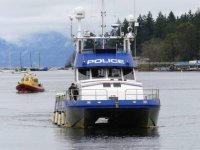
Crew of 4 and a speed of 25 t0 30 knots.
And smuggling afloat is not just a problem on the West Coast. it is a problem on the Lakes, the St Clair River, the Thousand Islands and along the thousands of kilometrers of Canada's deserted coast lines inundated by ocean going privately held pleasure craft.
And a lot of small craft actually working will justify the training of more, better qualified, crews.




