


- Reaction score
- 35
- Points
- 560
Does Somali navy boss have worst job in the world?
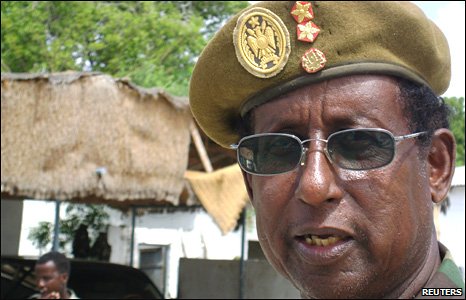
We used to be among the top navies in Africa, with ships carrying deadly missiles
and 10 battalions covering the coast
Farah Ahmed Omar
If you think you face an uphill challenge at work today, spare a thought for Farah Ahmed Omar,
the man in charge of Somalia's navy. He has neither boats nor equipment and admits he has
not been to sea for 23 years. The interim government does not control much of the 3,000-km
(1,860-mile) Somali coastline and then there is the headache of plentiful pirates.
Mr Omar said he was first put in charge of the navy in 1982, but speaking to the BBC by phone
from the capital, Mogadishu, he did not sound too daunted by the task ahead. "Today there is a
big piracy problem and we are ashamed. But we think they [the pirates] don't have sophisticated
equipment as they just have fishing boats and small arms which are easy to get in Somalia,"
he said.
Somalia's navy chief said 500 new recruits had recently joined after adverts were aired through
radio stations and the men would be paid $60 (£36) per month. Presumably the training will be
classroom-based, given the situation at sea. The country has been without an effective central
government for the best part of two decades, since the ousting of Siad Barre.
And this power vacuum has allowed the pirates to flourish as they demand multimillion dollar
ransoms from passing ships. More than 20 international vessels - operating under US, EU and
Nato commands - patrol the seas off Somalia in an attempt to protect the vital shipping route.
The interim government seems to think it could do a better job, provided it was given a helping
hand. Somali Prime Minister Omar Abdirashid Ali Sharmarke said on a recent trip to Nairobi:
"If 5% of the money being spent on the warships guarding those waters could be spent on building
a security force that deals with the piracy, this could be much more effective because these guys
have bases on the land and the best way to deal with them is to deny them a safe haven there."
It is widely accepted that patrols at sea are not enough and the key to ending piracy is on land
by targeting the pirates' bases.
The prime minister appeared to be ignoring the fact that government troops are far from welcome
at those bases, such as Harardhere, to the north of Mogadishu. Another notorious pirates' lair, Eyl,
is in Puntland, which has broken away from Somalia altogether.
Coastguard 'turncoats'
But the international community may be smarting from previous mistakes and reluctant to turn
on the funding taps.
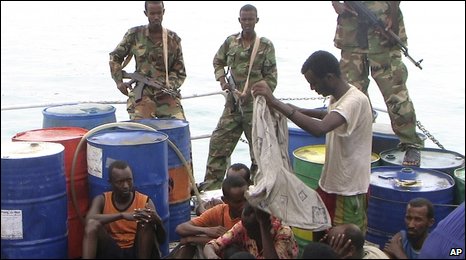
"Previous efforts at security sector reform have seen money disappear into a black hole
as there was no accountability," says Rashid Abdi, a Somalia analyst for the International
Crisis Group. "Plus there is evidence that some of the people trained to tackle piracy as
coastguards in Puntland ended up working as pirates themselves."
Once upon a time Somalia had a proud navy which the Soviet Union had helped establish
in the 1960s, with bases at Mogadishu and Kismayo. During the Cold War the Soviets turned
the port of Berbera into an important base that included a missile storage facility for the
Soviet navy to counter United States military activities in the region. But it was not just
Russian assistance that helped build the Somali navy back then.
'Give us one year'
When Somalia cut ties with the Soviet Union in 1977 (because of Russian support for Somalia's arch rival
Ethiopia), Mogadishu signed a deal with Washington three years later. It gave the US access to Somali ports
and airfields in exchange for tens of millions of dollars in military equipment and aid in subsequent years.
The navy has not been operational since the country descended into violence in 1991, but its commander
predicts a Somali naval renaissance. "The international community should give us one year and let them
see what we are going to do," he said. "I can promise on behalf of the government that I will eradicate
piracy within that period if only they give us the resources and support in terms equipment. "That way
the international community could be relieved of the burden."
Mr Omar has certainly had time on his hands whilst the navy has been boat-less and sailor-less. He set up
his own university and has also been a professor of economics.
Perhaps a lecture on the economic cost of choosing to be a sailor on $60 a month, rather than a potentially
rich pirate will be part of the training.
We used to be among the top navies in Africa, with ships carrying deadly missiles
and 10 battalions covering the coast
Farah Ahmed Omar
If you think you face an uphill challenge at work today, spare a thought for Farah Ahmed Omar,
the man in charge of Somalia's navy. He has neither boats nor equipment and admits he has
not been to sea for 23 years. The interim government does not control much of the 3,000-km
(1,860-mile) Somali coastline and then there is the headache of plentiful pirates.
Mr Omar said he was first put in charge of the navy in 1982, but speaking to the BBC by phone
from the capital, Mogadishu, he did not sound too daunted by the task ahead. "Today there is a
big piracy problem and we are ashamed. But we think they [the pirates] don't have sophisticated
equipment as they just have fishing boats and small arms which are easy to get in Somalia,"
he said.
Somalia's navy chief said 500 new recruits had recently joined after adverts were aired through
radio stations and the men would be paid $60 (£36) per month. Presumably the training will be
classroom-based, given the situation at sea. The country has been without an effective central
government for the best part of two decades, since the ousting of Siad Barre.
And this power vacuum has allowed the pirates to flourish as they demand multimillion dollar
ransoms from passing ships. More than 20 international vessels - operating under US, EU and
Nato commands - patrol the seas off Somalia in an attempt to protect the vital shipping route.
The interim government seems to think it could do a better job, provided it was given a helping
hand. Somali Prime Minister Omar Abdirashid Ali Sharmarke said on a recent trip to Nairobi:
"If 5% of the money being spent on the warships guarding those waters could be spent on building
a security force that deals with the piracy, this could be much more effective because these guys
have bases on the land and the best way to deal with them is to deny them a safe haven there."
It is widely accepted that patrols at sea are not enough and the key to ending piracy is on land
by targeting the pirates' bases.
The prime minister appeared to be ignoring the fact that government troops are far from welcome
at those bases, such as Harardhere, to the north of Mogadishu. Another notorious pirates' lair, Eyl,
is in Puntland, which has broken away from Somalia altogether.
Coastguard 'turncoats'
But the international community may be smarting from previous mistakes and reluctant to turn
on the funding taps.
"Previous efforts at security sector reform have seen money disappear into a black hole
as there was no accountability," says Rashid Abdi, a Somalia analyst for the International
Crisis Group. "Plus there is evidence that some of the people trained to tackle piracy as
coastguards in Puntland ended up working as pirates themselves."
Once upon a time Somalia had a proud navy which the Soviet Union had helped establish
in the 1960s, with bases at Mogadishu and Kismayo. During the Cold War the Soviets turned
the port of Berbera into an important base that included a missile storage facility for the
Soviet navy to counter United States military activities in the region. But it was not just
Russian assistance that helped build the Somali navy back then.
'Give us one year'
When Somalia cut ties with the Soviet Union in 1977 (because of Russian support for Somalia's arch rival
Ethiopia), Mogadishu signed a deal with Washington three years later. It gave the US access to Somali ports
and airfields in exchange for tens of millions of dollars in military equipment and aid in subsequent years.
The navy has not been operational since the country descended into violence in 1991, but its commander
predicts a Somali naval renaissance. "The international community should give us one year and let them
see what we are going to do," he said. "I can promise on behalf of the government that I will eradicate
piracy within that period if only they give us the resources and support in terms equipment. "That way
the international community could be relieved of the burden."
Mr Omar has certainly had time on his hands whilst the navy has been boat-less and sailor-less. He set up
his own university and has also been a professor of economics.
Perhaps a lecture on the economic cost of choosing to be a sailor on $60 a month, rather than a potentially
rich pirate will be part of the training.


