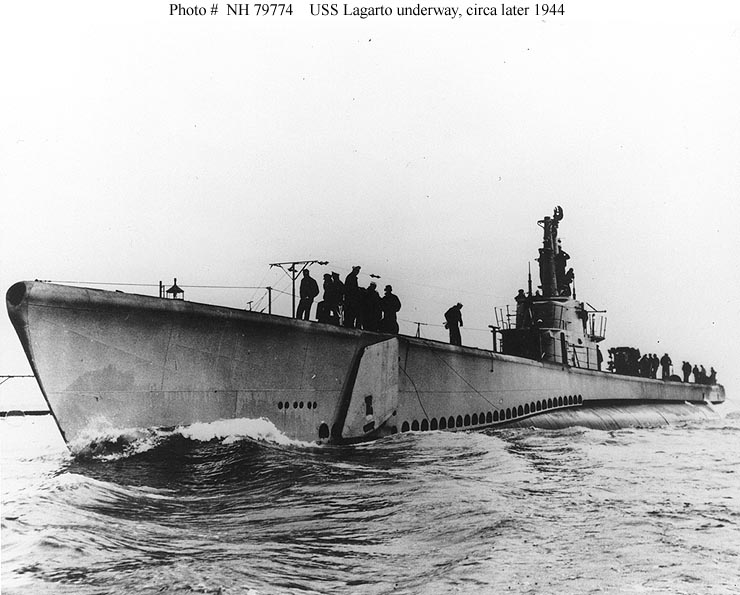
USS Lagarto Submarine
Discovered 2005, By Jamie MacLeod, Stewart Owhl and the crew of MV Trident Shipwreck Research Vessel
Location:- Southern Gulf of Siam - South China Sea
Registration:- American SS-371, Sunk 05/03/1945
Classification:- Balao Class Submarine
Specifications:- 1,526 tons. 311.8ft x 27ft. SS-371.
Depth:- 72meters in open ocean; An extremely challenging Trimix technical dive
USS Lagarto picture courtesy of www.navsource.org
USS Lagarto passing through Chigago. Picture donated by Steve Morast,
son of William D. Morast (1921-1974) who served as a signalman and
radio operator on three subs during WWII
USS Lagarto on the bottom at 230ft. Summary of dives 1-4. by Steve Burton
USS Lagarto formal identification photo's and dive sketch produced August 2005.
Drawing copyright 2005 by Steve Burton www.thaiwreckdiver.com
+++++
Dive Site Classification:-
NOTE:- This is very much an allied 'War Grave' and remains the property
of the US government. Diving activities are subject to USN permission.
86 allied servicemen (many of whose relatives I know personally) perished
in the sinking. The crewmen's bodies still lie entombed within her sealed
compartments- No penetration or artifact recovery whatsoever is permitted.
I will personally commence proceedings against anyone discovered to be
desecrating this site.
Method of sinking
Reported as probably sunk by Japanese minelayer HATSUTAKA in the Gulf of
Siam. Believed lying in 30 fathoms of water. The Hatsutaka was herself sunk
by the USS Hawksbill 12 days later.
Construction details
Laid down January 12th 1944 at Manitowoc Shipbuilding Co, Manitowoc.
Launched May 28th 1944. Commissioned October 14th 1944
Missing USS-Lagarto Submarine discovered.
author:- Steve Burton - copyright 2006
The Gulf of Siam with Bangkok as its hub, has been an important
international seaway stretching back over millennia. Until recent
years, trade routes into Thailand overland from all neighboring
countries were tenuous at best. With either mountains, wide fast
flowing rivers, or impenetrable jungles preventing all shipments by
land larger than could be carried by pack mule.
Such was the situation that faced Japan following its invasion of
Thailand in 1941. Just one railroad joined Thailand with Singapore
and with transport aircraft being the only other viable means of
logistical supply, the Gulf of Siam was busy with Japanese merchant
vessels transporting the heavier items needed for the war effort, plus
warships protecting their vulnerable cargo against the growing threat
of allied submarine action.
Just how successful submarines were in destroying Japanese naval
supply lines are given in these stark figures: - The US Navy's WWII
submarine force sank over 5 million tons of enemy shipping accounting
for over 60 percent of all destroyed enemy tonnage.
But US submarines didn’t have it all their own way during the deadly
cat and mouse game above and below the waves, and in all, 52 US
submarines and over 3,500 sub crewmen lost their lives.
USS LAGARTO – LOST
Such was to be the fate of the USS-LAGARTO, when during a joint radio
co-coordinated attack of a Japanese convoy with the submarine USS-BAYA
on the 3rd May 1945, the Japanese escort minelayer HATSUTAKO recorded
a depth charge attack on a US submarine in 30 fathoms (55 meters) of water.
The BAYA was never able to re-establish radio communications with the
LAGARTO and it is assumed that it was this attack that was responsible for
her sinking. The ‘unusually alert’ HATSUTAKA crew was so vigilant in defending
the convoy that it was also able to successfully drive the USS BAYA off.
That the HATSUTAKA was subsequently sunk 12 days later was not by accident.
The captain of a nearby US submarine USS HARKBILL was a close friend of the
LAGARTOS captain, he requested and was granted permission by COMSUBPAC
to divert from his patrol orders for a revenge attack. 4 torpedoes were expended
against the HATSUTAKA during a prolonged attack that lasted two days. A final
lucky MK14 mod 3 torpedo fired from a distance of nearly 3 miles through an allied
minefield, finally blew the HATSUTAKA into two pieces while an attempt was being
made by Japanese naval forces to take her under tow for repairs caused by the
damage from the HAWKBILL’s earlier attacks. No survivors of the HATSUTAKA’ s
sinking permitted themselves to be rescued.
On May 7th 1995 on the 50th anniversary of the LAGARTO’ s sinking, Commander
Vaughn from the Los Angeles class Nuclear submarine USS New York City laid a
Wreath at the presumed final resting place of the USS-Lagarto.
The exact location where USS-Lagarto was attacked and sunk remained a mystery
until 19th May 2005. When just after the 60th anniversary of her sinking, Koh Tao
Divers Jamie Macleod & Stewart Oehl diving from the Koh Tao based shipwreck
research vessel M.V. Trident descended a shot line in 73 meters of water to
investigate an underwater anomaly rising some 15 meters from the seabed
close to the LAGARTO’ s last reported position of N007.55, E102.00.
The shot line landed near to the bows of the LAGARTO, and on a day of
uncharacteristically good visibility at these great depths, they stood on
the bottom and gazed up at the distinctive massive outline of a Balao
class submarine.
Dive Review
From the dive plan printouts, it’s interesting to note, that for only
a 25minute bottom dive, the diver has to spend 1hr 14mins carrying
out very formal mixed gas decompression. It took 4 dives of this type
just to swim around all 4 quadrants of the wreck taking the notes and
sketches that formed the basis of the analysis in this article. In accordance
with the US navy permission for diving the LAGARTO, no penetration
dives at all into the living quarters of the submarine were made,
and no part of the wreck was disturbed in any way.
Unbelievably during a whole day of diving, A juvenile Whale Shark joined
the dive team while waiting at their long decompression stops. Divers
already on the surface quickly re-entered the water to snorkel with the
gentle giant. For added fun and double-jeopardy a poisonous sea snake
also swam near the group until it bumped into the lens of the (until then…)
totally fearless video-grapher.
+++++
The pictures and dive sketches show the 311ft long 1,500ton USS LAGARTO upright
and in one piece. The sinking location lies in open ocean, and as would be expected
for a dive so far out to sea, the surface visibility is excellent at around 50 meters plus.
During this dive sequence, the tip of the LAGARTO’ s twin periscope tubes and conning
tower pierced a silty thermo-cline that began from 60 meters and extended all the way
down to the sea bed at 75 meters depth. Visibility below the thermo-cline was much
reduced from that near the surface, but the wreck was still clearly visible as a submarine,
even before divers reached the wreck.
During the 1st dive on the LAGARTO with over riding need to return to the ascent line so
as to assure that our dive team didn’t become a ‘lost-at-sea statistics(again!) , our team ‘
reeled out’ from the ascent line along the top surface of the wreck. This gave an indication
of the massive size of the LAGARTO, since by the time we’d reached the bow, I’d used all
of the 50meters of line on the reel.
Natural light still penetrated through the thermo-cline, but all divers were thankful of the
high power technical diving torches which each diver carried with them, that gave
illumination to the fine details of the wreck necessary when diving at these depths.
As Jamie’s Purple book of ‘net snag marks’ indicated, the LAGARTO has caused many
fishing boats to loose their nets. These large football pitch sized nets cost upwards
of USD25,000 each, and are not left on the bottom without a fight. All smaller sized
items that protruded through the hull have been pulled off during attempts to wrestle
free the nets, leaving only massive lumps of steel such as the conning tower, bow &
stern planes, props, plus the twin 5 inch guns intact.
Final Moments
After each dive, it was possible to add more details to the dive sketch that would formally
identify the USS LAGARTO. Unlike many other Balao class submarines, the LAGARTO had
two 5-inch guns mounted in front of, and behind the conning tower. These were clearly
visible mounted in a stowed position, which together with the wrecks location confirmed
the identification.
A forward starboard torpedo door is open, and it’s possible to peer inside and confirm
that it is empty. This suggests that the LAGARTO went down fighting and that a torpedo
had been fired during her last moments. The rubber seals of the torpedo tube muzzle
door are still in excellent condition even after 60 years underwater.
Sadly, also visible was the massive damage caused to the port quarter forward of the
conning tower. The LAGARTO had plainly sustained a direct hit from a depth charge or
other large explosive ordinance. The destruction caused by this device had been
sufficient to entirely destroy the external steel plating that contained several large
buoyancy compartments and then penetrate much further into the sub to punch a
large hole through the 1 inch thick high tensile steel inner pressure bulk head that
contained the crew’s living spaces.
All crew in the compartment adjacent to the damaged area would have perished
instantly from the force of the explosion. Tons of water per second from the 55 meters
of water pressure would have rapidly entered these forward living spaces, throwing
the sub off balance and negatively buoyant, and causing it accelerate rapidly nose
down towards the sea bed. The subs external control planes are juxta-positioned;
The foreword planes are set to the ‘dive’ position whereas the stern planes were
set to ‘surface’. It may have been that with all the internal watertight doors closed,
the stern compartments crews survived the initial explosion (as in the Russian Kursk
submarine disaster on August 12th 2000), and that a desperate last ditch attempt
was made to override the steep descent by blowing emergency buoyancy tanks and
moving the aft control planes into the ‘ascend’ position from other emergency controls
located aft. However, the weight of the flooded forward living spaces compounded with
the destroyed forward buoyancy compartments was too much weight to overcome, and
the sub stayed on the bottom.
re-print of Wisconsin Maritime Museum newsletter, http://www.wisconsinmaritime.org/re-print of Wisconsin Maritime Museum newsletter, http://www.wisconsinmaritime.org/
Extract of the USS Lagarto's co-operation with the USS Hawkbill. Courstesy of the Wisconsin Maritime Museum newsletter, http://www.wisconsinmaritime.org/
SUBVETS
Submarine Veterans or SUBVETS are a special breed. ‘Pride runs deep’
within the community of WWII SUBVET families, their children, and their
grandchildren that continues to this day. All submarines are very specialized
pieces of military hardware, but the origins of the LAGARTO are particularly
interesting. The Manitowoc shipyard that built the LAGARTO was located
hundreds of miles inland. That the US Navy department through its bureau
of ships contracted a small shipbuilding company, located on the shores of
Lake Michigan, about as far from the ocean by river as you could possibly
imagine, to build submarines, the most difficult shipbuilding construction job
known at that time is a story in itself. The Manitowoc shipbuilding company
ended up building 28 of these Balao class submarines in total. WWII
SUBVETS and their relatives still live in the area to this day.
Sub Crews in WWII developed a battlefield humor when writing home about
the very real risks of falling victim to depth charge attacks. ‘Don’t’ worry if
anything happens to me. I’ll have a 6 Million Dollar Coffin with plenty of friends…”
was a common remark.
Prior to the discovery of the LAGARTO, I’d received many requests for help from
SUBVET relatives and technical assistance from personnel at the Wisconsin
Maritime Museum in Manitowoc in the USA.
On learning of the LAGARTO’s discovery, a Mrs. Nancy Mabin Kenney (the daughter
of LAGARTO Signalman First Class William T. Mabin), established contact with the
dive expedition group. Nancy contacted other surviving relatives and during July
2005 two of Nancy’s children (grandchildren of the LAGARTO crewman) traveled to
Thailand to accompany the wreck research vessel for the trip that would formally
identify the USS-LAGARTO.
For Nancy Mabin Kenney of Lake Leelanau, Michigan USA. and for the surviving
relatives of the LAGARTO’ s crewmen, 2005 was a special year that provided
closure from knowing the exact location where Husbands, fathers and grandfathers
lay, and pride in the knowledge that the LAGARTO went down fighting.
“All my life, I never really knew my father, but the people who knew him well kept
him alive in my memory,” Kenney said. “To think of what my mother’s generation
went through with all the uncertainty during the war is just overwhelming. But
now it’s up to my generation to support these men and make sure they’re honored,”
she said.
On the conclusion of the final dive sequence, a memorial service was held at the
LAGARTOS final resting place.
With Special thanks to:-
Jamie Macleod, Stewart Oehl and the divers and crew of the M.V. Trident during the
USS Lagarto Memorial trip July 2005. MV Trident may be contacted at www.techthailand.com
Nancy Mabin Kenney, daughter of USS Lagarto crewman William T Mabin, Wisconsin USA
The Grandchildren of USS Lagarto crewman William T Mabin
Article References online & print:-
http://www.techthailand.com MV Trident Wreck Research vessel main web site.
http://www.thaiwreckdiver.com For up to date information on the USS LAGARTO
http://www.usslagarto.org The official web site for USS Lagarto news
http://www.navsource.org/archives/08/08371a.htm For the USS Lagarto’s home page on the authoritative 'navsource.org' web site
http://www.multied.com/navy/Submarine/lagarto.html More Lagarto History
http://www.csp.navy.mil/news/111405vet.html Veterans Day ceremony highlights newly found USS Lagarto
http://www.wisconsinmaritime.org/ The Wisconsin Maritime Museum
Veterans Day Ceremony honors the USS Lagarto Submarine veterans were honored in a Veterans Day ceremony held at Pearl Harbor Naval Station
http://usmilitary.about.com/library/milinfo/blsubslost.htm US Submarines Losses
http://www.maritime.org/fleetsub/ Complete WWII Operating & Maintenance manuals for a 'Fleet Submarine'
Ships Log for the USS BAYA (the last vessel to contact the USS Lagarto) courtesy of Mr Fred Evans, Commercial Diver
http://www.bowfin.org/website/index.cfm The science & operation of a WWII submarine - The Virtual tour is great
http://uboat.net Submarine battle reports, chronology of sinkings
‘Wisconsin Maritime Museum newsletter’ Jul-Sep 1998 & Oct-Dec 1998 issues.
‘Wisconsin WWII Stories-The home front’ Video cassette from the Wisconsin maritime Museum
‘Fresh Water Submarines the Manitowoc Story’ by Rear Admiral William T. Nelson, published Heffner printing 1988
“The wreck of the USS Lagarto is a restricted war grave and as such cannot be disturbed. Any dives on the wreck have to be carried out with the express permission of the USN"
A WAR TO REMEMBER
In memory of the sailors lost on the USS Lagarto
Gulf of Siam, South China Sea, May 3, 1945.
A Sailor's Poem
Run silent, run deep
For freedom we fought to keep
How we spent so many days
Beneath the shimmering waves
A terrible foe we fought
And gave our lives; and freedom bought
Now our souls forever lie
Restlessly beneath the waves
So silent now, so deep
For it is not enough for you to weep
For we shall not have died in vain
Lest you forget for what we gave
We gave our lives, freedom to save
For if you forget our deeds
Then we shall never sleep
Though we lie so silent, so deep.
by Al Alessandra, July 3rd, 2005