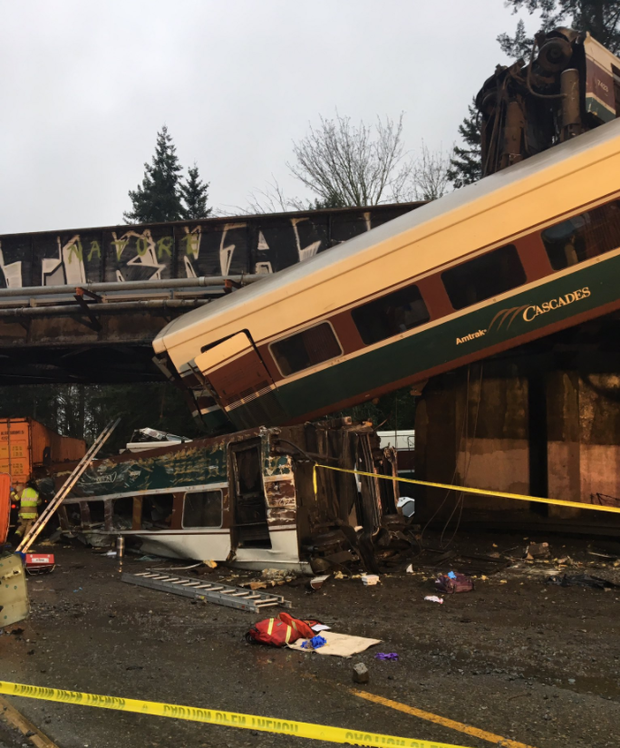
Photos and additional links are available via the link below.
This appears, from the first photo of the article, to be a push-pull service similar to Ontario's GO Trains, with a locomotive at one end and an unpowered cab car at the other. Amtrak has operated seven twelve- or thirteen-car Talgo sets in push-pull service in that area since 1998, but this was an inaugural run on this newly-upgraded line.
In this case, the lead unit is a brand-new Siemens SC-44 Charger locomotive with which I am unfamiliar. They have only just entered service in this region "late this year" - Amtrak's first revenue run was on 24 August 2017, but I do not know where. There is currently some debate whether it was actually powering the train or was inactive, with the GE-built P42 (similar to VIA Rail's P42DCs) at the tail end pushing (or not). While Amtrak has cab cars for these trains, it has used Non-Powered Control Units, or de-engine diesel locomotives, with Talgo sets in this region. To the best of my knowledge, though, these have all been older F40 units; the P42s are much newer and I doubt that any have been gutted yet.
The Talgo trainset is of Spanish manufacture and is articulated, ie each end of each car, less the first and last cars in the set, shares a truck with the connecting cars as opposed to standard cars which have two trucks of their own. The Talgo cars are much shorter than standard cars.
The tail-end P42 is still upright, and possibly even still on the rails. That, and the lay of the cars, leads me to believe that the P42 was likely pushing. Emergency braking should have been applied automatically and immediately as soon as the accident occurred, but the effect would not have been immediate.
There is no need for two powered diesels on a short train like this.
The badly-banged up (but in surprisingly good condition considering the circumstances of the crash) lead unit, powered or otherwise, is visible in the second photo, sitting on the Interstate. The two-man crew got out with minor injuries, despite a deceleration from 130+km/hr to 0 in about 100 metres max. This is a good testament to survivability and protective measures designed into modern locomotives.
There were no motorist deaths.
The curve is definitely a tight one, even allowing for a little foreshortening due to lens and camera angle in the first photograph. It looks more like a model railway curve than a main line one in this view. It does not look quite so bad in a Google Map overhead view, but it's still completely unsuitable for the entry speed. The approach is also downhill in the direction of travel, which may have complicated deceleration - trains have a lot of mass and inertia and steel wheels on steel track have much less traction than rubber tires on asphalt.
See also "Lakewood mayor had predicted new Amtrak rail line would lead to fatalities", one of the links from the article. I doubt that the mayor foresaw this as a likely accident as he relates other perceived dangers, but the history of trains taking curves and switches at higher than posted speeds is a lengthy and catastrophic one.
Technology to reduce the chances of that happening is not new. It does have to be both installed and activated in order to work, however.
I think that the survivors are very, very lucky. This one could have been much worse.
There's still more media speculation than solid information right now, though.
https://www.seattletimes.com/seattle-news/transportation/curve-where-amtrak-train-derailed-in-washington-has-speed-limit-of-30-mph/
Amtrak train that derailed onto I-5 was reportedly going 80 in a 30-mph zone, officials say
Originally published December 18, 2017 at 3:04 pm | Updated December 19, 2017 at 9:34 am
By Mike Baker, David Gutman and Mike Lindblom
Seattle Times staff reporters
The Amtrak train that derailed Monday morning on its inaugural trip through a faster railway route was supposed to slow dramatically before entering the curve where the crash occurred.
The speed limit at the curve where the train crosses Interstate 5 is 30 miles per hour, said state transportation department spokeswoman Barbara LaBoe, while the speed limit on most of the track is 79 mph. She said speed-limit signs are posted two miles before the lowered speed zone and then just before the zone.
<snip>
Russell Quimby, a consultant who was previously an investigator-in-charge for the NTSB, said it appeared to him that the derailment was caused by speed. He said the track appeared relatively undisturbed, so it seemed unlikely that something knocked the train off the track, and he noted that it appeared the train drove in a straight line, missing the turn.
The railway route had recently undergone a $181 million retrofit program in order to speed up passenger service that previously traveled away from the freeway and along the coast. Part of that retrofit was to include “positive train control” systems that can prevent dangerous situations such as excessive speed.
The 14.5-mile corridor is now equipped for positive train control equipment, but the train controls aren’t operating yet in that area, said Amtrak CEO Richard Anderson. An Amtrak spokesman said the equipment was still being tested.
Federal safety officials have been pushing for the implementation of those control systems for years, including in 1993 after a head-on crash between freight trains killed five crewmen in Kelso, Cowlitz County. Congress first mandated in 2008 that they be put in use by the end of 2015.
Since then, other fatal passenger-train accidents have also come from speeding trains that did not have the train control system installed. That includes 2013 Metro-North commuter train in the Bronx and a 2015 Amtrak crash in Philadelphia, when a train traveling more than twice the speed limit went off the tracks, killing eight people.
In Washington state, Amtrak suspended a train engineer earlier this year after a derailment near Steilacoom, Pierce County. Officials blamed speed and human error in that case, saying the engineer approached a drawbridge going faster than the 40-mph speed limit.