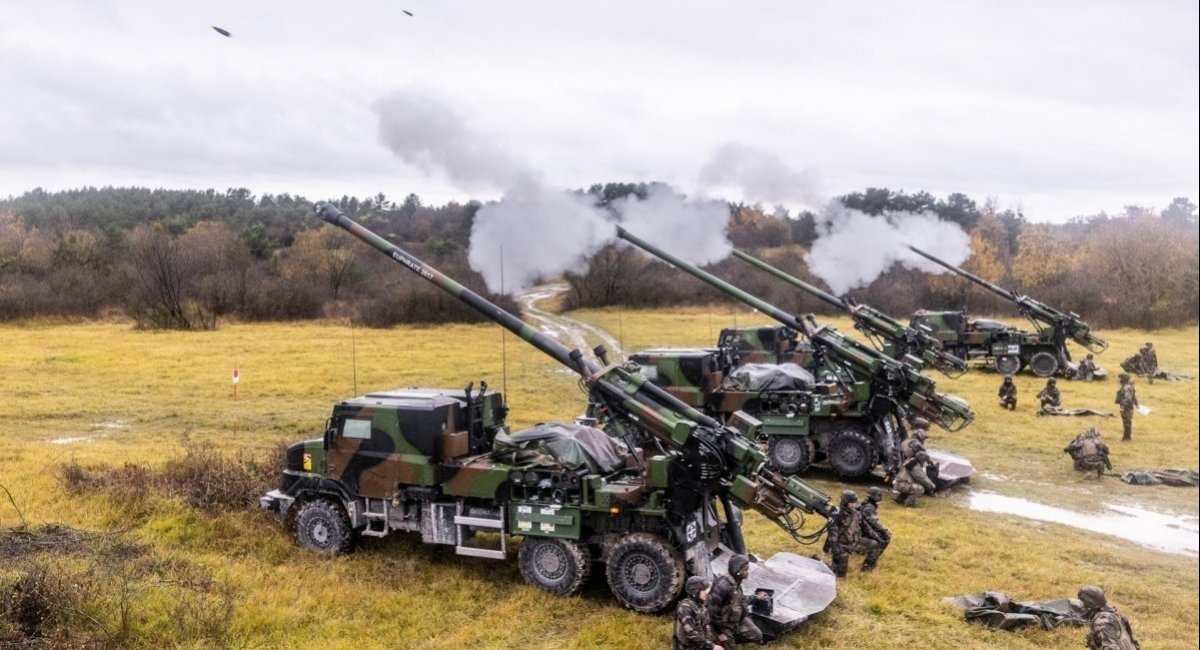
That's not really enough. See below.
Grouping guns in troops and batteries had more to do with locate and oreint guns to a common grid so as to be able to concentrate their fire, having a single command post to produce firing data for the troop, resupply and local defence and security.
The ability of guns to be able to self locate and orient and the ability to pass or self produce firing data takes away one of those requirements to group. It doesn't relieve the other ones and the more that you spread around the guns the harder recce, position preparation, local defence, and resupply become. This is why in the past I've cautioned that reduced detachment size of a single gun is a false economy. Manpower needs go up elsewhere especially in a 24/7 environment.
It's technically feasible and even desirable from a counter battery view to deploy as single guns. (That leaves aside the fact that you are now firing from everywhere in the rear area and drawing fire on other folks who you are sharing space with - they don't like guns near them)
Absolutely. Big, big issue even as low as the regimental issue. Ammo dumps. Break bulk tasks. Forward rearming points Stocks on wheels for emergency resupply. Cover, concealment, local defence.
It's an easy to ignore issue by saying the engineers will do it. I've dug in guns from L5s to M109s. It ain't easy. I'm of the view that you don't need engineers with all the skills that they have. You just need dedicated entrenching systems appropriate for the gun in use and folks who are able to operate the gear and then do all the revetting, overhead protection and camouflage etc etc. Much of that is non complex bull work. But it needs to be done often and quickly.
Again, these are folks with far more skills than are needed. Arty recce is quite different from cavalry-type recce. Local defence doesn't need qualified infantry. CUAS does not need a full blown air defender. BUT - it does need people and the proper weapons and equipment and a certain level of training. On top of that you want your ammo teams, local defenders etc etc gunner qualified because, sure as shooting, some of them will be killed or wounded or just plain exhausted and will need to be replaced by folks that can already operate a gun or an LM launcher or bulk break ammo etc. etc.
Too slow.
Some guns must be concealed in firing positions in order to respond quickly when needed. As they start engaging others can shuttle from a hide to a firing position so that the guns that are firing can move. The key is many more hides, rearming points, firing platforms than you have guns with many also set up as decoys and drone ambushes and EW defences all coupled with a robust counter battery system so that the moment someone starts shooting at your guns you can immediately take them out. The overarching problem is that shooting unmasks guns, but so does moving. LMs are a bit better off as the launch can be concealed to an extent, but LMs can't do it all.
In my mind, divisional artillery is much more an orchestra that operates on a continuous 24/7 symphony than anything else. A whole lot of different skills and capabilities coming together in a continuing orchestrated manner. On top of that there has to be a high level of redundancy and self-healing of the system in order to provide that continuous fire support required.
It's way different than anything that I grew up with and, what's worse, its much different from what any of our higher leadership experienced in Afghanistan. In spite of everything, Afghanistan was a very permissive environment as far as fires was concerned. Any restrictions there were self-imposed. Things have changed dramatically.
$0.02