• Thanks for stopping by. Logging in to a registered account will remove all generic ads. Please reach out with any questions or concerns.

Iran Super Thread- Merged

So this is what a trillion dollars in military spending gets you.

Outsmarted by some dude in Iran with a map and basic understanding of UNCLOS.

Im all for turning the USN loose and have them sink and kill anything that doesn't make eye contact.

The US doesn't fail because of its military might, it fails because of the political inability to let it do what it does to its maximum potential.
 
I'm curious now about the Financial Times reporting that ships are getting through. Reminder the Twitter/X post was citing FT. Hardly a fly by night source.
 
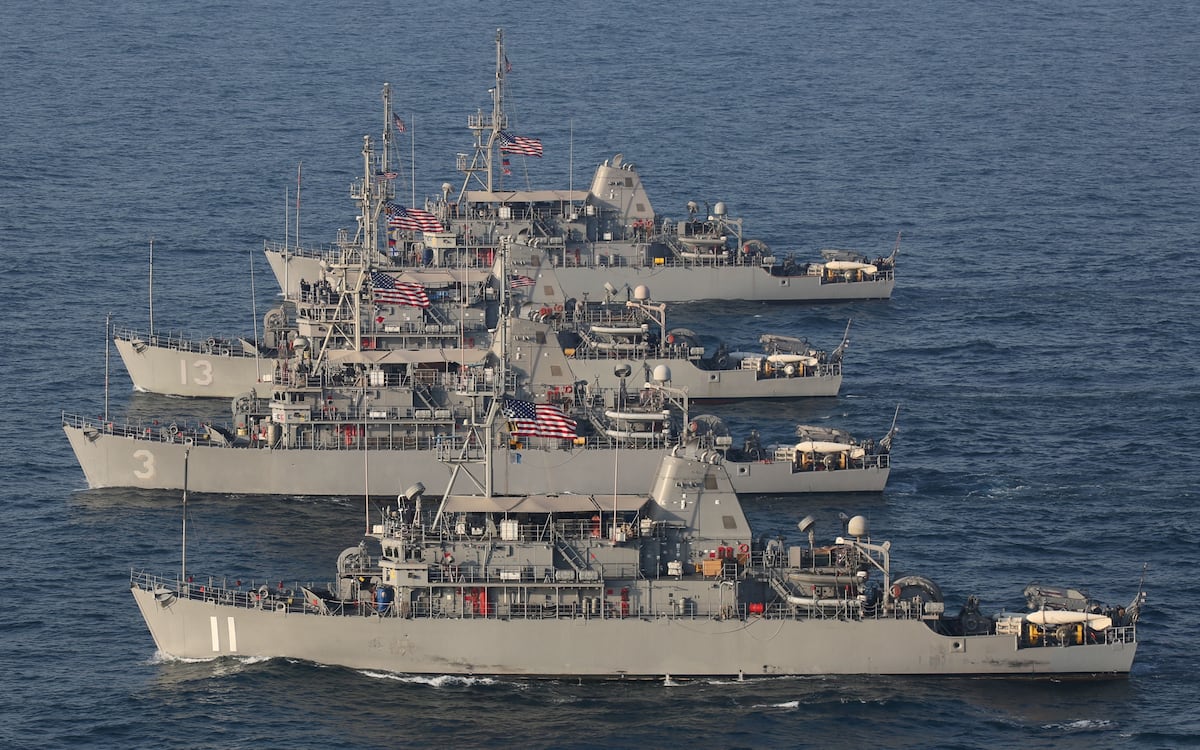
Does the US have minesweepers in the Gulf now? Has anyone read that they have?


Trump orders Navy to ‘shoot and kill any boat’ laying mines in Hormuz Strait​

The president added that he is ordering U.S. minesweepers to continue clearing the strait “at a tripled up level!
 
I'm curious now about the Financial Times reporting that ships are getting through. Reminder the Twitter/X post was citing FT. Hardly a fly by night source.
You can see it on the marine traffic sites; they may turn off their AIS for some of the transits, but if a ship goes from one side to the other with a dropped track for part of it, pretty clear indication. Usually you have to pay to see the actual tracks though.

There is an insane amount of ships at anchor on both sides of the Strait.
 
Does the US have minesweepers in the Gulf now? Has anyone read that they have?


Trump orders Navy to ‘shoot and kill any boat’ laying mines in Hormuz Strait​

The president added that he is ordering U.S. minesweepers to continue clearing the strait “at a tripled up level!
So Iran is supposed to be laying mines in the Strait, that the USN has total control over? This is very Gulf war era Sadam defence minister kind of doublespeak.
 
  • Like
Reactions: ytz
You can see it on the marine traffic sites; they may turn off their AIS for some of the transits, but if a ship goes from one side to the other with a dropped track for part of it, pretty clear indication. Usually you have to pay to see the actual tracks though.

There is an insane amount of ships at anchor on both sides of the Strait.
Read an interesting article about the 'chip' industry and its need for Helium in order to manufacture them. South Korea dominates the market and relies on over 60% of its helium coming out of the Gulf. If SK can't continue to get its Helium supplies they will be forced to start closing their chip manufacturing and the resulting chip shortage will be much worse than the COVID supply crunch.
 
Read an interesting article about the 'chip' industry and its need for Helium in order to manufacture them. South Korea dominates the market and relies on over 60% of its helium coming out of the Gulf. If SK can't continue to get its Helium supplies they will be forced to start closing their chip manufacturing and the resulting chip shortage will be much worse than the COVID supply crunch.

I fully expect a semiconductor shortage and subsequent recession later this year as the AI boom comes to a screeching halt because of this.

Personally just hoping it's after Apple's BTS sale cause I need a new laptop this summer....
 
Read an interesting article about the 'chip' industry and its need for Helium in order to manufacture them. South Korea dominates the market and relies on over 60% of its helium coming out of the Gulf. If SK can't continue to get its Helium supplies they will be forced to start closing their chip manufacturing and the resulting chip shortage will be much worse than the COVID supply crunch.
I’d forgotten about helium. Yeah, that one’s gonna potentially be a problem. It’s also important in medical imaging.

Helium’s not just stuck for transit; major production was taken out when Qatar was hit.
 
Helium’s not just stuck for transit; major production was taken out when Qatar was hit.

I wonder how much of this is gone:

chart_eikon.jpg


How the distribution plays out:

chart.png


I looked into it a bit; helium production is often a byproduct of natural gas. Canada is a producer (mostly Saskatchewan) though it’s not a very matured industry. But it doesn’t look like we’re up a creek there.

If usage has to be triaged, I think manufacturing, especially the tech sector is screwed.
 
Oil, gases, fertilizer, and medicines are now all way up in price.

Several of the -enes (benzene, toluene etc) are critical feedstocks for prescription medications. The production of meds uses lots of hydrocarbon derivatives as solvents and reagents. Because so much of that is made in India, it’s reliant on a middle eastern petroleum distillate supply chain.

Now, this isn’t likely a major factor in the cost of newer or more complex medications that are still paying off years of expensive research and trials. But, for long established generic medications that have been mass produced for decades, there is a potential for a supply shock not just of cost but of availability. So, not great.
 
Does the US have minesweepers in the Gulf now? Has anyone read that they have?


Trump orders Navy to ‘shoot and kill any boat’ laying mines in Hormuz Strait​

The president added that he is ordering U.S. minesweepers to continue clearing the strait “at a tripled up level!

Minesweepers or mineclearance assets?

Not quite the same thing.


"Clearing the strait could take two or three weeks, Clark said, and Iranian attacks on mine‑clearing crews could slow the process and raise risks. As a result, he said, the U.S. military may deploy defensive measures like ships and airborne drones to defend crews and equipment."


And that defensive effort includes those two destroyers sent into the Straits.


US at risk of running out of missiles if another war breaks out after depleting stockpile in Iran operations


In just 7 weeks:

50% THAAD interceptors
50% Patriot interceptors
45% PrSM
30% Tomahawk missiles
20% Joint Air-to-Surface Standoff Missiles
20% SM-3 and SM-6

China is absolutely loving every second of this, and is only increasing the threat to the place that manufactures 60% of the worlds semiconductors and 90% of advanced chips. It'll take years to restock and this thing isn't even over yet.

Ukraine was the warning.
 

US at risk of running out of missiles if another war breaks out after depleting stockpile in Iran operations


In just 7 weeks:

50% THAAD interceptors
50% Patriot interceptors
45% PrSM
30% Tomahawk missiles
20% Joint Air-to-Surface Standoff Missiles
20% SM-3 and SM-6

China is absolutely loving every second of this, and is only increasing the threat to the place that manufactures 60% of the worlds semiconductors and 90% of advanced chips. It'll take years to restock and this thing isn't even over yet.

Ukraine was the warning.


how many new low cost cruise missiles are in development or production internationally

As of April 2026, there is a significant international push to develop and produce low-cost, high-volume cruise missiles, often referred to as "mini cruise missiles" or "affordable mass munitions," to address inventory shortages and support Ukraine. Driven by the need for low-cost ($150,000–$300,000 per unit), long-range strike capabilities, dozens of projects are in development across the U.S. and Europe, with several set for production in 2026.
Missile Matters — with Fabian Hoffmann

Key Low-Cost Cruise Missile Projects

Anduril Barracuda (U.S.): A family of "software-defined" cruise missiles designed for mass production, with a new factory set to open in January 2026, aimed at producing 2,000 units per shift.

ERAM / AGM-188A Rusty Dagger (U.S./Ukraine): Developed by Zone 5 Technologies, this missile was tested on F-16s in March 2026 for rapid deployment. The first batch of 840 ERAM missiles is scheduled for delivery in October 2026.

RAACM & RAACM-ER (U.S.): CoAspire is developing the Rapidly Adaptable Affordable Cruise Missile (RAACM), with an extended-range version (RAACM-ER) unveiled in April 2026 that boasts a range of roughly 1,800 km.

OWE 500+ (Europe): A joint initiative by Germany, France, Italy, Poland, Sweden, and Great Britain to develop a low-cost, 500+ km range cruise missile.

Chorus (France): Developed by Renault and Turgis Gaillard, this 3,000 km range missile is designed for mass production at a cost of roughly US$117,200.

Narwhal (Czech Republic): Developed by LPP and scheduled to be fielded by 2026.

Project Brakestop (UK): A Ministry of Defence initiative to produce a ground-launched one-way effector, heavy (OWE-H) with a range over 500 km, aiming for production in 2025/2026.

...

Further, the locals in China's backyard aren't sitting around waiting for the US


Japan, South Korea, Taiwan, and Australia are rapidly expanding their long-range precision missile inventories, focusing on strike capabilities to counter China and North Korea. Japan is deploying upgraded 1,000-km range Type-12 cruise missiles, while Taiwan produces thousands of cruise missiles, including the Hsiung Feng IIE. South Korea and Australia are increasing arsenals, often in coordination with the US, which faces supply strains.
Facebook

Japan: Actively deploying upgraded Type-12 surface-to-ship guided missiles with ranges of up to 1,000 km, aimed at bolstering deterrence against China. Japan is also increasing its production capabilities and procurement of foreign systems.

South Korea: Possesses advanced, high-precision ballistic and cruise missiles designed to counter North Korean threats. Its missile systems are technically advanced, with ongoing production efforts to expand their arsenal, which is under pressure to maintain high readiness.

Taiwan: Maintains a significant, growing arsenal of thousands of domestic and US-supplied missiles (with ranges of 300–1000+ km) designed for deterrence and self-defense, including the Hsiung Feng IIE land-attack cruise missile.

Philippines: Focuses on acquiring shore-based anti-ship cruise missiles to defend its maritime territory, often in partnership with other nations, though its arsenal is smaller compared to others listed.

Australia: Deepening defense ties with Japan and the US, acquiring advanced, long-range missile capabilities to enhance its strike power, with a focus on interoperability with US systems.
The International Institute for Strategic Studies

The overall trend indicates a rapid buildup and diversification of missile assets in these nations to address regional insecurity.

 
Back
Top