• Thanks for stopping by. Logging in to a registered account will remove all generic ads. Please reach out with any questions or concerns.

Liberal Minority Government 2025 - ???

from a practical view, every above ground electrified rail system in Canada fails regularly in winter weather and none of the operators has been able to provide a fix. The weather to the east of Peterborough is just plain brutal and 90 billion dollars is a hell of a price to pay for a part-time system

Cause ya know, Japan, Korea, China, Sweden, Russia, Austria and Switzerland famously don't get snow....

Just because Canadians are uniquely incompetent at building something doesn't make a technology useless.

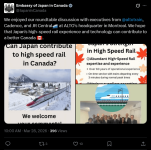
By the way, the government recognized this. That's why every consortium building had an experienced builder from countries that had already done this. In this case the winning consortium has SNCF. The company that built the French HSR network. There's also consultations like this so we can learn from others:

1000053564.png
 
For the Liberals are always great no matter what pro HSR crowd, here is a quick google AI

High-speed rail (HSR) generally fails or faces extreme challenges in areas with low population density, long distances between major urban centers, high land acquisition costs, and dominant car/airline cultures, notably in Canada, Australia, and parts of the US. It struggles when terrain is difficult, land ownership is private/expensive, or infrastructure investment favors highways over rail.

Key Environments Where HSR Does Not Work/Is Challenging:
  • Low-Density or Vast Areas: Countries like Canada and Australia have sparse populations spread over immense distances, making the per-capita cost of HSR astronomically high.
  • Existing Freight Rail Dominance: In the US, high-speed passenger trains face difficulties sharing tracks with heavy, long freight trains. Building dedicated, grade-separated tracks is immensely expensive.
  • High Land Acquisition & Legal Costs: In regions with strong private property rights (e.g., California), acquiring land for straight, specialized tracks leads to lengthy legal battles and high costs.
  • Political and Cultural Barriers: Areas with high car dependency, such as North America, have historical policies favoring highway and airport investment over rail infrastructure.
  • Urban Sprawl & Topography: Dense urban centers with already congested infrastructure make it difficult to build new rail lines in or out of cities
Common Reasons for Failure:
  • Funding and Profitability: HSR projects often face challenges in reaching ridership goals that justify construction costs, which are much higher in the US than in Asia.
  • Competition: When highways are developed and air travel is inexpensive, HSR struggles to compete as a faster or more convenient option.

 
I don't care who builds this. As long as it gets built. I was fine voting for O'Toole who supported the previous version of this project.
I am pretty sure this aint on the list of things this nation has been begging for, maybe you.

O'Toole was weak as a leader, hence why he got tossed
 
For the Liberals are always great no matter what pro HSR crowd, here is a quick google AI

High-speed rail (HSR) generally fails or faces extreme challenges in areas with low population density, long distances between major urban centers, high land acquisition costs, and dominant car/airline cultures, notably in Canada, Australia, and parts of the US. It struggles when terrain is difficult, land ownership is private/expensive, or infrastructure investment favors highways over rail.

Key Environments Where HSR Does Not Work/Is Challenging:
  • Low-Density or Vast Areas: Countries like Canada and Australia have sparse populations spread over immense distances, making the per-capita cost of HSR astronomically high.
  • Existing Freight Rail Dominance: In the US, high-speed passenger trains face difficulties sharing tracks with heavy, long freight trains. Building dedicated, grade-separated tracks is immensely expensive.
  • High Land Acquisition & Legal Costs: In regions with strong private property rights (e.g., California), acquiring land for straight, specialized tracks leads to lengthy legal battles and high costs.
  • Political and Cultural Barriers: Areas with high car dependency, such as North America, have historical policies favoring highway and airport investment over rail infrastructure.
  • Urban Sprawl & Topography: Dense urban centers with already congested infrastructure make it difficult to build new rail lines in or out of cities
Common Reasons for Failure:
  • Funding and Profitability: HSR projects often face challenges in reaching ridership goals that justify construction costs, which are much higher in the US than in Asia.
  • Competition: When highways are developed and air travel is inexpensive, HSR struggles to compete as a faster or more convenient option.

You can read the "HSR wont work in Canada" input from here lmao. The density of the corridor in question is about on par with the Madrid region...sparsely populated area that is. AI slop lol.
 
For the Liberals are always great no matter what pro HSR crowd, here is a quick google AI

High-speed rail (HSR) generally fails or faces extreme challenges in areas with low population density, long distances between major urban centers, high land acquisition costs, and dominant car/airline cultures, notably in Canada, Australia, and parts of the US. It struggles when terrain is difficult, land ownership is private/expensive, or infrastructure investment favors highways over rail.

Key Environments Where HSR Does Not Work/Is Challenging:
  • Low-Density or Vast Areas: Countries like Canada and Australia have sparse populations spread over immense distances, making the per-capita cost of HSR astronomically high.
  • Existing Freight Rail Dominance: In the US, high-speed passenger trains face difficulties sharing tracks with heavy, long freight trains. Building dedicated, grade-separated tracks is immensely expensive.
  • High Land Acquisition & Legal Costs: In regions with strong private property rights (e.g., California), acquiring land for straight, specialized tracks leads to lengthy legal battles and high costs.
  • Political and Cultural Barriers: Areas with high car dependency, such as North America, have historical policies favoring highway and airport investment over rail infrastructure.
  • Urban Sprawl & Topography: Dense urban centers with already congested infrastructure make it difficult to build new rail lines in or out of cities
Common Reasons for Failure:
  • Funding and Profitability: HSR projects often face challenges in reaching ridership goals that justify construction costs, which are much higher in the US than in Asia.
  • Competition: When highways are developed and air travel is inexpensive, HSR struggles to compete as a faster or more convenient option.
I asked the question differently

does hsr make sense in canada?:

Short answer: Yes — high‑speed rail (HSR) can make sense in Canada, but only in specific corridors and under certain conditions. The latest federal work on the Alto project (Toronto–Québec City) shows the government is treating it as a generational infrastructure investment with real economic upside, but also very real cost, risk, and timeline challenges.


🚄 Where HSR​

The viability hinges on population density, travel patterns, and economic integration. The Toronto–Ottawa–Montréal–Québec City corridor is the only place in Canada where all three align:

  • 18 million people live in the corridor, making it one of the densest in North America.
  • Travel demand is already high across car, air, and VIA Rail.
  • The Alto proposal envisions 300 km/h electric trains on ~1,000 km of dedicated track.
  • Federal projections suggest a 1.1% annual GDP uplift once operational.
This is why the government is investing heavily in design, land access, Indigenous consultation, and regulatory prep — it’s the largest transport infrastructure project in generations.


🧩 The core arguments​

  1. Travel time competitiveness HSR beats both driving and flying for city‑centre to city‑centre trips. Acela’s performance in the U.S. Northeast shows this clearly.
  2. Environmental impact Electrified HSR cuts emissions significantly compared to short‑haul flights and highway traffic.
  3. Economic clustering Faster intercity travel strengthens labour markets, business ties, and tourism. Brightline’s Miami station shows how downtown stations can catalyze development.
  4. Capacity and reliability Dedicated tracks avoid freight interference — a major issue for VIA Rail today.

🧱 The arguments​

  1. Cost Estimates exceed $80 billion for the full corridor. Canada’s construction costs are among the highest in the world.
  2. Timeline Even with the current co‑development phase underway, full buildout will take decades.
  3. Geography and land acquisition Canada’s sprawl and fragmented rights‑of‑way complicate routing, especially near major cities.
  4. Political continuity Multi‑decade megaprojects require stable political commitment — historically a challenge in Canada.
  5. Limited national applicability Outside the Québec–Windsor corridor, population density drops sharply. HSR in the Prairies or Atlantic Canada is not economically justifiable.

🧭 So… does HSR make sense?​

Yes — but only in the Toronto–Québec City corridor, and only if Canada executes with discipline. The federal government’s current approach (private development partner, staged co‑development, early Indigenous consultation, and dedicated electrified track) is aligned with global best practices.

The real question isn’t “Does HSR make sense?” It’s “Can Canada deliver it efficiently enough to realize the benefits?”
 
As I pointed out earlier - of the 7 ridings east of Toronto to Ottawa and then the riding east of Ottawa to the Quebec border, 6 of those 7 are held by Conservatives.

That's just normal voting. But I'm fairly sure after this, Peterborough won't be going back to blue for a long time. Also, I was willing to bit that if a station is announced in Perth or Smiths Falls that riding would flip too.

People aren't stupid. Some rural land owner will complain. But if your town can suddenly add 10 000 city slickers with six figure incomes you won't say no. This is also why we see the interesting dynamic of all their town councils saying things like "We oppose this unless we get a stop."

When this gets confirmed I'm going to invest in property in Peterborough. Going to get the highest concentration of doctors and lawyers in the country.
 
For the Liberals are always great no matter what pro HSR crowd, here is a quick google AI

High-speed rail (HSR) generally fails or faces extreme challenges in areas with low population density, long distances between major urban centers, high land acquisition costs, and dominant car/airline cultures, notably in Canada, Australia, and parts of the US. It struggles when terrain is difficult, land ownership is private/expensive, or infrastructure investment favors highways over rail.

Key Environments Where HSR Does Not Work/Is Challenging:
  • Low-Density or Vast Areas: Countries like Canada and Australia have sparse populations spread over immense distances, making the per-capita cost of HSR astronomically high.
  • Existing Freight Rail Dominance: In the US, high-speed passenger trains face difficulties sharing tracks with heavy, long freight trains. Building dedicated, grade-separated tracks is immensely expensive.
  • High Land Acquisition & Legal Costs: In regions with strong private property rights (e.g., California), acquiring land for straight, specialized tracks leads to lengthy legal battles and high costs.
  • Political and Cultural Barriers: Areas with high car dependency, such as North America, have historical policies favoring highway and airport investment over rail infrastructure.
  • Urban Sprawl & Topography: Dense urban centers with already congested infrastructure make it difficult to build new rail lines in or out of cities
Common Reasons for Failure:
  • Funding and Profitability: HSR projects often face challenges in reaching ridership goals that justify construction costs, which are much higher in the US than in Asia.
  • Competition: When highways are developed and air travel is inexpensive, HSR struggles to compete as a faster or more convenient option.
Again, I pointed out that there are 15.3m Canadians in the GTHA, Peterborough, Ottawa, Montreal, Trois Rivieires, Quebec City route.
 
That does sounds better, but I will wait and see what actually comes out of the murky ether. If anything ever does.

This isn't the first rodeo for three companies building this. But, I do think they made a political mistake with the corridor and their consultation thing. They created two different routings in Ontario. So now you have two groups of people upset. But only one of those is getting built.

There's an insane number of people who think their property is under threat. When it's a tiny fraction. And they wanted to preserve some room to manoeuvre around sensitive areas within that corridor. Clearly they should have been less sensitive. Draw the actual line and start expropriating. There'd be more people relieved they didn't get expropriated than those who actually did.
 
Again, I pointed out that there are 15.3m Canadians in the GTHA, Peterborough, Ottawa, Montreal, Trois Rivieires, Quebec City route.

You aren't going to win him over. Just keep this on hand when he inevitably starts whining about somebody blocking a pipeline. Maybe the government should have called this a "passenger pipeline" to get the petrosexuals turned on.
 
This isn't the first rodeo for three companies building this. But, I do think they made a political mistake with the corridor and their consultation thing. They created two different routings in Ontario. So now you have two groups of people upset. But only one of those is getting built.

There's an insane number of people who think their property is under threat. When it's a tiny fraction. And they wanted to preserve some room to manoeuvre around sensitive areas within that corridor. Clearly they should have been less sensitive. Draw the actual line and start expropriating. There'd be more people relieved they didn't get expropriated than those who actually did.

Like I said, I am glad you're excited and I hope it works out, this time.
 
  • Like
Reactions: ytz
Build an expensive rail to meet the business commuting needs of classes of people who are already WFH, telecommuting, telemeeting, etc.

Fighting the antepenultimate last war...
 
You can read the "HSR wont work in Canada" input from here lmao. The density of the corridor in question is about on par with the Madrid region...sparsely populated area that is. AI slop lol.

I've taken that line (different destinations) in Spain. And it's incredibly how transformative it is to them. I was on my honeymoon. A decade and a bit ago. Going from Cordoba to Seville. Was expecting lots of tourists. Get to the station. And it's all suits. Start talking to some bloke. He's a lawyer. Explains that living in Cordoba (population of 250k) is great when he can get a big city salary in Seville (population of 2M Metro area like Montreal) and the commute of 150 km was 45 mins. He didn't mind the ticket price because he was in the office 2-3x per week and the salary differential and quality of life made up for it. Best part? They have a grocery store at the station. He picks up groceries on his way home. Said desk to his front door is just over an hour... With a 150 km commute. Over here will take an hour to get from Orleans to Kanata.

And Spain doesn't have our winters. Flights are much cheaper than Canada. But their trains are packed. People will occassionally pay more to take high speed rail there than flying.

That experience is what convinced me this would be transformative over here. Simply being able to combine the Ottawa-Montreal job market would be amazing. For both employers and employees.
 
Build an expensive rail to meet the business commuting needs of classes of people who are already WFH, telecommuting, telemeeting, etc.

Fighting the antepenultimate last war...
Cant see the economic opportunity beyond the political colours. If it uplifts GDP by even half of what has been projected its a win in less than a decade but partisanship is partisanship.
 
  • Like
Reactions: ytz
Cant see the economic opportunity beyond the political colours. If it uplifts GDP by even half of what has been projected its a win in less than a decade but partisanship is partisanship.

Everything is a culture war to culture warriors. They'd sacrifice their kids to score points.

And to be clear, both parties supported this until PP's announcement yesterday. But I'm glad he's taken a firm position. Makes my next vote easy. I don't vote for NIMBYs.
 
I've taken that line (different destinations) in Spain. And it's incredibly how transformative it is to them. I was on my honeymoon. A decade and a bit ago. Going from Cordoba to Seville. Was expecting lots of tourists. Get to the station. And it's all suits. Start talking to some bloke. He's a lawyer. Explains that living in Cordoba (population of 250k) is great when he can get a big city salary in Seville (population of 2M Metro area like Montreal) and the commute of 150 km was 45 mins. He didn't mind the ticket price because he was in the office 2-3x per week and the salary differential and quality of life made up for it. Best part? They have a grocery store at the station. He picks up groceries on his way home. Said desk to his front door is just over an hour... With a 150 km commute. Over here will take an hour to get from Orleans to Kanata.

And Spain doesn't have our winters. Flights are much cheaper than Canada. But their trains are packed. People will occassionally pay more to take high speed rail there than flying.

That experience is what convinced me this would be transformative over here. Simply being able to combine the Ottawa-Montreal job market would be amazing. For both employers and employees.
I can’t speak to Montreal, but Ottawa would need to seriously unass local transportation to make getting to or from the HSR station, wherever it ends up, worthwhile. We’ll see a uniquely Ottawa experience of smoothly commuting from Montreal tor Peterborough to then get boned by LRT in the last 5km.
 
I think you are getting too emotionally involved in this. You're getting no argument from me. I am simply saying I can empathize with a property owner in this scenario.

I am in Halifax, what you lot do up there is best left up there.
Not at all. I'm nowhere near it and, at my age, will never ride it and my economy will not be effected by it. Just providing points. If my post seemed as a direct reply to you rather than the general discussion, I apologize.

Curious though; if a discussion surrounding a 'nation building project' is only to be restricted to those directly impacted, should navy matters be out of bounds to inlanders?

No doubt, landowners directly impacted by this, or any other public undertaking have a right to be pissed; I would be too.
 
  • Like
Reactions: ytz
I can’t speak to Montreal, but Ottawa would need to seriously unass local transportation to make getting to or from the HSR station, wherever it ends up, worthwhile. We’ll see a uniquely Ottawa experience of smoothly commuting from Montreal tor Peterborough to then get boned by LRT in the last 5km.

Ottawa is uniquely stupid.

In 2007, I was newly posted to Ottawa. I actually decided I should be a good citizen and attend some public consultations on this. My first time doing anything like that.

Very first meeting. City engineer makes a 30 min long presentation on all the problems with a bus only system and the capacity constraints in the downtown core. Explains that without buried rail the city will face major traffic issues that threaten economic development. Very first question: "This is Ottawa. We're not Toronto or Montreal. Why do we need a subway?". Oy Vey.

Next consultation. They bring in a whole bunch of foreign companies. Japanese engineer from Kinkisharyo (Japanese train OEM) explains that Ottawa is doing this wrong. He explains that the climate, population and other conditions means that an actual subway would be better. He explains that the speed were would run at is more suited to heavier trains and likewise with the snow. Explains that they have similar experiences elsewhere in the world and a light Metro would work in Ottawa.

The city then decides they'll try to build a subway like system using trams that will run on the street in the suburbs. The VIA bus crash happens in Barrhaven. They cancel all the street running in the suburbs. But keep the trams. Everything that Japanese engineer said would happen did.

Oh and the best part? Montreal spent a few percent more per Km to build the REM. A system that is fully automated, with fully enclosed climate controlled stations.

I'm not sure why this country is so allergic to learning from the rest of the world. Sometimes even from the city next door.
 
Back
Top