• Thanks for stopping by. Logging in to a registered account will remove all generic ads. Please reach out with any questions or concerns.

Pipelines, energy and natural resources

  • Thread starter Thread starter QV
  • Start date Start date
The reading I have done indicates that, if there is Chinese circuitry, there is a non-zero chance of spyware; kill switches and malware…
but i dont think that would be in the panels themselves would it? More the controller or inverter?
obviously the solution is to break the dependence on the Chinese supply chain
 
  • Like
Reactions: ytz
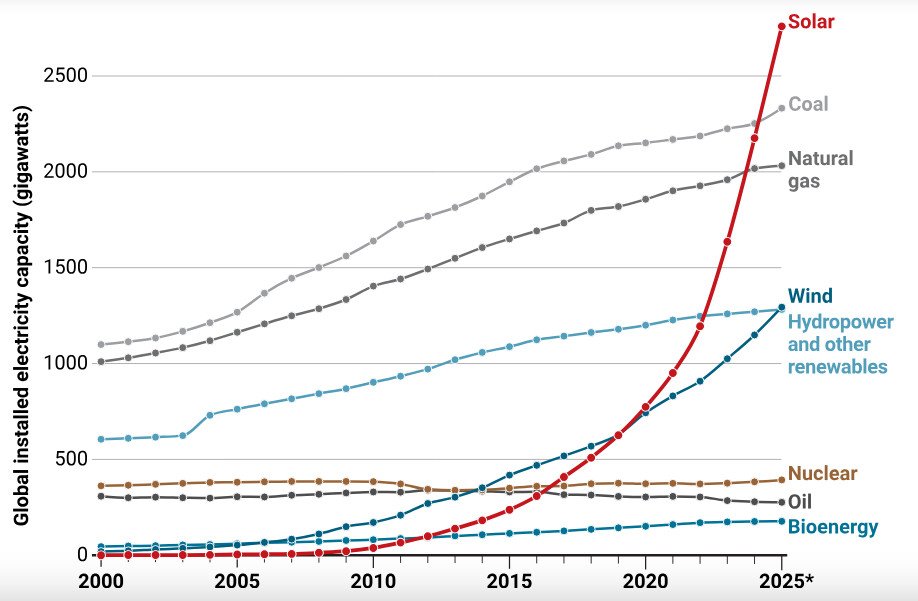
What's the blindspot? That renewables are replacing mostly nuclear's share?

Think economics. Renewables displaced the most expensive form of generation first and fastest. That was nuclear. After that it's been displacing coal. We're now starting to see renewables and batteries displace gas peakers. When it eventually gets cheap enough all gas.

We're also really early days on doing system of systems. So not just batteries at a solar site. But say pumped hydro at mid day solar peak that can be used later in the day or seasonally. Etc.

More interesting is world energy demand.

Thermo 101. What happens when you burn something to make motion? How do you balance the equation? Do you remember?

If you use electricity, you need a lot less total energy because primary losses are orders of magnitude lower. Compare the 90% efficiency of an electric motor vs. the 30% efficiency an internal combustion engine. One of them converts most input energy into motion. The other makes more heat than motion. If you replace and ICEV with an EV, what's the effect on your diagram? Hint: Not 1:1.
 
Those same people realize we do not have the infrastructure in place to make it realistic for every house to charge a electric vehicle. That includes power generation, power transmission and storage. It really is a Trillion dollar question that needs to be addressed before things can progress forward.

You know what the biggest expansion of the electric grid was for? Air conditioning. Do you think people put off buying ACs because the grid might collapse? Nah. They bought ACs and utilities spent the capital to upgrade the grid to meet demand. The exact same thing is happening with EVs. They can add will upgrade transmission. Not just for EVs. But for electric heating, data centres, etc.

By the way the average draw of an EV charging overnight for a commuter is no different than the AC at their house. Say 3 kW. For utilities this isn't much different than everybody doubling AC in a neighbourhood.
 
You know what the biggest expansion of the electric grid was for? Air conditioning.
Commercial or residential? I know AI data centers consume large amounts of cooling and consume large amounts of electricity. I wonder if the population increase has been accounted in those exact numbers.
Many newer HVAC systems are very efficient.
Do you think people put off buying ACs because the grid might collapse? Nah.
Not a chance Especially when someone else pays the cost of the infrastructure. As long as they keep paying for cheap electricity.
They bought ACs and utilities spent the capital to upgrade the grid to meet demand.
It is funny because the Powerlines built in Ab over the past few years to send electricity to the US were funded by Albertans, not the end users. The same can be said about Bc's transmission lines and some of their power plants.
The exact same thing is happening with EVs. They can add will upgrade transmission. Not just for EVs. But for electric heating, data centres, etc.
The costs are staggering for the infrastructure.
By the way the average draw of an EV charging overnight for a commuter is no different than the AC at their house. Say 3 kW. For utilities this isn't much different than everybody doubling AC in a neighbourhood.
That actually can and has been very bad for many areas in the summer time who suffer brown outs.

This is one of those forced processes that when the true costs are known people cringe. When the actual costs are hidden and passed onto others people do not care.
I wonder what the average cost is across Canada and the US.
 
Think economics. Renewables displaced the most expensive form of generation first and fastest. That was nuclear. After that it's been displacing coal. We're now starting to see renewables and batteries displace gas peakers. When it eventually gets cheap enough all gas.
One point of the image I posted is that the target is moving. Demand increased roughly 12,000 from 2014 to 2019, and another 12,000 from 2019 to 2024. In those two time frames the 4 categories at the top ("renewables") increased about 3,500 and somewhat under 7,000. The acceleration in demand is discouraging; the acceleration in supply is encouraging. However, another point is that the target is very, very large compared to their current contribution.
If you use electricity, you need a lot less total energy because primary losses are orders of magnitude lower. Compare the 90% efficiency of an electric motor vs. the 30% efficiency an internal combustion engine. One of them converts most input energy into motion. The other makes more heat than motion. If you replace and ICEV with an EV, what's the effect on your diagram? Hint: Not 1:1.
If you can use electricity. Micro-generation for small demands will cover a gap; it's unlikely to cover all gaps. (Recent amusing news: not all the heat from IC engines is "wasted" during Canadian winters, and some EVs are having difficulty meeting needs.)

Being over-enthusiastic about trend lines is just as bad as living in the past. I'm pro-tech, but I'm guarded with expectations.
 
You know what the biggest expansion of the electric grid was for? Air conditioning. Do you think people put off buying ACs because the grid might collapse? Nah. They bought ACs and utilities spent the capital to upgrade the grid to meet demand. The exact same thing is happening with EVs. They can add will upgrade transmission. Not just for EVs. But for electric heating, data centres, etc.

By the way the average draw of an EV charging overnight for a commuter is no different than the AC at their house. Say 3 kW. For utilities this isn't much different than everybody doubling AC in a neighbourhood.
We had decades to adopt everything else we already have, and during much of that time projects were not as time-consuming or costly. Why big projects are so much more costly is important (provided the "why" could reveal some way to massively cut costs), but not as important as the fact that they are so much more costly.

I did a back-of-envelope calculation a while back and estimated I'd need to roughly double my household electrical consumption to match my annual mileage with an EV. (It would however be far less expensive per km.) How BC Hydro could approximately double supply in short order to suit governments pressing for wholesale EV adoption, I don't know. And that would only be the personal vehicle fleet.

The trend lines are likely to flatten, and we really haven't gotten very far yet.
 
We had decades to adopt everything else we already have

And we'll switch to EVs over decades too. Average life of a car is 11 years. So even if sales went to 100% EV overnight (which they obviously won't), we'd have at least 11 years till the road fleet was 100% electric. In reality we won't see 100% EV sales till 2035-2040 in most countries and most segments. And then 10-15 years from that till the road fleet kicks over. So utilities are planning that they have to double transmission over the next 20-30 years. They'll do it. And you won't even notice. I guarantee it.
 
Recent amusing news: not all the heat from IC engines is "wasted" during Canadian winters, and some EVs are having difficulty meeting needs.)

1) Most of the world isn't Canada. And almost anybody designing a product or service would be foolish to design for the outlier. Similarly, it's silly for Canadians who have an outlier climate to project our experiences.

2) Even in Canada, you're running your AC a lot more than you're running your heater. Maybe you live in Whitehorse. In which case, I'll give you this one.

In these discussions it would help if we stop mixing up global trends and national trends. We are a cold weather oil exporting country. We are not going to have the same local perspective as the majority of the world who live in warm countries that import oil. It would help to at least acknowledge that basic reality.
 
Last edited:
Crux of the challenge is the possible changing paradigm.


PetroStates-ElectroStates-052725-1.png
 
Back
Top