• Thanks for stopping by. Logging in to a registered account will remove all generic ads. Please reach out with any questions or concerns.

Pipelines, energy and natural resources

  • Thread starter Thread starter QV
  • Start date Start date
Of note, the TSX energy index closed at an all time high within the past couple days. Market sentiment on the Canadian energy sector as it exists now seems to be bullish, at least.
Guess what composite index (not just energy) had a threefold better performance than the Dow over the past 12 months?

TSX Composite - 30.32% / 1yr
IMG_8241.jpeg

Dow Jones - 10.52% / 1yr
IMG_8240.jpeg
 
Those darned economists... always the joy killers ;) ;)


Proposed West Coast oil pipeline faces harder questions than just approval

Economists warn the biggest risk is not politics or protests, but whether Alberta can attract enough investment to fill a new pipeline to Prince Rupert

Prime Minister Mark Carney was in B.C. last week speaking with Coastal First Nations to clear a path for new energy projects, including a West Coast oil pipeline to Prince Rupert.

That path is littered with political, legal and environmental landmines, not the least of which is opposition by Coastal First Nations.

But the biggest challenge to a new oil pipeline may be economic and financial, not political.

"I think there's a very strong case that Canada could be competitive for shipping oil to Asia,” said economist Jack Mintz.

“The big issue to me isn't the pipeline. The question is: will the pipeline get filled up? Will there be enough investment in Canada to fill the pipelines?"

A new element of urgency was introduced into the pipeline debate at the beginning of the year with U.S. President Donald Trump’s interventions in Venezuela.

The fear is that Venezuela’s decrepit oil sector could make a comeback and begin supplanting Alberta oil at Gulf Coast heavy oil refineries.

Energy experts are downplaying that risk, noting that it would take billions in investment and up to a decade to bring Venezuela’s oil production back to what it was in the late 1990s.

The greater risk is that the U.S. under Trump is proving to be an increasingly capricious and hostile trade partner, creating an imperative to diversify markets for Canadian commodities, especially oil.

"We already knew there was unreliability building there," said energy analyst Rory Johnston of Commodity Context. "This just adds to that."

A memorandum of understanding signed by Alberta and Ottawa sets the political and regulatory stage for a new West Coast pipeline, which the Carney government has determined to be a national priority.

It is likely to be a revised version of the Northern Gateway project that the Trudeau government killed with the implementation of a northwest coast oil tanker moratorium.

The question now is not so much whether a new pipeline to the West Coast could be built, or whether there is a demand for Alberta oil in Asia, but who would pay for it and where it would terminate.


 

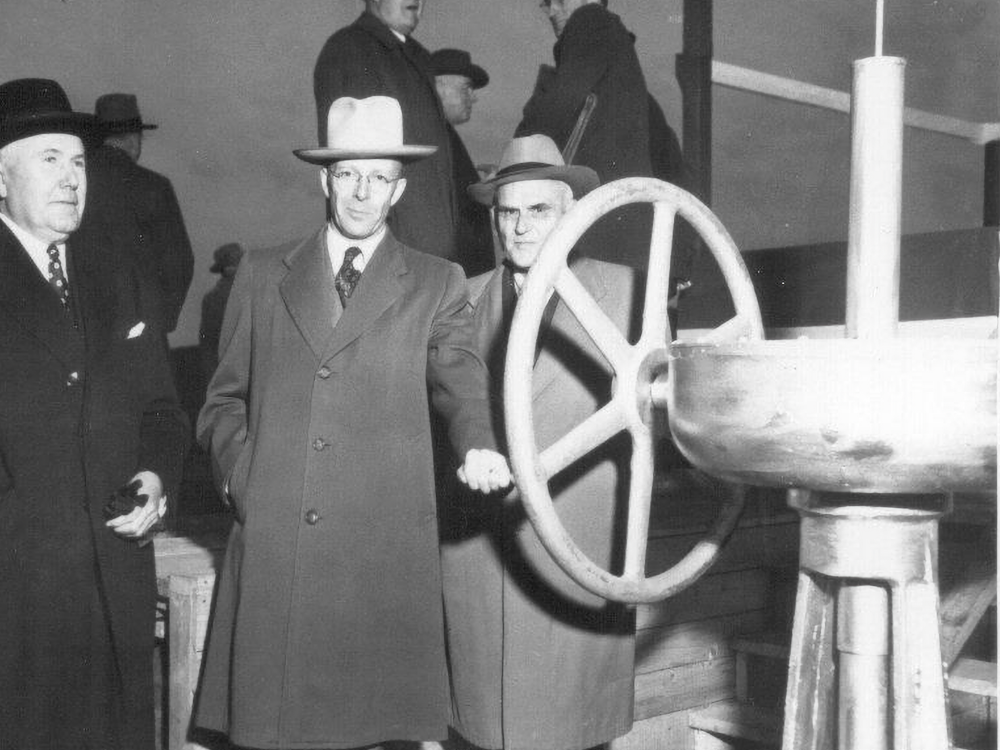
Impressive in its own way was the original Trans-Mountain pipeline, from Edmonton to Burnaby, B.C., traversing 1,150 kilometres of mostly rugged, mountainous terrain. Construction began in February 1952, finishing eight months later, costing the equivalent of $1.1 billion today. Expansion of the pipeline, proposed by Kinder Morgan in 2013 — 910 kilometres of line for an estimated $6.8 billion — did not go well. Initial federal approvals alone took three years, followed by a taxpayer buyout and an ultimate cost of $34 billion for six years of construction.
 

Olds getting a 10 BCAD Data Centre in two years. 1Gigawatt self-generated natural gas power plant, 2,000,000 sq.ft., 300 acres, 2000 construction jobs, 1000 permanent jobs and a tie in to the local college as both a supplier and a user.

The cooling system will be a closed loop system requiring only a one-time fill and no on-going demand. Presumably water or glycol to air radiators.
2 GW of surplus heat for Olds to tap into.


AI Overview


As of late 2025, there are over 37 data centre projects in the Alberta Electric System Operator (AESO) connection queue requesting over 19 gigawatts of power, with other reports citing at least 15 major proposals. Major projects include a $750 million facility near Calgary and a massive AI project near Grande Prairie.

Key details on Alberta's data centre boom:
  • Massive Power Demand: The 37+ projects are pushing for 19.4 gigawatts, which has outpaced the existing grid capacity.
  • Key Projects: eStruxture is developing its 90-megawatt CAL-3 facility near Calgary, expected to be operational by late 2026.
  • Development Activity: Two European firms recently approved four new,, large-scale data centres.
  • Industry Drivers: The surge is largely driven by AI demand and the province's push to become a data hub.
Due to capacity constraints, the AESO is limiting new, large-load, grid-connected data centres to roughly 1.2 gigawatts of capacity through 2028, requiring many new projects to bring their own power generation.
 
Actually, Ihave that 2GW of waste heat wrong. It would be more like 2GW of high quality (high temperature) waste heat from the combustion process and another GW ow low grade waste heat from all the servers after they have consumed the electricity.

And, wrt, that 170 CAD/tonne CO2 tax

1 GJ of Natural Gas produces 0.05 tonnes of CO2.
1GW of electricity requires 3 GW of Natural Gas or 3 GJ/sec
3GJ/sec x 0.05 tonnes CO2 per GJ = 0.15 tonnes CO2 per second
0.15 tonnes CO2 per second x 170 CAD per tonne of CO2 = 25 CAD/sec

1500 CAD/min
90,000 CAD/hr
2,200,000 CAD/day
15,000,000 CAD/wk
800,000,000 CAD/yr

In government revenues.


....

In addition

1000 permanent jobs
Average wage in Alberta of 60,000 CAD/yr
60,000,000 more into the economy


...

If all the projects with their 20 GW of electricity are realized then 20,000 jobs, 1.2 BCAD in wages, 16 BCAD in CO2 taxes.

And 40 GW of high grade waste heat or enough to heat 10,000,000 homes for a year.
 
If you're not at the table you're on the menu (looking at you BC ;) )


With just one day to go before Prime Minister Mark Carney hosts a high-level huddle with his fellow first ministers, provincial and territorial premiers head behind closed doors for a closed-door meeting of the Council of the Federation, which is slated to get rolling in Ottawa later this morning.

For his part, Carney is also booked in for one-on-one chats with British Columbia Premier David Eby (12:45 p.m.) and Yukon Premier Currie Dixon (4 p.m.), as well as a three-way tête-à-tête with both Eby and Alberta Premier Danielle Smith (1:20 p.m.), before hosting what his office is billing as a “First Ministers’ working dinner” this evening.


Meanwhile, further to all those naturalg as powered data centres and what to do with all that spare heat and CO2


Olds College is an agriculture and technical college.
 
Back
Top