
- Reaction score
- 12,265
- Points
- 1,040
Technically there may be no veto. (Whenever consent is a condition, there is a veto.) Practically, the way the politics work there is in many cases effectively a veto.



you are clutching at straws. Partnership requires a signature. A signature implies agreement. But the other conditions are dealbreakers as well. There is supposed to be an agreement on the carbon capture programme that has also hit the wall. Carney's conditions were designed to fail. imho


Well business case for not shipping to america......#4
Same facility had similar incidents happen in 2017, 2022, and 2024.
 )
)


 vancouver.citynews.ca
To further expand on this.Trans Mountain will be at capacity by next month, April, over 18+months ahead of schedule.
That capacity will be at 890,000 barrels/day.
They are spending another 9$ million (which is absolute peanuts) by Jan 2027 to add 'drag reducing agents' that will increase the flow by 10%. That will bring the number of barrels/day to 979,000.
In addition, they are constructing more pumping stations that will be completed in 2028. That will add another 360,000 barrels/day to the pipeline.
By the 2028 Trans Mountain will be shipping 1,339,000 barrels/day to the docks for shipping somewhere in the world.
At 70$ USD/barrel that's 93.7m USD/day or 34.2b USD a year.

To further expand on this.
In 2024 Canada exported around 4.2m barrels/day. These expansions to Trans Mountain will result in a 10+% increase in the amount of oil exports on a daily basis. By 2028, with no other expansions or additions, exported oil will be at 4.7m barrels a day. That places us as the 4th largest producer and exporter in the world. Which lines up with us having the 4th largest oil reserves in the world.
We could get a better deal if we had more pipeline capacity. The US has been buying oil/ natural gas cheap from around the worked and selling it at a profit for decades. If you look at the pipeline protest and the major source of funding behind them it makes a person wonder.I hear the word of the day is "re-export" as in the oil that we export to the US is re-exported to those Asian markets we can't supply by the US Gulf Goast ports.
Much of it without further processing.
Too bad we didn't have any leverage to get a better deal on our WCS.
We could get a better deal if we had more pipeline capacity. The US has been buying oil/ natural gas cheap from around the worked and selling it at a profit for decades. If you look at the pipeline protest and the major source of funding behind them it makes a person wonder.
It sounds like US companies are buying up all capacity in the pipelines down to the US, then they are re-selling it when it hits the docks in Texas to the highest bidder. If that's the case, then those same Asian buyers should be 'going back to the source' and buy the oil before it hits the docks - meaning back in Alberta and doing exactly what the US firms are doing.I hear the word of the day is "re-export" as in the oil that we export to the US is re-exported to those Asian markets we can't supply by the US Gulf Goast ports.
Much of it without further processing.
Too bad we didn't have any leverage to get a better deal on our WCS.
if there was only a way to deliver the product. Have the oil companies in the U.S. bought most of the product being delivered to VR.It sounds like US companies are buying up all capacity in the pipelines down to the US, then they are re-selling it when it hits the docks in Texas to the highest bidder. If that's the case, then those same Asian buyers should be 'going back to the source' and buy the oil before it hits the docks - meaning back in Alberta and doing exactly what the US firms are doing.

 www.theglobeandmail.com
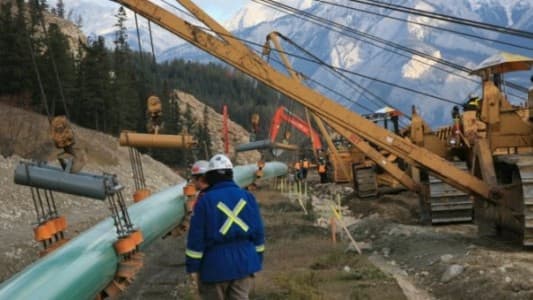
 oilprice.com
So that 1m/day will be 30% less that what Trans Mountain will be transporting by 2028, just to put this into perspective.Customers willing to invest in supply
Alberta Courts Asian Capital for 1M bpd Pipeline to Break U.S. Dependence | OilPrice.com
Asian and Middle Eastern investors are willing to fund a major Alberta-to-Pacific pipeline to reduce Canada’s reliance on U.S. exports.
So that 1m/day will be 30% less that what Trans Mountain will be transporting by 2028, just to put this into perspective.
But, adding another 1m/day would be a very good thing for certain.


