• Thanks for stopping by. Logging in to a registered account will remove all generic ads. Please reach out with any questions or concerns.

Pipelines, energy and natural resources

  • Thread starter Thread starter QV
  • Start date Start date
There's a dividing line clearly between Toyota, and to a lessor extent, Honda, and all the others. The Japanese car industry is ripe for consolidation. EV's might very well be the catalyst that brings it on.

Toyota is leading the way with their EV approach - which is the Hybrid vehicle - and the others are playing catch up.

Go look at the balance sheets of all these companies. They have insane debt levels. And the second reason they are all in trouble? They had high dependency on China for profits. First the Chinese brands took back market share at home. Now they are exporting EVs taking marketshare everywhere else. And unless you actually make cars in your country, you don't care where you import from. So their profits are starting to evaporate and they can't survive just on home market share.

Toyota is going to become Japanese GM.
 
There's a dividing line clearly between Toyota, and to a lessor extent, Honda, and all the others. The Japanese car industry is ripe for consolidation. EV's might very well be the catalyst that brings it on.

Toyota is leading the way with their EV approach - which is the Hybrid vehicle - and the others are playing catch up.

This is basically what happened in NA.
 
There's a dividing line clearly between Toyota, and to a lessor extent, Honda, and all the others. The Japanese car industry is ripe for consolidation. EV's might very well be the catalyst that brings it on.

Toyota is leading the way with their EV approach - which is the Hybrid vehicle - and the others are playing catch up.
There was a time, not that long ago, when the automotive media was down on hybrids. Minimal benefit, increased complexity and added cost. That seems to be changing. If nothing else, it eliminates range anxiety in cold climates.

As for consolidation, I think Nissan is circling the drain; maybe also the auto division of Mitsubishi.
 
There was a time, not that long ago, when the automotive media was down on hybrids. Minimal benefit, increased complexity and added cost. That seems to be changing. If nothing else, it eliminates range anxiety in cold climates.

Should be noted that this is a very North American take. Nobody in Scandinavia is worried about range anxiety with their EV. They are worried about paying over CA$3/L on top of the insane taxes they had to pay when buying a car with an internal combustion engine.

And even here, it's debatable how long hybrids will hold the conversation with range extenders coming. See Scout.
 
There was a time, not that long ago, when the automotive media was down on hybrids. Minimal benefit, increased complexity and added cost. That seems to be changing. If nothing else, it eliminates range anxiety in cold climates.

As for consolidation, I think Nissan is circling the drain; maybe also the auto division of Mitsubishi.
many machines start out complex until R&D figure out simpler ways to do it, hybrids and EVs are here to stay, and long term will likely cause consumer consumption of gasoline to decline slightly as efficiency increases.
 
There was a time, not that long ago, when the automotive media was down on hybrids. Minimal benefit, increased complexity and added cost. That seems to be changing. If nothing else, it eliminates range anxiety in cold climates.

As for consolidation, I think Nissan is circling the drain; maybe also the auto division of Mitsubishi.
I bought a Corolla Hybrid about 18 months ago and I love it. First time owning a Toyota and a hybrid. In the summer months I can get 47-48 miles/gallon highwary driving. So far great value for money. I tend to buy new and drive for 12-14+yrs, so it will be interesting to see if the hybrid battery lasts that long, that's the wildcard in my opinion.
 
many machines start out complex until R&D figure out simpler ways to do it, hybrids and EVs are here to stay, and long term will likely cause consumer consumption of gasoline to decline slightly as efficiency increases.

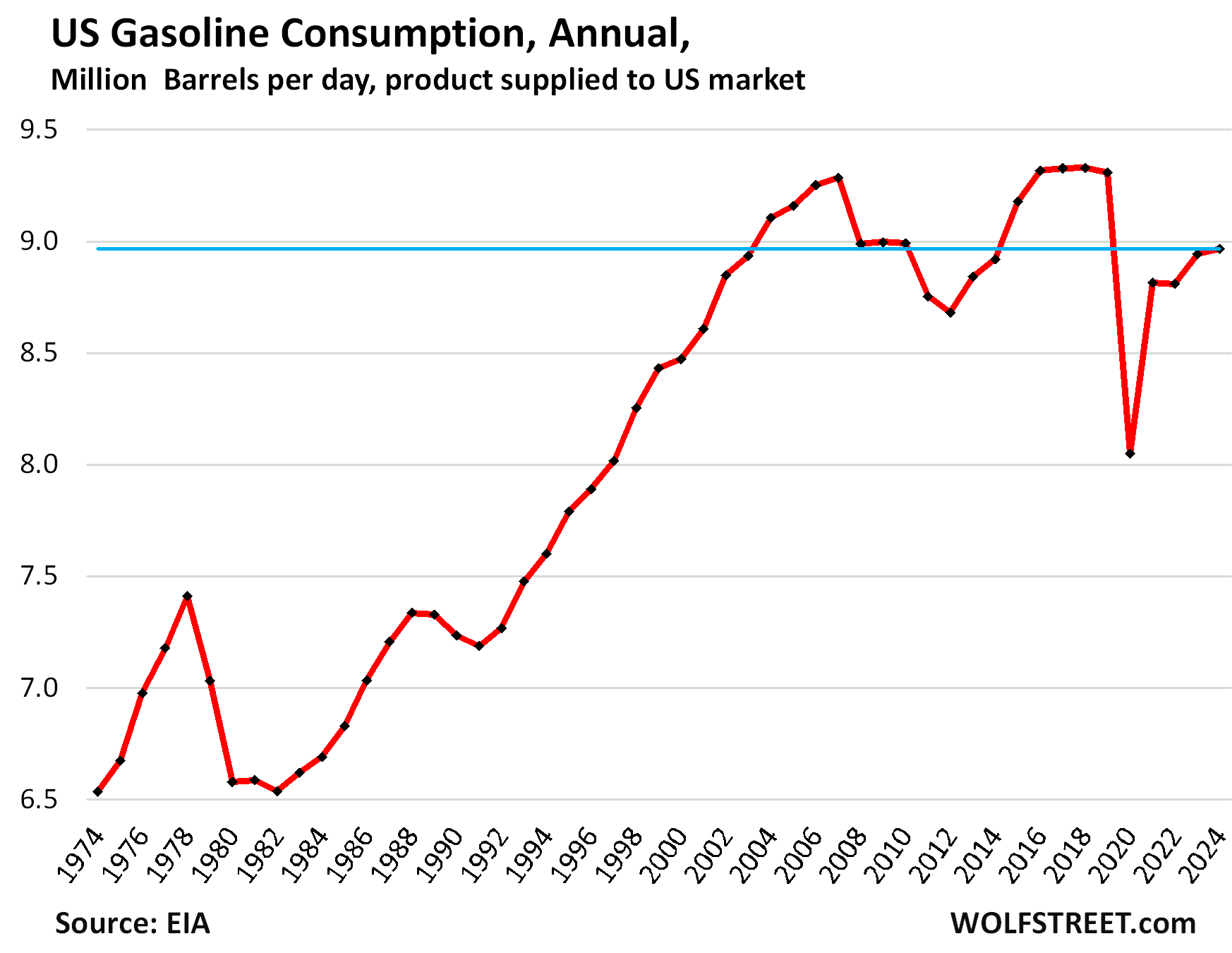
This is an understatement. EU gasoline consumption peaked in 2007. The US peaked in 2018. They are all on a slow but steady decline. And most of that was before even hybrids were really popular. Let alone EVs.

Figure_0.jpg


US-fuel-demand-2025-03-04-gasoline-total.png


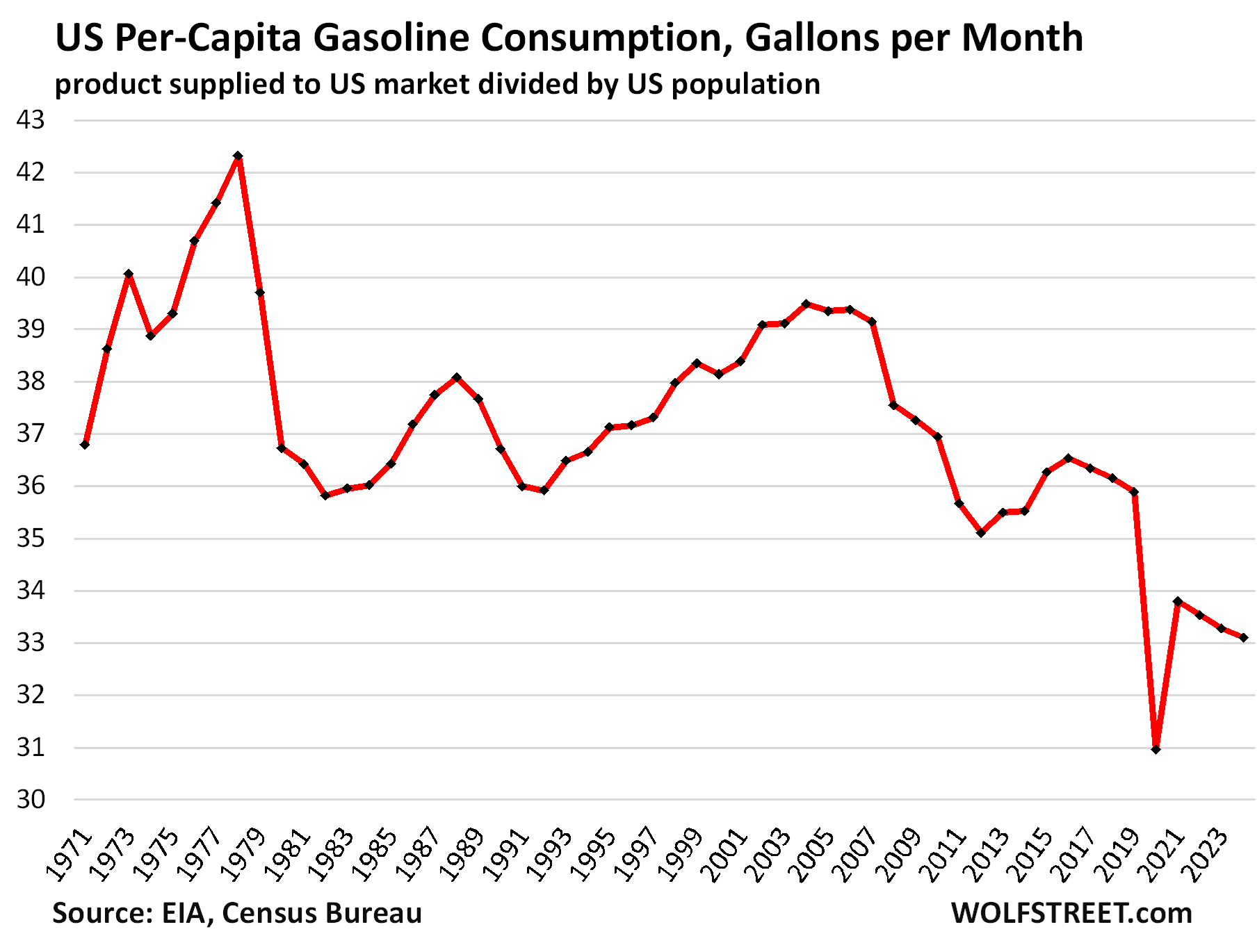
You can really see the impact of efficiency here, especially when you consider the context of population growth and vehicle size growth over the same period:

US-fuel-demand-2025-03-04-gasoline-per-capita.png


Now imagine the effect that this war will have, given the options that are available to consumers today. Especially outside North America.
 
I bought a Corolla Hybrid about 18 months ago and I love it. First time owning a Toyota and a hybrid. In the summer months I can get 47-48 miles/gallon highwary driving. So far great value for money. I tend to buy new and drive for 12-14+yrs, so it will be interesting to see if the hybrid battery lasts that long, that's the wildcard in my opinion.

Hybrid batteries haven't been an issue in well over a decade. Prius batteries go up to 200k miles with proper maintenance.


Tesla has talked about million mile batteries. And famously, their most prominent researcher, Prof. Jeff Dahn at Dalhousie, has worked on a 100 yr, 4 million mile battery. That may sound ridiculous. But these companies all want to produce reliable batteries with predictable lifecycles that will win over fleet customers. Getting taxis, delivery vans, etc to switch is attractive business.

Naturally it takes a decade or maybe two for the average person to actually catch up to reality on this stuff. But the "you'll have to pay $30k to replace your battery" is a silly and dated trope. Enjoy your car. It'll give you enough confidence to get a full EV in a decade......
 
Hybrid batteries haven't been an issue in well over a decade. Prius batteries go up to 200k miles with proper maintenance.


Tesla has talked about million mile batteries. And famously, their most prominent researcher, Prof. Jeff Dahn at Dalhousie, has worked on a 100 yr, 4 million mile battery:


Naturally it takes a decade or maybe two for the average person to actually catch up to reality on this stuff. But the "you'll have to pay $30k to replace your battery" is a silly and dated trope. Enjoy your car. It'll give you enough confidence to get a full EV in a decade......
My concern is not the distance but the duration.

The Honda Civic that I replaced with the Corolla Hybrid, my son now drives it to college and home, is a 2008 with only 156k on it. I want the battery to potentially last 12-16yrs, not necessarily how far I go in that time period.
 
My concern is not the distance but the duration.

The Honda Civic that I replaced with the Corolla Hybrid, my son now drives it to college and home, is a 2008 with only 156k on it. I want the battery to potentially last 12-16yrs, not necessarily how far I go in that time period.

Longevity isn't an issue. Battery wear is based on cycling. For a hybrid, that is almost all with how much you drive.

With pure EVs if you do things like powering your home, then maybe you incur additional cycles not related to drive.

I drove a rare Jetta Hybrid for about 12 years. Now with a gas crossover. I enjoyed the gas savings. But I didn't enjoy the Premium gas (cause of the turbos in there) or still having all the gas maintenance (like oil changes). I would have gone full EV when we switched but didn't have a place to charge at the time. Next vehicle for me, for sure. I kinda agree with Carlos Ghosn said about hybrids, "If you want a fish, you get a woman; if you want a woman, you get a fish."

I generally think if you're in a multi-car household, just make the commuter a small EV and then have big honking SUV or pickup for the roadtrips.
 
Back
Top