• Thanks for stopping by. Logging in to a registered account will remove all generic ads. Please reach out with any questions or concerns.

Pipelines, energy and natural resources

  • Thread starter Thread starter QV
  • Start date Start date
Carney and the environment minister can and the stroke of a pen issue exemptions to the tanker ban. No vote in parliment needed, no law changes needed, they can just do it. They can then get around the province by doing a federal environmental review to by pass the province via the one review law. So then so long as they do proper consultations with FN. BC can smoke it

The Eby government, and Eby himself, are at great peril of being erased from the political map pretty quick. Just watch what starts to happen after the Conservatives elect a party leader next week..

My untutored guess is that Carney is waiting for the BC NDP government to get kicked out, hopefully within the next year, then work with the BC Conservatives to get it done. In the meantime, like he says, he'll focus elsewhere.

Much easier to let the locals do your dirty work for you before swooping in to save the day. ;)
 
That is the way it is supposed to be. Some view it as a complete veto.
And there is no guarantee that "some" are not wrong.

We have legislated the principle of 'free, prior and informed consent' from the UN declaration on the rights of indigenous persons into Canadian law, but it really hasn't been tested. On its face, it sure looks like a veto to me. and no doubt would be argued as such. The government can dance around it, work within it or repeal it; all have costs. I suspect most FN groups have it framed on the wall.
 
It appears that nobody in Vancouver has an issue with a fully laden tanker sailing from Burrard inlet past 3 bridges (hello Baltimore?), through an extremely busy harbour, then at least 3 90 degree turns, past several marine parks (Race Rocks for one) and without a tug escort once they are past Lions Gate Bridge.

Meanwhile, Prince Rupert is basically a strait shot to open ocean once they clear wherever they decide to put the terminal. Also you could have a 4 tug escort and a pilot with a breathalyzer to ensure the master is sober! (Exxon Valdez Joseph Hazelwood - Wikipedia)
 
It appears that nobody in Vancouver has an issue with a fully laden tanker sailing from Burrard inlet past 3 bridges (hello Baltimore?), through an extremely busy harbour, then at least 3 90 degree turns, past several marine parks (Race Rocks for one) and without a tug escort once they are past Lions Gate Bridge.

Meanwhile, Prince Rupert is basically a strait shot to open ocean once they clear wherever they decide to put the terminal. Also you could have a 4 tug escort and a pilot with a breathalyzer to ensure the master is sober! (Exxon Valdez Joseph Hazelwood - Wikipedia)
I remember sitting at my desk back in 98/99/00 watching the LNG tankers enter Boston Harbour and every time I crossed my fingers that some small lobster boat didn't get in its way.
 
And there is no guarantee that "some" are not wrong.

We have legislated the principle of 'free, prior and informed consent' from the UN declaration on the rights of indigenous persons into Canadian law, but it really hasn't been tested. On its face, it sure looks like a veto to me. and no doubt would be argued as such. The government can dance around it, work within it or repeal it; all have costs. I suspect most FN groups have it framed on the wall.
Our government of the last 10 years has put us between a rock and a hard place. They have loaded the courts with left leaning judges who as far as I can see have no compunction about interpreting a law in ways that were never intended. And many of them appear to have environmental activist in their record of employmentl They constantly support First Nation claims and castigate us because we arrived in Canada after the nations did. The courts have also regularly reinforced Environmental action claims. They also appear to have two standards in criminal trials: indigenous and white. Having loaded the courts in the first place what else did the government expect from any decision except a roadblock to development. It is what they wanted. Perhaps they have changed their mind, maybe not, but they won't tell and they don't have to. They can say all the right things knowing that the courts have their backs.
 
It appears that nobody in Vancouver has an issue with a fully laden tanker sailing from Burrard inlet past 3 bridges (hello Baltimore?), through an extremely busy harbour, then at least 3 90 degree turns, past several marine parks (Race Rocks for one) and without a tug escort once they are past Lions Gate Bridge.

Meanwhile, Prince Rupert is basically a strait shot to open ocean once they clear wherever they decide to put the terminal. Also you could have a 4 tug escort and a pilot with a breathalyzer to ensure the master is sober! (Exxon Valdez Joseph Hazelwood - Wikipedia)

And, unlike Prince Rupert, around Vancouver Harbour there are about a million people.. give or take...
 
Our government of the last 10 years has put us between a rock and a hard place. They have loaded the courts with left leaning judges who as far as I can see have no compunction about interpreting a law in ways that were never intended. And many of them appear to have environmental activist in their record of employmentl They constantly support First Nation claims and castigate us because we arrived in Canada after the nations did. The courts have also regularly reinforced Environmental action claims. They also appear to have two standards in criminal trials: indigenous and white. Having loaded the courts in the first place what else did the government expect from any decision except a roadblock to development. It is what they wanted. Perhaps they have changed their mind, maybe not, but they won't tell and they don't have to. They can say all the right things knowing that the courts have their backs.
It all boils down to how the parties view Article 32 of the Declaration:

Article 32

1. Indigenous peoples have the right to determine and develop priorities and strategies for the development or use of their lands or territories and other resources.

2. States shall consult and cooperate in good faith with the indigenous peoples concerned through their own representative institutions in order to obtain their free and informed consent prior to the approval of any project affecting their lands or territories and other resources, particularly in connection with the development, utilization or exploitation of mineral, water or other resources.

3. States shall provide effective mechanisms for just and fair redress for any such activities, and appropriate measures shall be taken to mitigate adverse environmental, economic, social, cultural or spiritual impact.

The federal government views it as a 'foundation for partnership', I suspect many in the FN community view it as a veto and, based on the wording, it's hard to argue. The Declaration says "in order to obtain", not try really, really hard to obtain'. Consultation and partnership is great, and most things can be solved with enough money but, at the end of the day, what if the other partner simply doesn't want to dance?

The Court could determine that there are reasonable limits under Sec. 1 of the Charter, but that is not guaranteed and I suspect few on either side want to find out. Lack of clarity has its advantages.
 
Welcome to the slippery slope of white guilt syndrome ...


Who runs B.C.?​

British Columbia has ceded unprecedented power to First Nations. The fallout will do lasting damage to the province— and will hurt Mark Carney’s nation-building plans​


The biggest question in many people’s minds is no longer how to achieve social justice. It’s democracy. What happens to democracy when your government has handed veto power over major parts of its economy to a tiny group of unelected chiefs who represent just six per cent of the population? Who invited the UN to make the rules?

The rest of Canada should listen up. Federal and provincial courts across the country are turning DRIPA’s uncompromising edicts into practical legal constraints on government decision-making.

This means big trouble for Mark Carney’s fast-track nation-building agenda. The prime minister is right when he says we desperately need to develop our infrastructure—not only for our economy, but for national security. The trouble is that a lot of that infrastructure is planned for B.C. Say goodbye to the fast track. And don’t bet on a new pipeline to the West Coast any time soon.

 
UNDRIP is an aspirational declaration of principle. It confers no legal obligations on any signatory countries.

Unregulated I. A particular jurisdiction, you are correct.

However…

True, but the federal United Nations Declaration on the Rights of Indigenous Peoples Act obliges the Canadian government. Apparently BC has a similar provincial statute.

Once you pass a law saying this is the way we're going to do business, people may expect that we do.

This.

B.C. legislation enacted in 2019 implements the declaration as binding on provincial affairs.

 
and thus no pipelines from Alberta to BC and no mining development on North Baffin. Any bets on being able to put through an HS line as proposed? Carney will be able to maintain his eco-centric stance and blame it all on the courts.
 
and thus no pipelines from Alberta to BC and no mining development on North Baffin. Any bets on being able to put through an HS line as proposed? Carney will be able to maintain his eco-centric stance and blame it all on the courts.
I am a bit surprised that I haven't seen (social media only, FWIW) more negative feedback from FNs regarding the HSR proposal in Ontario. The study areas are quite large - maybe they're keeping their powder dry.
 
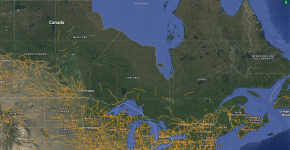
Back to the other option of running a new pipeline East through Ontario rather than dipping down into the US I wonder if building along abandoned/unused rail lines where possible might make it easier to cross the difficult terrain of the Canadian Shield. The total distance might be longer than an optimal straight line route but I wonder if that might be offset by the cost savings of building along a previously cleared path?

1779550693958.png
 
Back to the other option of running a new pipeline East through Ontario rather than dipping down into the US I wonder if building along abandoned/unused rail lines where possible might make it easier to cross the difficult terrain of the Canadian Shield. The total distance might be longer than an optimal straight line route but I wonder if that might be offset by the cost savings of building along a previously cleared path?

View attachment 100423
There would be significant advantages to using old railbeds due to, if nothing else, the muskeg is already filled in and the route is designed for all season weight. Crossings would need to be installed but that's any easy task for crews to install.

There would be some engineering issues in terms of widths needed but it's easier to expand a road than build from scratch or you end up with one-way segments with pullouts for passing.

Landownership however might be an issue as many of those old lines have been sold off and may be private holdings. In S. Ont. I believe a large number of them were converted to recreation trails.

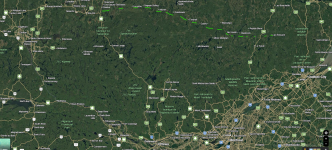
That said the key segments of Ignace (best guess on terminus) -> Thunder Bay -> Long Lac and then picking up fromt he area around Timmins -> Gogama -> Sudbury down towards Ottawa jump out as major corridors...in very difficult ground....to focus upon.

If you go east from Timmins -> Temuskiming (ONT/QUE) border area there is an interesting chain of communities I didn't see much roading too running from Val-de-Or east....pipes need to get south at some point but a route that is high and away from the communities of St. Lawarence might be an easier political battle than through the dense populations area. Maybe the Quebec solution is a port downstream of Quebec City and then it's either tanker to New Brunswick/Montreal or export overseas?
1779554091733.png
 
We've been knowingly compromising our energy sovereignty for generations for economic and 'easy button' reasons.

Keep your elbows up as much as you like, but we'll probably be relying on US pipelines etc. for ... forever....

‘Big vulnerability’: How Ontario and Quebec became reliant on the U.S. for oil and gas​

ARC Energy Institute leaders highlight the need for a new approach in a new reality

Despite Canada’s status as one of the world’s largest oil and gas producers, more than half of the country’s own population does not have true energy security – uninterrupted, reliable access to the energy they need at an affordable price.

Even though Western Canada produces much of the oil consumed in Ontario and Quebec, in order to get there, it moves on pipelines that run through the United States.

“It’s only energy secure if the Americans are our partners and friends,” leading energy researcher Jackie Forrest said on a recent episode of the ARC Energy Ideas podcast.

Amid rising trade tensions with the United States, energy security is taking on greater importance. But Forrest said the issue is not well understood across Canada.

“The concern is that in the worst-case scenario where the Americans want to really hurt our country, they have the ability to stop all crude oil flows to Ontario,” she said.

That action would also cut off the majority of oil supply to Quebec.

The issue isn’t much better for natural gas, with about half of consumption in Ontario and Quebec supplied by producers in the U.S.

“Tariffs or no tariffs, there is a real vulnerability there,” said Forrest’s co-host Peter Tertzakian, founder of the ARC Energy Research Institute.

The issue won’t go away with increased use of new technology like electric cars, he said.

“This isn’t just about combustion in engines. It’s about securing a vital commodity that is an input into other parts of our manufacturing and sophisticated economy.”

 
Historical precedent?

The Grand Trunk Railroad from Montreal to an ice free port.

Portland Maine.

Canadian nationalism entered the fray and a line to Halifax was deemed the answer.

But building a new line through the Gaspe was deemed to expensive and the Portland line wasn't paid off.

Use the Maine line to get to Halifax.

Sounds awfully like the Hearst vs Michigan highway, railway and pipeline discussions.

The Mounties rode American trains to get to Winnipeg to assert Canadian sovereignty in the face of the Americans


Wolseley's force had had to paddle the Rainy Lake route to Winnipeg from Thunder Bay because the Americans denied passage and there was no Canadian rail line.

None of this stuff is new.

We just never seem to come to terms with the cost of owning this land and if we really would rather be in Florida.
 
Back
Top