• Thanks for stopping by. Logging in to a registered account will remove all generic ads. Please reach out with any questions or concerns.

Public service employment has grown by 31 per cent

Yep.

I can’t see how RTO4 and RTO5 will make enough people quit by July. ERI won’t clear enough people and neither will WFA. At least not by the timelines that have been hinted at.
My experience with the last round of DRAP was it was the 'go to' people that were burnt out and tired that took it, not the deadweight. Don't expect any different here, as they are the ones that need a break, and if they still want to work likely can find a job (and generally seemed more financially responsible and prepped for retirement anyways). Hard to train new people as well when you shed your experienced people, without having an overlap period allowing for knowledge transfer, and we lost centuries of experience in critical sections.

They also want to increase the speed of DND procurement, but are cutting PSPC numbers, when PSPC is already a limiting factor with not enough contracting officers to support DND, so some of it doesn't make sense (unless they transfer to the new procurement arm and just do DND buys).

The people in my neck of the woods that are interested in it this time are cornerstones, and the ones that we hoped might take it are going to ride it out, and when you get high performers parachute when low performers cling on you just burn out the survivors faster, so bit of a double whammy. All this when we are basically trying to triple the size of our section, so keeping the experienced people around is a critical part to create a sustainable field of SMEs in a super particular niche where we were planning on a 3-5 year trajectory to train up journeymen and experience people to the weird requirements of the CAF.
 
The frequently seem to include the CAF in there; if they hit the numbers they are talking overall government employment will spike another 30ish%. Similarly need a big growth in DND, PSPC and a few other supporting agencies to hit and sustain 2%+ and maintain all this fancy equipment.

Would that still be an ouch?
Yes. When business isn’t growing much but the government is, there is less of a effective tax base to support the gov. Especially considering much of the jobs added to the private sector are rarely equal to the public sector jobs.

Much more part time and lower wage jobs with worse benefits.
 
Sure, but you can't cut the PS while doubling or tripling the DND spend, and also doubling the number of CAF personnel.

Lot of injection into local economies just from having the bases there, plus the various private jobs that directly support CAF activities, plus intermittent things like construction work or maintenance, so there are a lot of economic benefits to that.

People complain about government jobs, but at the end of the day you need peope to deliver services, regulate things under the government and just support the whole operation, so the gross number of govt jobs doesn't really mean anything one way or the other, and you would really need to get down way into the weeds to figure out what specific jobs, sections, divisions etc are 'bloat' and what are under-resourced.

The top down arbitrary shrinkage through largely attrition doesn't do any of that, and we'll probably lose a lot of actual capabities we will have wish we kept. Saw an interview with a guy at I think Parks Canada or Natural Resources that does forestry forensics or something, that looks for things like the emerald ash borer beetle and other pests and diseases that kill trees. He said there were 15 of them when he started, and they will be down to just one when he retires. Means a lot of things will go undetected, and we'll get fun things like mass die offs at much larger scale, which turns into huge fuel load for wildfires. Something like that would have a really big lag and huge impact, and would take decades to re-establish the program and catch back up, with a lot of destruction, damage and deaths in the interim, so probalby lots of examples like that where no one but the government would do it, but will get cut by managers and executives who largely don't actually understand what a lot of tech specialists do so they protect their pet projects for things like info dashboards and similar.
 
The staggering increase in FTEs during the Trudeau era continues to creep upwards despite best efforts to the contrary ...

Full-Time Equivalents in the Federal Public Service – 2025-26 Departmental Plans​


Over 2006-07 to 2023-24 the federal public service expanded from 335,000 full-time equivalents (FTEs) to 441,000 – an increase of over 105,000 FTEs.

According to the 2025-26 Departmental Plans (DPs), the number of FTEs is expected to have reached 445,000 in 2024-25. This represents an increase of over 13,000 FTEs compared to last year’s plans. The Canada Revenue Agency (CRA) accounts for about one third of this increase. Other departments with significant upward revisions to last year’s DPs include Employment and Social Development Canada (ESDC), Canada Border Services Agency and Indigenous Services Canada.

From 2025-26 onwards, the number of planned FTEs is projected to decline, falling to 415,000 FTEs in 2027-28. That said, this projected decline, even if it materializes, still leaves the number of FTEs well above both the pre-pandemic peak (382,000 in 2019-20) and the higher levels recorded during the pandemic (413,000 in 2021-22).

 
probalby lots of examples like that where no one but the government would do it, but will get cut by managers and executives who largely don't actually understand what a lot of tech specialists do so they protect their pet projects for things like info dashboards and similar.
Not necessarily. Try giving companies property rights to under-maintained resources and see what happens. (I don't mean handing over full ownership without any limitations.) Evidence confirms that when people have an economic interest in protecting the health of something, whether its a flock of chickens or a stand of timber, they will often protect it.
 
Not necessarily. Try giving companies property rights to under-maintained resources and see what happens. (I don't mean handing over full ownership without any limitations.) Evidence confirms that when people have an economic interest in protecting the health of something, whether its a flock of chickens or a stand of timber, they will often protect it.
I think the clear cut forests, giant open scars from mines, and poisoned rivers and water ways would strongly disagree. The stock market prioritizes short term profit and growth, not sustainability so that mentality is largely gone unless privately owned, and really depends on the personality of the owner.

Even that approach still would require oversight and legislation, as well as coordination across the country, as there are things businesses tend to not share with their competitors.
 
I think the clear cut forests, giant open scars from mines, and poisoned rivers and water ways would strongly disagree. The stock market prioritizes short term profit and growth, not sustainability so that mentality is largely gone unless privately owned, and really depends on the personality of the owner.

Even that approach still would require oversight and legislation, as well as coordination across the country, as there are things businesses tend to not share with their competitors.
Well, yes, that's the kind of behaviour we should expect from "here, take this, when it runs out we'll find you more, and externalize everything you want" policies. I'm writing about creating incentives to properly steward renewable resources, which is not at all what you describe.

As I wrote, "limitations" apply. For non-renewable resources, obviously once the ore or whatever is depleted it's necessary to move on, and I wouldn't allow a free-for-all to externalize pollution and general environmental degradation at any time. But that's not really the category I'm responding to.

For renewable resources, limits can also be applied to exploitation. But the important principle is to say, "this is all you get", and to demonstrate that you mean it. So a timber company could clear cut its allowance along with the necessary mitigation (limits : replanting, stream protection, etc) but then the government response should be, "sorry, you ate it all in one sitting". Or it could manage its allowable cut and protect the health of the stands to sustain a company that will be around indefinitely.

[Add: I don't mean there should be no oversight. I mean that some of the functions could be done privately rather than publicly. Crunches in publicly-funded institutions happen or are coming. Deal with it intelligently using proven techniques to manipulate human behaviour.]
 
The staggering increase in FTEs during the Trudeau era continues to creep upwards despite best efforts to the contrary ...

Full-Time Equivalents in the Federal Public Service – 2025-26 Departmental Plans​


Over 2006-07 to 2023-24 the federal public service expanded from 335,000 full-time equivalents (FTEs) to 441,000 – an increase of over 105,000 FTEs.

According to the 2025-26 Departmental Plans (DPs), the number of FTEs is expected to have reached 445,000 in 2024-25. This represents an increase of over 13,000 FTEs compared to last year’s plans. The Canada Revenue Agency (CRA) accounts for about one third of this increase. Other departments with significant upward revisions to last year’s DPs include Employment and Social Development Canada (ESDC), Canada Border Services Agency and Indigenous Services Canada.

From 2025-26 onwards, the number of planned FTEs is projected to decline, falling to 415,000 FTEs in 2027-28. That said, this projected decline, even if it materializes, still leaves the number of FTEs well above both the pre-pandemic peak (382,000 in 2019-20) and the higher levels recorded during the pandemic (413,000 in 2021-22).

Maybe some perspective would be useful.

This chart shows that GDP in 2006 was $1.3T, and in 2023 is $2.1T. That means that public sector employment numbers in comparison to GDP show that the economy has grown much faster than public sector employment. I understand the difference between causation and correlation, but nonetheless this is an additional data point or lens through which to interpret the numbers.

I also found that canada's population increased by 18% in the same time frame, so clearly fed PS numbers have grown faster than the population, but nowhere near as fast as the economy.

Again, not sure what to make of all of that yet
 
Maybe some perspective would be useful.

This chart shows that GDP in 2006 was $1.3T, and in 2023 is $2.1T. That means that public sector employment numbers in comparison to GDP show that the economy has grown much faster than public sector employment. I understand the difference between causation and correlation, but nonetheless this is an additional data point or lens through which to interpret the numbers.

I also found that canada's population increased by 18% in the same time frame, so clearly fed PS numbers have grown faster than the population, but nowhere near as fast as the economy.

Again, not sure what to make of all of that yet

And this data is from July, so it will be interesting to see the results a year from now after the 'Carney Cuts' kick in..
 
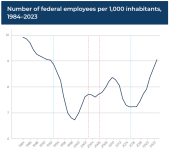
I'd be interested to see the PS to Population trend from 1945 to present, but best I can find only goes back to '80's.
View attachment 97188
Ref: Bloat in the Federal Public Service: Justin Trudeau Ranks Last among Canadian Prime Ministers over the Past 40 Years | Montreal

It will be interesting to see how AI might help us reduce the ‘national overhead’, because I’m pretty sure that just hiring more people won’t be a popular move anymore:

 
The challenge is that low skill, entry positions develop knowledge and experience to be able to address more complex situations. Those are the positions most likely to be disrupted by AI.

If we eliminate those entry level developmental positions, where does the skilled knowledge based workforce of the future come from?
 
Back
Top