- Reaction score
- 8,366
- Points
- 1,160
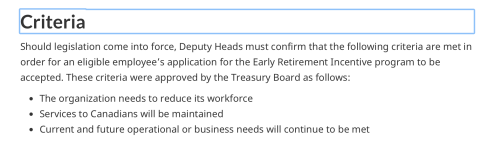
What they seem to be actually doing as a starting point is going for attrition and early retirements, not backfilling jobs, and letting managers make noise about it if they need that position.Legally per the various CA, they can't do it that way. They must decide which activities are no longer going to be done, or which sections reduced in size, and then delete boxes, not people. IE, you have a policy section of 20 personnel working on 5 different files, and you need to eliminate 10 positions. If everyone is working on files equally, and you are either going to stop progress on some files, or extend the timelines to complete the files, all 20 individuals get a notice they are affected, and the manager hopes people voluntarily retire/resign. If individual positions are assigned work on individual files, and certain files are being stopped, then those positions working on those specific files are given notices. Here, the manager may hope that someone working on a non-affected file want to take early retirement, or the resignation deal, and swaps with an affected employee, the position is still eliminated.
It is a pretty complex process that has a plethora of possibilities.
That can work, providing management actually is tracking what the impact is of people leaving a position, and doesn't protect their own sacred cows, which is a bit all over the place.
Remember one particular technical expert putting in their retirement notice about 18 months in advance, knowing they had about 30+ years of SME on an operationally critical role, with no backup to replace them, so that someone could get tagged for knowledge transfer and slowly take over that file. What actually happened is nothing, until about 6 weeks after they retired, and a ship needed approval for something that they were the SME for and someone outside the immediate CoC realised the position was vacant and what that actually meant. It was one of those positions where if you need to talk to them, you are calling them on a sat phone on a long weekend to see if you can sail Monday, so was a pretty big deal.
Someone else took over the file, and the previous incumbent came back as a casual worker for a while, trained someone else to formally take over the job etc, so it eventually got sorted out, but was a bit of a shitshow.
That's an expertise that was required to support day to day peacetime operations, and we have lots of one off SMEs that specialize in things relating to actual combat survivability that we aren't replacing, so we'll be pretty SOL if we wait to find out that we lost a support capability when the shooting has actually started.
I'm sure it'll be fine though; some of those sacred cows will have delivered tracking dashboards identifying it as a risk and deprioritized it as we'll never actually go to war, so it's fine.