Articles found April 24, 2009
Afghanistan opens its first national park
Thursday, 23 April 2009, 16:39 CDT
Article Link
The Afghanistan National Environmental Protection Agency says it has established that country's first internationally recognized national park.
The United States Agency for International Development provided key funding for the park's creation, while the Wildlife Conservation Society in New York conducted preliminary wildlife surveys and helped identify and delineate the park's boundaries.
Known as Band-e-Amir, the park will protect one of Afghanistan's best-known natural areas -- a series of six deep blue lakes separated by natural dams made of travertine, a mineral deposit. Travertine systems are found in only a few places around the world, virtually all of which are major international tourist attractions.
At its core, Band-e-Amir is an Afghan initiative supported by the international community. It is a park created for Afghans, by Afghans, for the new Afghanistan, said Steven Sanderson, president and chief executive officer of the WCS. Band-e-Amir will be Afghanistan's first national park and sets the precedent for a future national park system.
Though much of the park's wildlife has been lost, recent surveys indicate it still contains ibex, a species of wild goat, and urial, a type of wild sheep, along with wolves, foxes, smaller mammals, fish and various bird species including the Afghan snow finch, which is believed to be the only bird found exclusively in Afghanistan.
More on link
INTERVIEW-
Pakistan diplomat faults U.S. strategy
Fri Apr 24, 2009 By Adrian Croft
Article Link
LONDON, April 24 (Reuters) - Pakistan's top diplomat in Britain has criticised the new U.S. strategy on Afghanistan and Pakistan and defended his government's agreement to impose Islamic law in the northwestern Swat valley.
Wajid Shamsul Hasan, Pakistan's High Commissioner (ambassador) in London, said his personal view was that U.S. President Barack Obama's plan for fighting Taliban insurgents in Afghanistan, which broadens the focus to Pakistan, was the "wrong strategy".
"Pakistan is a semi-developed country and Afghanistan is not at all developed. They have never had any rule of law in their country," he told Reuters in an interview late on Thursday.
"You can't club the two countries (together)," he said.
Washington views Pakistan as crucial to its efforts to stabilise Afghanistan, where a Taliban insurgency has intensified. Surging militant violence in nuclear-armed Pakistan has also raised fears about its future.
U.S. Secretary of State Hillary Clinton accused Pakistan's government on Wednesday of abdicating to the Taliban by agreeing to impose Islamic law in the Swat valley and said the country now posed a "mortal threat" to the world.
Hasan said Clinton was "rather overstretching the issue."
More on link
Why textbooks we paid for never reached Afghanistan
By Marjorie Kehe 04.24.09
Article Link
About 45 million books – a total value of $15.4 million, paid for by the United Nations and the aid agencies of the US and Danish governments – were scheduled to arrive before classes started in Afghanistan last March. But according to the AP, millions of those books have still not been delivered.
About 500,000 books are in sitting in shipping containers in Pakistan awaiting customs clearance by the Afghan government, says the AP, while another 20 million books are said to be sitting in a warehouse in Kabul awaiting a distribution plan.
Overall, about a third of the school books ordered for 2008 were never delivered to the provinces, the AP learned from Afghan provincial officials and Education Ministry records.
Distribution within Afghanistan, of course, is anything but easy. There are safety concerns, mind-boggling transportation problems, and, in some cases, funding for book transit is non-existent. (That’s why, according to a US military liaison, there’s a school in Afghanistan that currently cannot be used for classes – it’s full to the brim with textbooks.)
Meanwhile, there have also been printing problems. Some of the printers contracted to do the work have either not completed it or done it so poorly that pages fall out or have been incorrectly collated into the wrong books.
The good news, however, is that where the books did arrive they were received with joy.
“Despite all the complaints,” the AP reported, “teachers emphasize how happy they are to receive books at all. In the past, some said, there were only three books for a class of 30 or 40 students, so youngsters had to copy down the lesson.”
Students in Afghanistan are thirsty for education, an Afghan Education Ministry spokesman told the AP.
More on link
The sad, unlamented end of UN peacekeeping
Thursday, April 23, 2009 | 6:32 PM ET Brian Stewart CBC News
Article Link
Many Canadians look forward to the day this country can leave the war in Afghanistan behind and return to the softer challenges of blue-helmeted peacekeeping.
There is still a dogged belief that UN-sponsored peacekeeping, a term introduced by then secretary of state for external affairs Lester Pearson in 1956, is our true national vocation.
In 1990, fully 10 per cent of all UN missions were staffed by Canadians and the image of blue-helmeted Canadian soldiers policing the world's flashpoints — from Cyprus and Sinai to Kashmir — became almost as iconic as the beaver.
But those days are gone. It's time to face the harsh reality.
More on link
Clinton: Pakistan realizing threat from insurgents
By ROBERT BURNS – 1 day ago
Article Link
WASHINGTON (AP) — Pakistan is beginning to recognize the severity of the threat posed by an extremist insurgency that is encroaching on key urban areas, Secretary of State Hillary Rodham Clinton said Thursday.
Clinton told a House appropriations subcommittee that the Obama administration is working to persuade the Pakistani government that its traditional focus on India as a threat has to shift to the Islamic extremists.
"Changing paradigms and mind-sets is not easy, but I do believe there is an increasing awareness of not just the Pakistani government but the Pakistani people that this insurgency coming closer and closer to major cities does pose such a threat."
On Wednesday, Clinton told another House committee that in her view the Pakistani government is "basically abdicating to the Taliban and the extremists."
She said Thursday that the administration's special envoy for Pakistan and Afghanistan, Richard Holbrooke, has had "painful, specific" conversations with a wide range of Pakistanis about the need to act more effectively against the insurgents.
"There is a significant opportunity here for us working in collaboration with the Pakistani government to help them get the support they need to make that mind-set change and act more vigorously against this threat," she said, adding, "There are no promises. They have to do it."
One measure of progress in Pakistan, she said, is the extent to which the Pakistani military is shifting its troops from the Indian border to the Afghan border, where the Taliban threat has been expanding.
Clinton was appearing before the appropriations panel that is reviewing the administration's request for $7.1 billion in additional funds for the State Department this budget year.
Clinton said that local job creation is a key purpose of the $980 million in extra funds the State Department is requesting for its work in Afghanistan.
She told the panel that a main goal is to improve security at the local level in Afghanistan by putting more people to work. And she said the Obama administration believes that many in the Taliban insurgency who are fighting against American and Afghan forces are motivated more by money than by ideology.
More on link




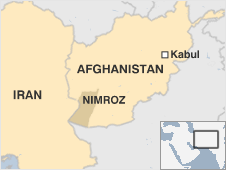

 Some Good News - Turning Tables, U.S. Troops Ambush Taliban With Swift and Lethal Results


