

You are using an out of date browser. It may not display this or other websites correctly.
You should upgrade or use an alternative browser.
You should upgrade or use an alternative browser.
The Sandbox and Areas Reports Thread December 2010
- Thread starter GAP
- Start date
Articles found December, 2010
Goodspeed Analysis: Afghanistan — NATO’s partner in war, mistrust
Article Link
Canadian Ambassador William Crosbie’s leaked diplomatic cable highlights the extremely fragile relationship that exists between the government of Afghanistan and the NATO alliance.
It is now obvious from Mr. Crosbie’s cable and the U.S. documents in the WikiLeaks trove that relations between Hamid Karzai, the Afghanistan president, and his foreign backers have become particularly poisonous.
Relations on a long list of issues continue to deteriorate, including disputed elections, corruption, a banking scandal, as well as the political and security situation.
The leaked Canadian memo is an independent confirmation of an earlier description of the corrupt and complex dynamics of the Afghan government made last year by Karl Eikenberry, the U.S. Ambassador to Afghanistan.
The picture painted by Mr. Crosbie of an Afghanistan President on the verge of potentially quitting his alliance with NATO comes at a time when Canada has just made a commitment to stay in the country for another three years. Canadian military trainers will head to Afghanistan after combat troops withdraw next year.
But as Mr. Crosbie reveals, despite NATO’s commitment to Afghanistan, relationships continue to worsen.
“We have gone through numerous crises as an international community in our relations with the Karzai government,” Mr. Crosbie wrote to Ottawa. “Rather than strengthening ties they have served to exacerbate and weaken them.”
Mr. Crosbie’s memo is not the first to highlight the disastrous relations with Mr. Karzai.
Mr. Eikenberry is a veteran victim of leaked diplomatic documents that highlight the controversial dynamics of U.S. foreign policy.
More on link
Goodspeed Analysis: Afghanistan — NATO’s partner in war, mistrust
Article Link
Canadian Ambassador William Crosbie’s leaked diplomatic cable highlights the extremely fragile relationship that exists between the government of Afghanistan and the NATO alliance.
It is now obvious from Mr. Crosbie’s cable and the U.S. documents in the WikiLeaks trove that relations between Hamid Karzai, the Afghanistan president, and his foreign backers have become particularly poisonous.
Relations on a long list of issues continue to deteriorate, including disputed elections, corruption, a banking scandal, as well as the political and security situation.
The leaked Canadian memo is an independent confirmation of an earlier description of the corrupt and complex dynamics of the Afghan government made last year by Karl Eikenberry, the U.S. Ambassador to Afghanistan.
The picture painted by Mr. Crosbie of an Afghanistan President on the verge of potentially quitting his alliance with NATO comes at a time when Canada has just made a commitment to stay in the country for another three years. Canadian military trainers will head to Afghanistan after combat troops withdraw next year.
But as Mr. Crosbie reveals, despite NATO’s commitment to Afghanistan, relationships continue to worsen.
“We have gone through numerous crises as an international community in our relations with the Karzai government,” Mr. Crosbie wrote to Ottawa. “Rather than strengthening ties they have served to exacerbate and weaken them.”
Mr. Crosbie’s memo is not the first to highlight the disastrous relations with Mr. Karzai.
Mr. Eikenberry is a veteran victim of leaked diplomatic documents that highlight the controversial dynamics of U.S. foreign policy.
More on link
Articles found December 3, 2010
Mounted gun delayed exit from chopper attacked in Afghanistan: DND
By Derek Abma, Postmedia News December 2, 2010
Article Link
OTTAWA — The placement of a mounted gun at the main door of a Chinook helicopter brought down by enemy fire Afghanistan in August impeded the exit of personnel after landing, the Department of National Defence says in a preliminary report on the incident.
The report indicated that all CH147 Chinooks in use in Afghanistan for such transport missions have since been modified to have their gun mounts on a swivel and are able to be pushed away in the event of an emergency exit.
DND said the investigation into this forced landing — made while flying low from a Panjwaii operating base to military facilities near the Kandahar Airfield — is ongoing. It said a final report would be issued about a year after the incident, which took place on Aug. 5.
The report issued this week said the helicopter, which was transporting coalition troops and supplies, was hit by enemy fire, though the exact weapon used has still not been determined.
More on link
Canadian deputy commander knows IED threat 'front and centre'
Article Link
By Matthew Fisher, Postmedia News December 2, 2010
KANDAHAR, Afghanistan — The new Canadian deputy commander of NATO's war in the south of Afghanistan is cautious about gains made against the Taliban this past summer.
"We and the (Afghan National Security Forces) have done a lot of damage to the Taliban," says Brig.-Gen. Andre Corbould.
"But one of the things we are trying to figure out is what is the difference between a seasonal change and a truly enduring change," he says, referring to the usual lull in fighting that occurs every winter in Afghanistan. "We've seen time and time again where we have had a very successful fall and then some issues in the spring that we (have) had to deal with."
However, there is some evidence that the situation might be different than in the past, the general says, referring to recent Eid celebrations in Kandahar City, which the Taliban had threatened to disrupt.
"The ANSF had a solid security plan and there were no spectacular attacks in Kandahar City during Eid," according to Corbould. "That is the first time that that has happened for five or six years.
More on link
Why it's so hard for NATO to train Afghan forces
Article Link
Corruption, drug addiction, and too many Afghan deserters, make handing over power a daunting task, say NATO officials and Western diplomats.
By Julius Cavendish, Correspondent / December 2, 2010
Sangin, Afghanistan
Men hurried through the dark with a stretcher, flares burst, and a helicopter thumped in to the forward operating base in southern Afghanistan. The evacuation was evidence of slick professionalism. But the casualty – a young Afghan policeman who had apparently overdosed on drugs – was an illustration of the immense difficulties facing NATO as it prepares Afghan National Security Forces to take responsibility for their country.
Handing over security to the Afghan government, as per the Lisbon summit two weeks ago, is an uphill task. Afghan President Hamid Karzai and NATO Secretary-General Anders Fogh Rasmussen want to finish transferring security by the end of 2014. Yet there are too few NATO trainers, too many Afghan deserters, and too much corruption, NATO officials and Western diplomats say, to make that a credible scenario.
IN PICTURES: Winning hearts and minds in Afghanistan
A recent review commissioned by the NATO Training Mission in Afghanistan, the body responsible for strengthening the Afghan security forces, found that most Afghan police “did not know the law they were responsible to enforce," that the training mission was critically understaffed and that most ordinary Afghans see the police as a predatory militia “rather than trusted law enforcement officials.” Drug addiction and illiteracy are also problems.
"All these factors make it difficult to recruit people and train them,” says Thomas Ruttig, co-director of the Afghanistan Analysts Network, a well-respected think tank in Kabul. “Already the timeline of handover by 2014 makes it hard enough to meet the target figures,” which call in the short term for the 115,500-man police force to hit 134,000 officers by October next year and the Army to reach 176,600.
More on link
Mounted gun delayed exit from chopper attacked in Afghanistan: DND
By Derek Abma, Postmedia News December 2, 2010
Article Link
OTTAWA — The placement of a mounted gun at the main door of a Chinook helicopter brought down by enemy fire Afghanistan in August impeded the exit of personnel after landing, the Department of National Defence says in a preliminary report on the incident.
The report indicated that all CH147 Chinooks in use in Afghanistan for such transport missions have since been modified to have their gun mounts on a swivel and are able to be pushed away in the event of an emergency exit.
DND said the investigation into this forced landing — made while flying low from a Panjwaii operating base to military facilities near the Kandahar Airfield — is ongoing. It said a final report would be issued about a year after the incident, which took place on Aug. 5.
The report issued this week said the helicopter, which was transporting coalition troops and supplies, was hit by enemy fire, though the exact weapon used has still not been determined.
More on link
Canadian deputy commander knows IED threat 'front and centre'
Article Link
By Matthew Fisher, Postmedia News December 2, 2010
KANDAHAR, Afghanistan — The new Canadian deputy commander of NATO's war in the south of Afghanistan is cautious about gains made against the Taliban this past summer.
"We and the (Afghan National Security Forces) have done a lot of damage to the Taliban," says Brig.-Gen. Andre Corbould.
"But one of the things we are trying to figure out is what is the difference between a seasonal change and a truly enduring change," he says, referring to the usual lull in fighting that occurs every winter in Afghanistan. "We've seen time and time again where we have had a very successful fall and then some issues in the spring that we (have) had to deal with."
However, there is some evidence that the situation might be different than in the past, the general says, referring to recent Eid celebrations in Kandahar City, which the Taliban had threatened to disrupt.
"The ANSF had a solid security plan and there were no spectacular attacks in Kandahar City during Eid," according to Corbould. "That is the first time that that has happened for five or six years.
More on link
Why it's so hard for NATO to train Afghan forces
Article Link
Corruption, drug addiction, and too many Afghan deserters, make handing over power a daunting task, say NATO officials and Western diplomats.
By Julius Cavendish, Correspondent / December 2, 2010
Sangin, Afghanistan
Men hurried through the dark with a stretcher, flares burst, and a helicopter thumped in to the forward operating base in southern Afghanistan. The evacuation was evidence of slick professionalism. But the casualty – a young Afghan policeman who had apparently overdosed on drugs – was an illustration of the immense difficulties facing NATO as it prepares Afghan National Security Forces to take responsibility for their country.
Handing over security to the Afghan government, as per the Lisbon summit two weeks ago, is an uphill task. Afghan President Hamid Karzai and NATO Secretary-General Anders Fogh Rasmussen want to finish transferring security by the end of 2014. Yet there are too few NATO trainers, too many Afghan deserters, and too much corruption, NATO officials and Western diplomats say, to make that a credible scenario.
IN PICTURES: Winning hearts and minds in Afghanistan
A recent review commissioned by the NATO Training Mission in Afghanistan, the body responsible for strengthening the Afghan security forces, found that most Afghan police “did not know the law they were responsible to enforce," that the training mission was critically understaffed and that most ordinary Afghans see the police as a predatory militia “rather than trusted law enforcement officials.” Drug addiction and illiteracy are also problems.
"All these factors make it difficult to recruit people and train them,” says Thomas Ruttig, co-director of the Afghanistan Analysts Network, a well-respected think tank in Kabul. “Already the timeline of handover by 2014 makes it hard enough to meet the target figures,” which call in the short term for the 115,500-man police force to hit 134,000 officers by October next year and the Army to reach 176,600.
More on link

- Reaction score
- 147
- Points
- 710
Daily brief: Karzai seen as "weak" by own cabinet, U.S. (lots of links at piece)
Foreign Policy, "AfPak Daily brief", Dec. 3
http://afpak.foreignpolicy.com/posts/2010/12/03/daily_brief_karzai_seen_as_weak_by_own_cabinet_us
WikiLeaks: “Much Ado about Nothing?”
Conference of Defence Associations' media round-up, Dec. 3
http://www.cdaforumcad.ca/cgi-bin/yabb2/YaBB.pl?num=1291394506/0#0
Mark
Ottawa
Foreign Policy, "AfPak Daily brief", Dec. 3
http://afpak.foreignpolicy.com/posts/2010/12/03/daily_brief_karzai_seen_as_weak_by_own_cabinet_us
...
U.S. diplomatic cables released by the web site Wikileaks follow Afghan President Hamid Karzai's trajectory from an "eager leader anointed by the West to an embattled politician who often baffles, disappoints or infuriates his official allies" (NYT, AFP, CNN). Some members of Karzai's cabinet and inner circle described him as a "weak man" who does not "listen to facts but was instead easily swayed by anyone who came to report even the most bizarre stories or plots against him" (Guardian, Reuters, AP). U.S. ambassador to Kabul Karl Eikenberry wrote about Karzai in a cable last summer: "Two contrasting portraits emerge. The first is of a paranoid and weak individual unfamiliar with the basics of nation building and overly self-conscious that his time in the spotlight of glowing reviews from the international community has passed. The other is that of an ever-shrewd politician who sees himself as a nationalist hero who can save the country from being divided" by political rivals, neighboring countries, and the U.S.
The cables also detail a "steady current" of "grim assessments" about the extent of corruption in Afghanistan...
NATO and Afghan officials, including the then-top commander of NATO troops in Afghanistan Gen. Dan McNeill, Karzai, and the provincial governor Gulab Mangal, all harshly criticized the British performance in Helmand, according to some of the cables, with Mangal, who has been strongly backed by the U.K. and U.S., saying in January 2009, "Stop calling it the Sangin district and start calling it the Sangin base -- all you have done here is built a military camp next to the city" (Guardian, Independent, AFP).
The cables also disclose that Iran is funding a range of Afghan politicians, religious leaders, and scholars, and allegedly providing weapons to the Taliban (Guardian, AFP, Times)...
The Pentagon has reportedly rolled out a prototype of a "smart" shoulder-fired grenade launcher, which can fire 25 mm air-bursting shells, which can be programmed to detonate at a precise distance, up to 2,300 feet (Tel). The Army expects the new weapon to be a "game-changer" in Afghanistan [emphasis added]. U.S. forces in Kunar are reportedly trying a new technique of running development projects on Afghan, rather than American, schedules and only starting projects that could continue after U.S. troops leave (McClatchy)...
WikiLeaks: “Much Ado about Nothing?”
Conference of Defence Associations' media round-up, Dec. 3
http://www.cdaforumcad.ca/cgi-bin/yabb2/YaBB.pl?num=1291394506/0#0
Mark
Ottawa
Articles found December 4, 2010
For the British, Afghanistan exposed army's limitations
Article Link
Two summers ago at the laundry at Kandahar Airfield I had a long conversation with a very angry U.S. Army colonel who had just returned from spending a year with British forces in
neighbouring Helmand province.
The gist of the colonel's complaint, which was dressed up, as such complaints often are, with a steady stream of expletives, was that the British had proudly and stupidly insisted that there was little difference between Helmand and Northern Ireland.
The officer was furious at how ill-equipped and poorly led the British were, trying to use unarmoured Land Rovers and a laid-back fighting style, to prosecute a war against an enemy whose weapons of choice, the homemade improvised explosive device, was chewing the British army up.
These factors help explain why Britain has suffered more than twice as many casualties as Canada, although the Canadians have fought in a much more populous province where there are arguably more Taliban.
The colonel was not the first or last American soldier to decry Britain's effort in Helmand. It has been an open secret for ages in Afghanistan that the British were no longer up to fighting a sustained overseas campaign in anything like the numbers that the Blair and Brown governments sent off to Iraq and Afghanistan, and that British commanders were not nearly as aggressive as its NATO or Afghan allies would have liked.
Those shortcoming have finally been confirmed, and then some, in a series of harsh criticisms of British forces contained in diplomatic cables that were released this week to certain American, British and German media by WikiLeaks.
As reported by the BBC, Gen. Dan McNeill, who ran NATO's war in Afghanistan three years ago, said that British forces had "made a mess of things in Helmand." Many later cables to Washington said much the same thing.
More on link
7 Afghan demining experts released by captors
By RAHIM FAIEZ - Associated Press 12/03/10
Article Link
KABUL, Afghanistan — Seven Afghan demining experts have been released, two days after kidnappers ambushed them near the Pakistan border, the border police commander for eastern Afghanistan said Saturday.
The deminers were released Friday after local elders helped in negotiations with the kidnappers, Gen. Aminullah Amerkhail said. Two of them had been beaten, he said.
The seven were the last to be released of a team of 16 Afghans seized Wednesday near the Pakistan border. The others were released several hours after the attack near the Torkham border crossing in Nangarhar province.
Also Saturday, NATO said a service member died of a non-combat injury in eastern Afghanistan. The military coalition did not provide further details.
Although NATO forces have poured troops into the southern provinces of Kandahar and Helmand and have been making progress in rolling back the Taliban, fighting has continued in the eastern provinces. The area bordering the Pakistani region of North Waziristan has been the target of numerous drone strikes against the Taliban, al-Qaida and the forces of the Haqqani network, a Taliban faction affiliated with al-Qaida
More on link
Elite Taliban bombers take name from slain leader
Article Link
The Canadian Press
Date: Friday Dec. 3, 2010 2:47 PM ET
KANDAHAR, Afghanistan — They consider themselves the rock stars of the insurgency in Afghanistan -- and some are even taking garish names to reflect their gruesome status.
They are the bomb-makers and roadside bombers who have exacted a bloody toll on Canadian and NATO soldiers throughout southern Afghanistan.
There was a time when Taliban bombers, if they took a "nom de guerre" at all, chose something mundane -- usually a Pashto word, like "mistari" (mechanic) or "malim" (teacher).
That was until last summer, at the height of the Taliban's ferocious counter-offensive to drive NATO forces out of the rural enclaves of Kandahar. One name appeared over and over again as the fighting season raged west of the provincial capital -- the Zarqawi Network.
Elite and likely foreign-trained, the bombers named themselves after Abu Musab al-Zarqawi, the Jordanian-born al-Qaida kingpin killed in Iraq in 2006. They specifically targeted Canadian troops in the Panjwaii district last summer.
When he first heard it, the battle group commander at the time, Lt.-Col. Conrad Mialkowski, rolled his eyes.
"Oh, that's original," he snorted.
More on link
Cleric offers reward to kill Christian woman
By Faris Ali, Reuters
Article Link
PESHAWAR, Pakistan - A hardline, pro-Taliban Pakistani Muslim cleric on Friday offered a reward for anyone who kills a Christian woman sentenced to death by a court on charges of insulting Islam.
The sentence against Asia Bibi has renewed debate about Pakistan’s blasphemy law which critics say is used to persecute religious minorities, fan religious extremism and settle personal scores. Non-Muslim minorities account roughly 4 percent of Pakistan’s about 170 million population.
Maulana Yousef Qureshi, the imam of a major mosque in the northwestern city of Peshawar, offered a $5,800 reward and warned the government against any move to abolish or change the blasphemy law.
“We will strongly resist any attempt to repeal laws which provide protection to the sanctity of Holy Prophet Mohammad,” Qureshi told a rally of hardline Islamists.
“Any one who kills Asia will be given 500,000 rupees in reward from Masjid Mohabat Khan,” he said referring to his mosque.
While Qureshi is not believed to have a wide following, comments by clerics can provoke a violent response and complicate government efforts to combat religious extremism and militancy.
Qureshi, cleric who has been leading congregation at the 17th century Mohabat Khan mosque for decades, later told Reuters he was determined to see her killed.
More on link
Taliban leaders being replaced by 'violent fanatics'
Article Link
New, radical commanders lessen the chance for peace, negotiator warns
By Ben Farmer, The Daily Telegraph December 3, 2010
The NATO campaign to assassinate militant leaders in Afghanistan has bred a new generation of radical commanders more violent than those they have replaced, a Taliban envoy-turned-negotiator has warned.
The special forces onslaught hailed by NATO as helping to turn the momentum against the Taliban was, in fact, making the chance of peace more remote, he claimed. Mullah Abdul Hakim Mujahid, a deputy leader of Hamid Karzai's peace council given the task of finding a political settlement, said the attempt to wipe out the Taliban hierarchy was "in vain."
The comments by the former Taliban ambassador to the United Nations contradict buoyant NATO commanders who have said that the raids by troops including the SAS have rattled the insurgency. By driving Taliban fighters from their heartlands with U.S. President Barack Obama's surge reinforcements, while targeting the command, NATO believes it can push insurgents to the negotiating table.
But Mullah Mujahid said that an older, more pragmatic, generation of Taliban leaders was being replaced by zealots opposed to any reconciliation.
"Any older commanders that have been killed, the fanatical ones have come in their place," he said. "In that way we are losing a lot of politically minded Taliban. The new ones have a more religious mentality. They are only fighters."
Mullah Abdul Qayum Zakir, a hardliner and former Guantanamo Bay prisoner who rose to become deputy leader this year, typified the new breed, he said.
More on link
For the British, Afghanistan exposed army's limitations
Article Link
Two summers ago at the laundry at Kandahar Airfield I had a long conversation with a very angry U.S. Army colonel who had just returned from spending a year with British forces in
neighbouring Helmand province.
The gist of the colonel's complaint, which was dressed up, as such complaints often are, with a steady stream of expletives, was that the British had proudly and stupidly insisted that there was little difference between Helmand and Northern Ireland.
The officer was furious at how ill-equipped and poorly led the British were, trying to use unarmoured Land Rovers and a laid-back fighting style, to prosecute a war against an enemy whose weapons of choice, the homemade improvised explosive device, was chewing the British army up.
These factors help explain why Britain has suffered more than twice as many casualties as Canada, although the Canadians have fought in a much more populous province where there are arguably more Taliban.
The colonel was not the first or last American soldier to decry Britain's effort in Helmand. It has been an open secret for ages in Afghanistan that the British were no longer up to fighting a sustained overseas campaign in anything like the numbers that the Blair and Brown governments sent off to Iraq and Afghanistan, and that British commanders were not nearly as aggressive as its NATO or Afghan allies would have liked.
Those shortcoming have finally been confirmed, and then some, in a series of harsh criticisms of British forces contained in diplomatic cables that were released this week to certain American, British and German media by WikiLeaks.
As reported by the BBC, Gen. Dan McNeill, who ran NATO's war in Afghanistan three years ago, said that British forces had "made a mess of things in Helmand." Many later cables to Washington said much the same thing.
More on link
7 Afghan demining experts released by captors
By RAHIM FAIEZ - Associated Press 12/03/10
Article Link
KABUL, Afghanistan — Seven Afghan demining experts have been released, two days after kidnappers ambushed them near the Pakistan border, the border police commander for eastern Afghanistan said Saturday.
The deminers were released Friday after local elders helped in negotiations with the kidnappers, Gen. Aminullah Amerkhail said. Two of them had been beaten, he said.
The seven were the last to be released of a team of 16 Afghans seized Wednesday near the Pakistan border. The others were released several hours after the attack near the Torkham border crossing in Nangarhar province.
Also Saturday, NATO said a service member died of a non-combat injury in eastern Afghanistan. The military coalition did not provide further details.
Although NATO forces have poured troops into the southern provinces of Kandahar and Helmand and have been making progress in rolling back the Taliban, fighting has continued in the eastern provinces. The area bordering the Pakistani region of North Waziristan has been the target of numerous drone strikes against the Taliban, al-Qaida and the forces of the Haqqani network, a Taliban faction affiliated with al-Qaida
More on link
Elite Taliban bombers take name from slain leader
Article Link
The Canadian Press
Date: Friday Dec. 3, 2010 2:47 PM ET
KANDAHAR, Afghanistan — They consider themselves the rock stars of the insurgency in Afghanistan -- and some are even taking garish names to reflect their gruesome status.
They are the bomb-makers and roadside bombers who have exacted a bloody toll on Canadian and NATO soldiers throughout southern Afghanistan.
There was a time when Taliban bombers, if they took a "nom de guerre" at all, chose something mundane -- usually a Pashto word, like "mistari" (mechanic) or "malim" (teacher).
That was until last summer, at the height of the Taliban's ferocious counter-offensive to drive NATO forces out of the rural enclaves of Kandahar. One name appeared over and over again as the fighting season raged west of the provincial capital -- the Zarqawi Network.
Elite and likely foreign-trained, the bombers named themselves after Abu Musab al-Zarqawi, the Jordanian-born al-Qaida kingpin killed in Iraq in 2006. They specifically targeted Canadian troops in the Panjwaii district last summer.
When he first heard it, the battle group commander at the time, Lt.-Col. Conrad Mialkowski, rolled his eyes.
"Oh, that's original," he snorted.
More on link
Cleric offers reward to kill Christian woman
By Faris Ali, Reuters
Article Link
PESHAWAR, Pakistan - A hardline, pro-Taliban Pakistani Muslim cleric on Friday offered a reward for anyone who kills a Christian woman sentenced to death by a court on charges of insulting Islam.
The sentence against Asia Bibi has renewed debate about Pakistan’s blasphemy law which critics say is used to persecute religious minorities, fan religious extremism and settle personal scores. Non-Muslim minorities account roughly 4 percent of Pakistan’s about 170 million population.
Maulana Yousef Qureshi, the imam of a major mosque in the northwestern city of Peshawar, offered a $5,800 reward and warned the government against any move to abolish or change the blasphemy law.
“We will strongly resist any attempt to repeal laws which provide protection to the sanctity of Holy Prophet Mohammad,” Qureshi told a rally of hardline Islamists.
“Any one who kills Asia will be given 500,000 rupees in reward from Masjid Mohabat Khan,” he said referring to his mosque.
While Qureshi is not believed to have a wide following, comments by clerics can provoke a violent response and complicate government efforts to combat religious extremism and militancy.
Qureshi, cleric who has been leading congregation at the 17th century Mohabat Khan mosque for decades, later told Reuters he was determined to see her killed.
More on link
Taliban leaders being replaced by 'violent fanatics'
Article Link
New, radical commanders lessen the chance for peace, negotiator warns
By Ben Farmer, The Daily Telegraph December 3, 2010
The NATO campaign to assassinate militant leaders in Afghanistan has bred a new generation of radical commanders more violent than those they have replaced, a Taliban envoy-turned-negotiator has warned.
The special forces onslaught hailed by NATO as helping to turn the momentum against the Taliban was, in fact, making the chance of peace more remote, he claimed. Mullah Abdul Hakim Mujahid, a deputy leader of Hamid Karzai's peace council given the task of finding a political settlement, said the attempt to wipe out the Taliban hierarchy was "in vain."
The comments by the former Taliban ambassador to the United Nations contradict buoyant NATO commanders who have said that the raids by troops including the SAS have rattled the insurgency. By driving Taliban fighters from their heartlands with U.S. President Barack Obama's surge reinforcements, while targeting the command, NATO believes it can push insurgents to the negotiating table.
But Mullah Mujahid said that an older, more pragmatic, generation of Taliban leaders was being replaced by zealots opposed to any reconciliation.
"Any older commanders that have been killed, the fanatical ones have come in their place," he said. "In that way we are losing a lot of politically minded Taliban. The new ones have a more religious mentality. They are only fighters."
Mullah Abdul Qayum Zakir, a hardliner and former Guantanamo Bay prisoner who rose to become deputy leader this year, typified the new breed, he said.
More on link
- Reaction score
- 147
- Points
- 710
ARTICLES FOUND DEC. 6
Canadian units back Afghan-led mission
Operation Baawar is targeting Taliban stronghold in the strategic Horn of Panjwaii
Postmedia News, Dec. 6
http://www.globalnews.ca/world/story.html?id=3932822
Afghan poll shows falling confidence in U.S. efforts to secure country
Washington Post, Dec. 6
http://www.washingtonpost.com/wp-dyn/content/article/2010/12/06/AR2010120601788.html
Mark
Ottawa
Canadian units back Afghan-led mission
Operation Baawar is targeting Taliban stronghold in the strategic Horn of Panjwaii
Postmedia News, Dec. 6
http://www.globalnews.ca/world/story.html?id=3932822
A major Afghan-led military operation, with backing from Canadian and U.S. units in the field, is underway to target a Taliban stronghold in lawless territory once held briefly by the Canadian Forces battle group.
The area, west of Kandahar City, is where "all the bad people are," Lt.-Col. Maurice Poitras, senior operations officer with Canada's Task Force Kandahar, said of the strategic Horn of Panjwaii.
Operation Baawar -- a Pashto word meaning "assurance" -- which got underway Sunday, comes at "the people's request," said Brig.-Gen. Ahmad Habibi, commander of the Afghan National Army's 1st Brigade, 205 Corps. The brigade is leading the engagement, which involves hundreds of soldiers.
"Now, with the insurgents, they are not letting kids go to school," he told Postmedia News through an interpreter.
"There's been a lot of intimidation," said Canadian task force commander Brig.-Gen. Dean Milner, describing the insurgents' efforts to force residents to side with the Taliban.
"I have a very good feeling that people out there want us out there."
But part of the challenge will be convincing residents that the Afghan National Security Forces intend to stay and provide sufficient protection in an area that has been a sanctuary for the Taliban...
Part of the immediate plan is to continue construction on an important all-season road, which has been much-delayed by insurgents harassing workers and planting roadside bombs. "It is the only road, it brings everything to them -- it is a vital link," said the battle group's St-Louis. Canadian tanks were to help stand guard over the workers...
Afghan poll shows falling confidence in U.S. efforts to secure country
Washington Post, Dec. 6
http://www.washingtonpost.com/wp-dyn/content/article/2010/12/06/AR2010120601788.html
Afghans are more pessimistic about the direction of their country, less confident in the ability of the United States and its allies to provide security and more willing to negotiate with the Taliban than they were a year ago, according to a new poll conducted in all of Afghanistan's 34 provinces.
But residents of two key southern provinces that have been the focus of U.S. military operations over the past year say aspects of their security and living conditions have improved significantly since last December.
The new poll - conducted by The Washington Post, ABC News, the British Broadcasting Corp. and ARD television of Germany - found a particularly notable shift in public opinion in Helmand province, where Marines have been conducting intensive counterinsurgency operations. The number of people in Helmand describing their security as "good" jumped from 14 percent in a December 2009 poll to 67 percent now. Nearly two-thirds of Helmand residents now say Afghanistan is on the right track.
In Helmand and in neighboring Kandahar, the percentage of residents reporting threatening nighttime letters from the Taliban has been sliced in half. Public assessments of the U.S. military efforts in the area have also improved over the year, but 79 percent of people in the two provinces say American and allied troops should start their withdrawal next summer or sooner.
The changes in Helmand and Kandahar bolster claims by senior U.S. military officials, including Gen. David H. Petraeus, the top coalition commander, that the application of greater combat power and civilian assistance is starting to make a difference. But the results also lay bare the challenge that remains in encouraging more Afghans to repudiate the insurgency and cast their lot with the government...
Nationwide, more than half of Afghans interviewed said U.S. and NATO forces should begin to leave the country in mid-2011 or earlier. More Afghans than a year ago see the United States as playing a negative role in Afghanistan, and support for President Obama's troop surge has faded. A year ago, 61 percent of Afghans supported the deployment of 30,000 additional U.S. troops. In the new poll, 49 percent support the move, with 49 percent opposed...
Overall, nearly three-quarters of Afghans now believe their government should pursue negotiations with the Taliban, with almost two-thirds willing to accept a deal allowing Taliban leaders to hold political office. Nearly a third of adults see the Taliban as more moderate today than they were when they ruled the country.
But the surge of U.S. troops and reconstruction funds in Helmand and Kandahar have improved many residents' perceptions of their quality of life. In Helmand, 71 percent now rate their living conditions as "good," up from 44 percent late last year, and 59 percent give positive marks to the availability of jobs, up from just 14 percent. In both southern provinces, public assessments of the availability of clean water and medical care are sharply higher than they were a year ago, running counter to trends elsewhere...
Mark
Ottawa
Articles found December 6, 2010
Army eyes use of tanks in Afghanistan
Article Link
By Michael Hoffman - Staff writer
Posted : Sunday Dec 5, 2010 18:29:49 EST
Army officials will keep a close eye on the arrival of U.S. tanks in Afghanistan as the Marine Corps begins to deploy its tracked vehicles there this winter.
The Army has witnessed the success Canada’s tank units have had against Taliban forces, Army officials said. They said in mid-November the Army has no plans so far to follow the Marine Corps’ lead and send tanks to Afghanistan, but one official said he hasn’t ruled it out.
Pentagon leaders have kept U.S. tanks out of Afghanistan since fighting started in 2001. Successfully employed in Iraq, Army tank companies have remained on the sidelines in Afghanistan while NATO forces have relied on Canadian and Danish tanks to protect convoys and troops.
Marine Corps officials first requested permission to deploy tanks last December but were turned down. Army Gen. David Petraeus, commander of U.S. forces in Afghanistan, in October approved the Marines’ more recent request. The tanks are scheduled to be deployed in mid-December and start operating in Helmand province by early spring, said Maj. Gabrielle Chapin, a Marine Corps spokeswoman in Afghanistan.
More on link
Hébert: The 24/7 information beast favours bite-size news
Article Link
By Chantal Hébert National Columnist
The only parliamentary debate on the latest extension of Canada’s military presence in Afghanistan was held during regular office hours on a November Thursday, a time in the week and in the parliamentary season when the Hill is a hive of media activity.
None of the party leaders spoke. But, for the first time since the government announced it would devote hundreds of soldiers to the training of the Afghan army, diverging visions of Canada’s post-2011 role were extensively laid out by proponents of the deployment and the development options.
Arguing from different corners, the Liberals’ Bob Rae and the NDP’s Jack Harris each gave a comprehensive rendition of the reasons why their respective parties sit on opposite sides of the fence on this issue.
With the notable exception of the news junkies who spend their days riveted to CPAC’s live parliamentary feed, most Canadians are unlikely to have been aware that a House debate took place, let alone to have been apprised of its highlights.
It might as well have been held in a remote cave in the dead of the night.
In the days leading up to the presentation by the Bloc Québécois of an Afghan-related motion, the politics of the government decision were dissected in various media quarters, including this one.
The subsequent vote on motion was also covered — mostly from the angle that it was a test of Liberal unity.
More on link
Pakistan suicide bomb attack kills dozens
Article Link
6 December 2010 Last updated at 07:56 ET
Some of the injured people were taken to Peshawar
A suicide bomb attack in north-west Pakistan has left at least 40 people dead, local officials have said.
The attack took place at a government compound in the Mohmand Agency as officials met anti-Taliban allies.
Dozens of people have also been hurt in the attack, local media say.
The area borders Afghanistan and is a stronghold of the Taliban and al-Qaeda. The military has launched offensives there but insurgent attacks continue on a regular basis.
A Taliban spokesman said the group was behind the latest attack.
It was carried out by two suicide bombers disguised in police uniforms and targeted a local administration compound in Ghalanai, the main town in Mohmand, about 175km (110 miles) north-west of the capital Islamabad.
More than 100 people were said to be in the compound, where talks were taking place between government officials, tribal elders and local anti-Taliban groups.
More on link
Army eyes use of tanks in Afghanistan
Article Link
By Michael Hoffman - Staff writer
Posted : Sunday Dec 5, 2010 18:29:49 EST
Army officials will keep a close eye on the arrival of U.S. tanks in Afghanistan as the Marine Corps begins to deploy its tracked vehicles there this winter.
The Army has witnessed the success Canada’s tank units have had against Taliban forces, Army officials said. They said in mid-November the Army has no plans so far to follow the Marine Corps’ lead and send tanks to Afghanistan, but one official said he hasn’t ruled it out.
Pentagon leaders have kept U.S. tanks out of Afghanistan since fighting started in 2001. Successfully employed in Iraq, Army tank companies have remained on the sidelines in Afghanistan while NATO forces have relied on Canadian and Danish tanks to protect convoys and troops.
Marine Corps officials first requested permission to deploy tanks last December but were turned down. Army Gen. David Petraeus, commander of U.S. forces in Afghanistan, in October approved the Marines’ more recent request. The tanks are scheduled to be deployed in mid-December and start operating in Helmand province by early spring, said Maj. Gabrielle Chapin, a Marine Corps spokeswoman in Afghanistan.
More on link
Hébert: The 24/7 information beast favours bite-size news
Article Link
By Chantal Hébert National Columnist
The only parliamentary debate on the latest extension of Canada’s military presence in Afghanistan was held during regular office hours on a November Thursday, a time in the week and in the parliamentary season when the Hill is a hive of media activity.
None of the party leaders spoke. But, for the first time since the government announced it would devote hundreds of soldiers to the training of the Afghan army, diverging visions of Canada’s post-2011 role were extensively laid out by proponents of the deployment and the development options.
Arguing from different corners, the Liberals’ Bob Rae and the NDP’s Jack Harris each gave a comprehensive rendition of the reasons why their respective parties sit on opposite sides of the fence on this issue.
With the notable exception of the news junkies who spend their days riveted to CPAC’s live parliamentary feed, most Canadians are unlikely to have been aware that a House debate took place, let alone to have been apprised of its highlights.
It might as well have been held in a remote cave in the dead of the night.
In the days leading up to the presentation by the Bloc Québécois of an Afghan-related motion, the politics of the government decision were dissected in various media quarters, including this one.
The subsequent vote on motion was also covered — mostly from the angle that it was a test of Liberal unity.
More on link
Pakistan suicide bomb attack kills dozens
Article Link
6 December 2010 Last updated at 07:56 ET
Some of the injured people were taken to Peshawar
A suicide bomb attack in north-west Pakistan has left at least 40 people dead, local officials have said.
The attack took place at a government compound in the Mohmand Agency as officials met anti-Taliban allies.
Dozens of people have also been hurt in the attack, local media say.
The area borders Afghanistan and is a stronghold of the Taliban and al-Qaeda. The military has launched offensives there but insurgent attacks continue on a regular basis.
A Taliban spokesman said the group was behind the latest attack.
It was carried out by two suicide bombers disguised in police uniforms and targeted a local administration compound in Ghalanai, the main town in Mohmand, about 175km (110 miles) north-west of the capital Islamabad.
More than 100 people were said to be in the compound, where talks were taking place between government officials, tribal elders and local anti-Taliban groups.
More on link
- Reaction score
- 147
- Points
- 710
Exclusive: Gen. Petraeus Not 'Sure' Victory in Afghanistan by 2014
ABC News blog "George's Bottom Line", Dec. 6, George Stephanopoulos
http://blogs.abcnews.com/george/2010/12/exclusive-gen-petraeus-not-sure-victory-in-afghanistan-by-2014.html
Mark
Ottawa
ABC News blog "George's Bottom Line", Dec. 6, George Stephanopoulos
http://blogs.abcnews.com/george/2010/12/exclusive-gen-petraeus-not-sure-victory-in-afghanistan-by-2014.html
In my exclusive interview with General David Petraeus he was encouraged by the progress made since President Obama's surge of forces into Afghanistan, but is he confident that the Afghan army can take the lead from U.S. forces by NATO's 2014 deadline?
“I think-no commander ever is going to come out and say, ‘I'm confident that we can do this.’ I think that you say that you assess that this is-- you believe this is, you know, a reasonable prospect and knowing how important it is-- that we have to do everything we can to increase the chances of that prospect,” the top commander in Afghanistan told me. “But again, I don't think there are any sure things in this kind of endeavor. And I wouldn't be honest with you and with the viewers if I didn't convey that.”
After nine years of war fewer Afghans support a U.S. presence in the country and fewer believe that the United States makes their country any safer, according to a new ABC News/ Washington Post poll
http://abcnews.go.com/Politics/Afghanistan/afghanistan-poll-things-stand-2010/story?id=12277743
– something that the U.S. “clearly” needs to continue to work on, Petraeus said.
“Well, we clearly have to continue to provide the message to the Afghan people about why we're here, and what it is that we want to do, not just for our own national objectives and coalition objectives, but also for the people of this country, and for the government of Afghanistan, to enable them, indeed, to secure and to govern themselves,” the top commander in Afghanistan said in an exclusive interview.
Petraeus said he is “not sure” why support for the U.S. presence has slipped over the last year, but suggested that some of the poll cutoff dates were before recent progress began.
For example, the Pentagon report which indicated insurgents are gaining ground. Petraeus said that did not account for some of the coalition’s latest successes west of Kandahar City. He also pointed to gains in central Helmand and Kabul province.
“It's been some time since there's been a serious attack here,” he said during our interview in Kabul. “This is not the Baghdad of 2007.”..
Mark
Ottawa
- Reaction score
- 147
- Points
- 710
Training Shortfall Persists
Defense Officials See a Shortage of NATO Specialists to Teach Afghan Forces
Wall St. Journal, Dec. 6
http://online.wsj.com/article/SB10001424052748703471904576003670314611998.html
ARTICLES FOUND DEC. 7
U.S. General Sets Afghan War Goal
Wall St. Journal, Dec. 6
http://online.wsj.com/article/SB10001424052748703471904576003200670926540.html?mod=WSJ_hp_MIDDLENexttoWhatsNewsSecond
Mark
Ottawa
Defense Officials See a Shortage of NATO Specialists to Teach Afghan Forces
Wall St. Journal, Dec. 6
http://online.wsj.com/article/SB10001424052748703471904576003670314611998.html
The White House said at the end of a North Atlantic Treaty Organization summit last month that allied states had filled all of the specialized-trainer positions needed for Afghanistan's security forces, an administration priority in the allied war effort.
Military officials say the U.S., however, remains 800 specialized trainers short of the 1,500 the U.S. says are needed from NATO allies to prepare the Afghan army and police to assume control of their nation's security.
The shortfall highlights the U.S.'s challenge in persuading allies to quickly deliver resources for the war. The challenge gained urgency after nations at the Lisbon summit set a goal of handing over nationwide security responsibilities to the Afghan government by the end of 2014.
The White House, when asked last week about the military officials' reports of a shortfall, said the NATO commitments were still being vetted...
Military officials said alliance members offered trainers without the specialized skills that the mission requires. These officials say 600 of the 1,500 training positions had been filled weeks before Lisbon, leaving a gap of 900 slots to be filled at the summit and at a follow-up meeting held last week. Since the Lisbon summit opened, only 100 more specialized trainers have been pledged, the officials said.
Some nations are considering replacing some of their combat troops with trainers, a shift that could help cover the shortfall.
But that could increase the strain on U.S. forces, congressional officials said, as Mr. Obama prepares to begin a gradual troop drawdown starting in July...
While progress has been made building up Afghan forces, military officials say there are critical shortcomings, such as a lack of specialized units that can fly helicopters, gather intelligence and clear roadside bombs, and a shortage of officers with the experience needed to serve as battlefield commanders...
U.S. defense officials said they are hoping they can persuade Canada to help close the training gap. Canada has said it will send 950 trainers—not necessarily specialized—to replace its combat forces after they leave at the end of 2011. Washington wants Ottawa to send at least some of those trainers earlier [emphasis added].
A spokeswoman for Canada's Department of National Defence said planning for the training mission was still under way.
ARTICLES FOUND DEC. 7
U.S. General Sets Afghan War Goal
Wall St. Journal, Dec. 6
http://online.wsj.com/article/SB10001424052748703471904576003200670926540.html?mod=WSJ_hp_MIDDLENexttoWhatsNewsSecond
KABUL—The measure of success in the Afghan war, the U.S.-led coalition's day-to-day commander said, will be whether Afghan civilians decide to join public service despite Taliban intimidation.
Coalition forces have been able to seize several Taliban strongholds in south Afghanistan over the recent months, but an insurgent campaign to kill off government workers has hampered efforts to solidify these battlefield gains.
In the south's main city of Kandahar, for example, two-thirds of municipal jobs remain unfilled because of Taliban assassinations and threats.
The Afghans "have to take some risks," said U.S. Lt. Gen. David Rodriguez, who leads the coalition's war-fighting headquarters in Kabul. "It's never going to be perfect security before they fill those positions….How that occurs over time will really be the measuring stick of how we're really accomplishing this mission of building stability."
The general, who commands most combat troops in Afghanistan, outlined what he saw as the military's successes and shortcomings in the year since the American troop surge began. He spoke Monday in an interview ahead of President Barack Obama's Afghan policy review this month, which is expected to endorse the counterinsurgency strategy advocated by the coalition forces' top commander, U.S. Gen. David Petraeus.
Gen. Rodriguez also highlighted a recent shift in Taliban tactics, said insurgents operate in more parts of the country than they did a year ago, and explained the limits of fighting corruption while trying to prop up an Afghan government that is riddled with graft.
"Just as we're not going to kill our way out of this insurgency, we're not going to arrest our way out of the corruption," he said...
Mark
Ottawa
Articles found December 7, 2010
Silent killers: Secrecy, security and JTF 2
COLIN FREEZE Globe and Mail Tuesday, Dec. 07, 2010
Article Link
They are Canada's most elite troops – the faceless soldiers who go to places they won't name, to complete missions they won’t talk about.
Hailed as a world-class special-operations unit for missions abroad, while facing mounting criticism at home, Joint Task Force Two remains a shadowy counterterrorism force about which little concrete can be said. Save for the fact that observers are clamouring more than ever to lift the veil on the ultra-secretive unit's operations.
JTF 2 bills itself as “a scalpel, not a hammer” – a fighting force that adds a sharp, surgical edge to Ottawa’s foreign policies. It is also the centrepiece of Canadian Special Operations Forces Command (CANSOFCOM) a $200-million-a-year grouping of special forces soldiers, sailors and airmen with diverse skill sets, including specialized infantry, rapid-response pilots and cleanup crews trained to deal with chemical warfare, including nuclear attacks.
More on link
2 ISAF Troops Killed In Afghanistan
12/6/2010
Article Link
Two members of the NATO-led International Security Assistance Force (ISAF) were killed in separate insurgent attacks in southern Afghanistan
.
The ISAF statement did not disclose the nationality of the troops, pending communication to the soldier's family.
American, British, and Canadian troops mostly serve in the volatile southern region.
With this, ISAF casualties in Afghanistan this year rose to 678.
More on link
Wikileaks cables 'will not damage UK-Afghan relations'
Article Link
David Cameron: "President Karzai gives me confidence that our plans for transition are achievable"
Continue reading the main story
David Cameron and Afghan President Hamid Karzai have played down the impact of Wikileaks cables which revealed strong criticism of UK military operations in the country.
Mr Cameron said the leaks - one of which quoted Mr Karzai saying Britain was "not up to the task" - should not "come between a strong relationship"
More on link
Silent killers: Secrecy, security and JTF 2
COLIN FREEZE Globe and Mail Tuesday, Dec. 07, 2010
Article Link
They are Canada's most elite troops – the faceless soldiers who go to places they won't name, to complete missions they won’t talk about.
Hailed as a world-class special-operations unit for missions abroad, while facing mounting criticism at home, Joint Task Force Two remains a shadowy counterterrorism force about which little concrete can be said. Save for the fact that observers are clamouring more than ever to lift the veil on the ultra-secretive unit's operations.
JTF 2 bills itself as “a scalpel, not a hammer” – a fighting force that adds a sharp, surgical edge to Ottawa’s foreign policies. It is also the centrepiece of Canadian Special Operations Forces Command (CANSOFCOM) a $200-million-a-year grouping of special forces soldiers, sailors and airmen with diverse skill sets, including specialized infantry, rapid-response pilots and cleanup crews trained to deal with chemical warfare, including nuclear attacks.
More on link
2 ISAF Troops Killed In Afghanistan
12/6/2010
Article Link
Two members of the NATO-led International Security Assistance Force (ISAF) were killed in separate insurgent attacks in southern Afghanistan
.
The ISAF statement did not disclose the nationality of the troops, pending communication to the soldier's family.
American, British, and Canadian troops mostly serve in the volatile southern region.
With this, ISAF casualties in Afghanistan this year rose to 678.
More on link
Wikileaks cables 'will not damage UK-Afghan relations'
Article Link
David Cameron: "President Karzai gives me confidence that our plans for transition are achievable"
Continue reading the main story
David Cameron and Afghan President Hamid Karzai have played down the impact of Wikileaks cables which revealed strong criticism of UK military operations in the country.
Mr Cameron said the leaks - one of which quoted Mr Karzai saying Britain was "not up to the task" - should not "come between a strong relationship"
More on link
Articles found December 8, 2010
Afghan villagers vent frustrations at Canadian soldiers
Article Link
he Canadian Press
Date: Tuesday Dec. 7, 2010 5:29 PM ET
ZANGABAD, Afghanistan — Canadian tanks and engineering vehicles endured a barrage of a different sort from local Afghan villagers Tuesday as they pushed to the edge of a long-time Taliban redoubt southwest of Kandahar city.
Farmers in this otherwise bucolic hamlet, long known for its support of the insurgency, vented their frustrations at the convoy of vehicles as it cut a swath across their land, making way for the area's first major roadway.
"I was never told about this," Abdul Rahman, a local land owner whose grape field is being cut in half by the new gravel road, said through a translator.
The road is to be eight metres wide, but the disruption is far wider: to discourage the Taliban from planting bombs, engineers have cleared 25 metres of land on either side of the project.
Rahman threw up his hands as mine-sweeping tanks churned up the field in front of him. "What am I going to do with that?" he railed. "They might as well take the whole field."
It was up to the district governor to consult with residents, but Rahman and several other landowners who turned up at a meeting with coalition officers said they weren't told the exact route.
Rahman said he tried in vain to convince engineers not to bisect his land, and even offered to allow his personal mosque to be demolished if it meant a different route.
The officer commanding the route clearing was mortified at the request and the optics it would have presented for the locals, to say nothing of the propaganda bonanza for the Taliban.
"It's weird, but quite frankly I don't want to have Canadian soldiers being seen levelling a mosque when there's a clear option to go somewhere else," said Maj. Eric Landry, the commander of the tank squadron.
More on link
Canadian battle group in Afghanistan transfers command authority
Published On Thu Dec 02 2010 By Lieutenant Travis Smyth
Article Link
Kandahar Airfield, Afghanistan; 27 November 2010 — Soldiers formed up on parade on this cool, sunny morning marked the transfer of command authority from Lieutenant-Colonel Conrad Mialkowski and the 1st Battalion, The Royal Canadian Regiment Battle Group out of Land Force Central Area to LCol Michel-Henri St-Louis and the 1st Battalion, Royal 22e Régiment Battle Group from Land Force Quebec Area.
Among the dignitaries in attendance were Lieutenant-General Marc Lessard, commander of Canadian Expeditionary Force Command, and Brigadier-General Habibi, commander of the 1st Brigade, 205 Corps, Afghan National Army. The presiding officer was Brigadier-General Dean Milner, Commander of Joint Task Force Afghanistan.
“To the 1 RCR Battle Group: I thank you for your tremendous work in Afghanistan,” said BGen Milner to the formed parade. “You have created the momentum that has brought us to where we are today.”
In his address to the troops after signing the certificates, LCol St-Louis said, “The 1 RCR Battle Group has exemplified what a fighting force should be, and they have been outstanding in their transfer of knowledge and experience to our battle group.”
More on link
Military big guns see possible new role for chaplains
Article Link
Recent conference at Saint Paul University looks at connecting padres, religious leaders
By Jennifer Green, Ottawa Citizen December 8, 2010 8:04 AM
Could clergy walk into a field of war and make at least a little bit of peace? It's a possibility that some of the biggest guns in the Canadian and U.S. military are taking seriously.
A recent conference at Ottawa's Saint Paul University attracted former chiefs of defence staff Maurice Baril and John de Chastelaine; Canada's political director in Afghanistan, Gavin Buchan, as well as other military, foreign affairs officials, and academics from across North America.
As head of the International Commission on Decommissioning in Northern Ireland, de Chastelaine has had long experience with the slow process of reconciliation.
Maj. Steve Moore, a United Church padre, organized the low-key meeting to probe the possibility of making connections between military chaplains and religious leaders in communities in the midst of the conflict.
"I'm getting some traction," he said from his office at Saint Paul University. "It's incremental."
Moore began thinking about this project in Bosnia in 1993 with the Second Royal Canadian Regiment battle group, living in a compound amid the communities of Roman Catholic Croats, Muslim Bosniaks and Orthodox Serbs.
More on link
Afghanistan's Sarpoza Prison prepares for possible problems from outside its walls
Article Link
By Doug Schmidt, Postmedia News December 7, 2010
KANDAHAR CITY, Afghanistan — It may house hundreds of captured insurgents, as well as some of Afghanistan's most hardened and desperate common criminals, but the real threat for the guards working at notorious Sarpoza Prison lies outside its high stone walls, razor wire and armed guard towers.
Baqi Jan was recently shot by a masked gunman as he walked out the door of his city home on his way to work. Whether it was by the way he collapsed after being hit, or just the nervousness of his would-be killer, Jan survived the assassination attempt.
"He ran away, he thought I was dead," said Jan, who returned to work as soon as the bullet hole through his thigh sufficiently healed.
Jan's attack came after the Taliban had posted several so-called night letters on his door, warning him to either quit his job or die.
"I don't have any other option — what else should I do?" said Jan, who has six children but 12 family members who depend on him for support.
More on link
Afghan villagers vent frustrations at Canadian soldiers
Article Link
he Canadian Press
Date: Tuesday Dec. 7, 2010 5:29 PM ET
ZANGABAD, Afghanistan — Canadian tanks and engineering vehicles endured a barrage of a different sort from local Afghan villagers Tuesday as they pushed to the edge of a long-time Taliban redoubt southwest of Kandahar city.
Farmers in this otherwise bucolic hamlet, long known for its support of the insurgency, vented their frustrations at the convoy of vehicles as it cut a swath across their land, making way for the area's first major roadway.
"I was never told about this," Abdul Rahman, a local land owner whose grape field is being cut in half by the new gravel road, said through a translator.
The road is to be eight metres wide, but the disruption is far wider: to discourage the Taliban from planting bombs, engineers have cleared 25 metres of land on either side of the project.
Rahman threw up his hands as mine-sweeping tanks churned up the field in front of him. "What am I going to do with that?" he railed. "They might as well take the whole field."
It was up to the district governor to consult with residents, but Rahman and several other landowners who turned up at a meeting with coalition officers said they weren't told the exact route.
Rahman said he tried in vain to convince engineers not to bisect his land, and even offered to allow his personal mosque to be demolished if it meant a different route.
The officer commanding the route clearing was mortified at the request and the optics it would have presented for the locals, to say nothing of the propaganda bonanza for the Taliban.
"It's weird, but quite frankly I don't want to have Canadian soldiers being seen levelling a mosque when there's a clear option to go somewhere else," said Maj. Eric Landry, the commander of the tank squadron.
More on link
Canadian battle group in Afghanistan transfers command authority
Published On Thu Dec 02 2010 By Lieutenant Travis Smyth
Article Link
Kandahar Airfield, Afghanistan; 27 November 2010 — Soldiers formed up on parade on this cool, sunny morning marked the transfer of command authority from Lieutenant-Colonel Conrad Mialkowski and the 1st Battalion, The Royal Canadian Regiment Battle Group out of Land Force Central Area to LCol Michel-Henri St-Louis and the 1st Battalion, Royal 22e Régiment Battle Group from Land Force Quebec Area.
Among the dignitaries in attendance were Lieutenant-General Marc Lessard, commander of Canadian Expeditionary Force Command, and Brigadier-General Habibi, commander of the 1st Brigade, 205 Corps, Afghan National Army. The presiding officer was Brigadier-General Dean Milner, Commander of Joint Task Force Afghanistan.
“To the 1 RCR Battle Group: I thank you for your tremendous work in Afghanistan,” said BGen Milner to the formed parade. “You have created the momentum that has brought us to where we are today.”
In his address to the troops after signing the certificates, LCol St-Louis said, “The 1 RCR Battle Group has exemplified what a fighting force should be, and they have been outstanding in their transfer of knowledge and experience to our battle group.”
More on link
Military big guns see possible new role for chaplains
Article Link
Recent conference at Saint Paul University looks at connecting padres, religious leaders
By Jennifer Green, Ottawa Citizen December 8, 2010 8:04 AM
Could clergy walk into a field of war and make at least a little bit of peace? It's a possibility that some of the biggest guns in the Canadian and U.S. military are taking seriously.
A recent conference at Ottawa's Saint Paul University attracted former chiefs of defence staff Maurice Baril and John de Chastelaine; Canada's political director in Afghanistan, Gavin Buchan, as well as other military, foreign affairs officials, and academics from across North America.
As head of the International Commission on Decommissioning in Northern Ireland, de Chastelaine has had long experience with the slow process of reconciliation.
Maj. Steve Moore, a United Church padre, organized the low-key meeting to probe the possibility of making connections between military chaplains and religious leaders in communities in the midst of the conflict.
"I'm getting some traction," he said from his office at Saint Paul University. "It's incremental."
Moore began thinking about this project in Bosnia in 1993 with the Second Royal Canadian Regiment battle group, living in a compound amid the communities of Roman Catholic Croats, Muslim Bosniaks and Orthodox Serbs.
More on link
Afghanistan's Sarpoza Prison prepares for possible problems from outside its walls
Article Link
By Doug Schmidt, Postmedia News December 7, 2010
KANDAHAR CITY, Afghanistan — It may house hundreds of captured insurgents, as well as some of Afghanistan's most hardened and desperate common criminals, but the real threat for the guards working at notorious Sarpoza Prison lies outside its high stone walls, razor wire and armed guard towers.
Baqi Jan was recently shot by a masked gunman as he walked out the door of his city home on his way to work. Whether it was by the way he collapsed after being hit, or just the nervousness of his would-be killer, Jan survived the assassination attempt.
"He ran away, he thought I was dead," said Jan, who returned to work as soon as the bullet hole through his thigh sufficiently healed.
Jan's attack came after the Taliban had posted several so-called night letters on his door, warning him to either quit his job or die.
"I don't have any other option — what else should I do?" said Jan, who has six children but 12 family members who depend on him for support.
More on link
Articles found December 9, 2010
Canadian cash keeps Afghan prison guards on the job
Article Link
An extra $50 a month means a lot to guards. As one father of six told Doug Schmidt, 'I don't have any other option.'
By Doug Schmidt, Postmedia News December 8, 2010
KANDAHAR city, Afghanistan — It may house hundreds of captured insurgents, as well as some of Afghanistan's most hardened common criminals, but the real threat for guards at notorious Sarpoza Prison lies outside its high stone walls, razor wire and armed guard towers.
Baqi Jan was recently shot by a masked gunman as he walked out the door of his home. Whether it was by the way he collapsed or just the nervousness of his would-be killer, Jan survived.
"He ran away. He thought I was dead," said Jan who returned to work as soon as the bullet hole in his thigh sufficiently healed.
The attack came after the Taliban had posted several night letters on his door, warning him to either quit his job or die.
"I don't have any other option -- what else should I do?" said Jan, who has six children but 12 family members who depend on him for support.
A Sarpoza prison guard's life away from the job is exceedingly dangerous. One of the warden's lieutenants was killed in November, two guards have been targeted and killed in recent months, and night letters and threats are common.
It's why the warden is praising a Canadian initiative giving his staff better pay in recognition of the risks. The threats and the fear were having a debilitating effect on Sarpoza's staffing levels at a time when Correctional Services Canada mentors are preparing to exit Kandahar in the new year.
More on link
Muslim youth in Canada targets for radicalization: Study
Article Link
By TOM GODFREY, Toronto Sun Last Updated: December 8, 2010
Al-Qaida-inspired domestic terrorism by young Muslims poses the largest single threat to Canadian security agencies, a sweeping new study says.
“Canada has been identified repeatedly in al-Qaida propaganda as a legitimate target because of its involvement in Afghanistan,” according to a 250-page report, The Edge of Violence by a group of researchers in the United Kingdom. “The idea of being part of an international jihadi movement can be exhilarating.”
The report, released Wednesday, took researchers Jamie Bartlett, Jonathan Birdwell and Michael King two years to complete and involved interviews with hundreds of Muslims and others in Canada and Europe.
They studied the differences between violent and non-violent Islamic radicals, including the so-called Toronto 18 terror cell, and conducted focus groups in Toronto and Montreal with 70 Muslim youth last year.
One group made up of young men between the ages of 18 and 30 “was unanimous that brainwashing was taking place.”
Young Muslims “had a distrust of government, a hatred for foreign policy and many felt a disconnection from their local community,” the report found.
There “was a high level of distrust towards policing and intelligence agencies.”
Canadian Muslims fare better than their western European counterparts on a number of socio-economic indicators, the report said.
Signs that young Muslims are becoming more radical, the report indicates, include the distribution of jihad videos, clashes with existing mosque authorities and debates between “doers and talkers.”
“The unemployment rate of Canadian Muslims is double the national average,” the study said. “Discrimination, and the perception of discrimination, has been a problem in both Canada and Europe.”
Taha Ghayyur, of DawaNet, a Muslim help group in Mississauga, said Muslims face a hard time getting jobs and moving up in Canadian society.
“There are always members of the community who feel isolated or alienated,” Ghayyur said. “Any level of radicalization being placed on anyone in the community is a big concern for us.”
More on link
Mint will produce Highway of Heroes coin
Article Link
By Northumberland Today staff Posted 14 hours ago
The Royal Canadian Mint will produce a commemorative Highway of Heroes coin after all.
"In keeping with its proud tradition of issuing coins honouring Canada's veterans and Remembrance, the Royal Canadian Mint today advised members of the Northumberland County Council that a collector coin commemorating the celebrated 'Highway of Heroes' and Canada's fallen in Afghanistan will once again illustrate these themes in 2011," states a press release from the Mint on Wednesday.
Northumberland Today photographer-reporter Pete Fisher took a tour of the Mint in August 2009.
Seeing the coins that were struck in honour of persons, groups and causes, he began enquiring if one could be made to honour the people who gather at the Highway 401 overpasses to pay tribute to fallen soldiers on the Highway of Heroes.
Though his idea was initially met with an enthusiastic reaction by the Mint earlier this year, it was ultimately turned down Nov. 4.
Since that time, 1,750 people signed an online petition started by Fisher's friend Caroline McIntosh of Mississauga. The idea for the coin was also endorsed by several municipal councils, including first by Trent Hills and also Cobourg and Port Hope.
More on link
Dress rules established for transsexuals in military
Article Link
Tom Blackwell, National Post · Wednesday, Dec. 8, 2010
As U.S. politicians continue to debate whether to let gays serve openly in the American military, the Canadian Forces have issued a new policy detailing how the organization should accommodate transsexual and transvestite troops specifically. Soldiers, sailors and air force personnel who change their sex or sexual identity have a right to privacy and respect around that decision, but must conform to the dress code of their “target” gender, says the supplementary chapter of a military administration manual.
A gay-rights advocate hailed development of the guidelines as a progressive approach to people whose gender issues can trigger life-threatening psychological troubles.
Cherie MacLeod, executive director of PFLAG Canada, a sexual orientation-related support group, said she has helped a number of Forces members undergoing sex changes, surgery the military now funds.
“This is an important step towards recognizing a community that has always struggled for equal rights and basic human protection,” said Ms. MacLeod. “When government becomes more inclusive, over time, society will follow.”
Some within the Forces, though, were irked by the document’s appearance in e-mail boxes last week, just after a report by the military ombudsman that lambasted the National Defence Department for giving short shrift to the grieving families of fallen soldiers.
More on link
Canadian cash keeps Afghan prison guards on the job
Article Link
An extra $50 a month means a lot to guards. As one father of six told Doug Schmidt, 'I don't have any other option.'
By Doug Schmidt, Postmedia News December 8, 2010
KANDAHAR city, Afghanistan — It may house hundreds of captured insurgents, as well as some of Afghanistan's most hardened common criminals, but the real threat for guards at notorious Sarpoza Prison lies outside its high stone walls, razor wire and armed guard towers.
Baqi Jan was recently shot by a masked gunman as he walked out the door of his home. Whether it was by the way he collapsed or just the nervousness of his would-be killer, Jan survived.
"He ran away. He thought I was dead," said Jan who returned to work as soon as the bullet hole in his thigh sufficiently healed.
The attack came after the Taliban had posted several night letters on his door, warning him to either quit his job or die.
"I don't have any other option -- what else should I do?" said Jan, who has six children but 12 family members who depend on him for support.
A Sarpoza prison guard's life away from the job is exceedingly dangerous. One of the warden's lieutenants was killed in November, two guards have been targeted and killed in recent months, and night letters and threats are common.
It's why the warden is praising a Canadian initiative giving his staff better pay in recognition of the risks. The threats and the fear were having a debilitating effect on Sarpoza's staffing levels at a time when Correctional Services Canada mentors are preparing to exit Kandahar in the new year.
More on link
Muslim youth in Canada targets for radicalization: Study
Article Link
By TOM GODFREY, Toronto Sun Last Updated: December 8, 2010
Al-Qaida-inspired domestic terrorism by young Muslims poses the largest single threat to Canadian security agencies, a sweeping new study says.
“Canada has been identified repeatedly in al-Qaida propaganda as a legitimate target because of its involvement in Afghanistan,” according to a 250-page report, The Edge of Violence by a group of researchers in the United Kingdom. “The idea of being part of an international jihadi movement can be exhilarating.”
The report, released Wednesday, took researchers Jamie Bartlett, Jonathan Birdwell and Michael King two years to complete and involved interviews with hundreds of Muslims and others in Canada and Europe.
They studied the differences between violent and non-violent Islamic radicals, including the so-called Toronto 18 terror cell, and conducted focus groups in Toronto and Montreal with 70 Muslim youth last year.
One group made up of young men between the ages of 18 and 30 “was unanimous that brainwashing was taking place.”
Young Muslims “had a distrust of government, a hatred for foreign policy and many felt a disconnection from their local community,” the report found.
There “was a high level of distrust towards policing and intelligence agencies.”
Canadian Muslims fare better than their western European counterparts on a number of socio-economic indicators, the report said.
Signs that young Muslims are becoming more radical, the report indicates, include the distribution of jihad videos, clashes with existing mosque authorities and debates between “doers and talkers.”
“The unemployment rate of Canadian Muslims is double the national average,” the study said. “Discrimination, and the perception of discrimination, has been a problem in both Canada and Europe.”
Taha Ghayyur, of DawaNet, a Muslim help group in Mississauga, said Muslims face a hard time getting jobs and moving up in Canadian society.
“There are always members of the community who feel isolated or alienated,” Ghayyur said. “Any level of radicalization being placed on anyone in the community is a big concern for us.”
More on link
Mint will produce Highway of Heroes coin
Article Link
By Northumberland Today staff Posted 14 hours ago
The Royal Canadian Mint will produce a commemorative Highway of Heroes coin after all.
"In keeping with its proud tradition of issuing coins honouring Canada's veterans and Remembrance, the Royal Canadian Mint today advised members of the Northumberland County Council that a collector coin commemorating the celebrated 'Highway of Heroes' and Canada's fallen in Afghanistan will once again illustrate these themes in 2011," states a press release from the Mint on Wednesday.
Northumberland Today photographer-reporter Pete Fisher took a tour of the Mint in August 2009.
Seeing the coins that were struck in honour of persons, groups and causes, he began enquiring if one could be made to honour the people who gather at the Highway 401 overpasses to pay tribute to fallen soldiers on the Highway of Heroes.
Though his idea was initially met with an enthusiastic reaction by the Mint earlier this year, it was ultimately turned down Nov. 4.
Since that time, 1,750 people signed an online petition started by Fisher's friend Caroline McIntosh of Mississauga. The idea for the coin was also endorsed by several municipal councils, including first by Trent Hills and also Cobourg and Port Hope.
More on link
Dress rules established for transsexuals in military
Article Link
Tom Blackwell, National Post · Wednesday, Dec. 8, 2010
As U.S. politicians continue to debate whether to let gays serve openly in the American military, the Canadian Forces have issued a new policy detailing how the organization should accommodate transsexual and transvestite troops specifically. Soldiers, sailors and air force personnel who change their sex or sexual identity have a right to privacy and respect around that decision, but must conform to the dress code of their “target” gender, says the supplementary chapter of a military administration manual.
A gay-rights advocate hailed development of the guidelines as a progressive approach to people whose gender issues can trigger life-threatening psychological troubles.
Cherie MacLeod, executive director of PFLAG Canada, a sexual orientation-related support group, said she has helped a number of Forces members undergoing sex changes, surgery the military now funds.
“This is an important step towards recognizing a community that has always struggled for equal rights and basic human protection,” said Ms. MacLeod. “When government becomes more inclusive, over time, society will follow.”
Some within the Forces, though, were irked by the document’s appearance in e-mail boxes last week, just after a report by the military ombudsman that lambasted the National Defence Department for giving short shrift to the grieving families of fallen soldiers.
More on link
- Reaction score
- 147
- Points
- 710
Gates says troop infusion is making a difference in Afghanistan
Despite receiving sobering updates on Taliban resistance in the south and a potent insurgency in the east, the Defense secretary says progress 'has exceeded my expectations.'
LA Times, Dec. 9
http://www.latimes.com/news/nationworld/world/la-fg-gates-afghanistan-20101209,0,607203.story
New Push to Lift Kabul's Firepower
Wall St. Journal, Dec. 9
http://online.wsj.com/article/SB10001424052748704447604576007504084223150.html
New rifles give Army snipers in Afghanistan needed range
USA Today, Dec. 9
http://www.usatoday.com/news/military/2010-12-09-sniper09_ST_N.htm
More:
http://defense-update.com/wp/20101004_xm2010_m24.html
Mark
Ottawa
Despite receiving sobering updates on Taliban resistance in the south and a potent insurgency in the east, the Defense secretary says progress 'has exceeded my expectations.'
LA Times, Dec. 9
http://www.latimes.com/news/nationworld/world/la-fg-gates-afghanistan-20101209,0,607203.story
Reporting from Kabul, Afghanistan —
After two days in Afghanistan, Defense Secretary Robert M. Gates said he was convinced the massive infusion of American troops over the last year is turning around the 9-year-old war, even as U.S. soldiers remain locked in a grinding fight to control many parts of the country.
It was Gates' most definitive statement yet endorsing the U.S. strategy to have Afghan forces formally take over lead security responsibility in more peaceful regions beginning in spring, while U.S. and Afghan forces fight together in the most violent regions through 2014...
At the same time, Gates received sobering updates during his visit. Only a few hours before he appeared with Afghan President Hamid Karzai at a news conference in Kabul, Gates had been in restive Helmand province, where Maj. Gen. Richard Mills, the Marine commander in the southern province, said Marines were facing stiff resistance in Sangin, a longtime Taliban stronghold.
Mills said the fierce fighting was the logical consequence of the success Marines have had in driving insurgents out of former Helmand strongholds such as the city of Marja. "He's got a hold on Sangin," Mills said, referring to the insurgents. "The enemy is fighting with desperation."
On Monday, a commander in eastern Afghanistan told him the Islamist insurgency remained potent. A U.S. official said the region had seen a 16% increase in the number of attacks from May through November compared with the same period in 2009. But the official also noted a 28% decrease in attacks that caused casualties to Afghan or Western forces.
U.S. officials concede that large parts of the south and east will probably remain too violent to permit large-scale withdrawal of U.S. and European troops in the near future...
The Afghan army and police remain too fragile and poorly equipped to be able to prevent the Taliban from infiltrating back into already-cleared towns and villages without Marines and other North Atlantic Treaty Organization forces remaining nearby to assist, U.S. officials said.
For that reason, though security has improved in some areas, Mills said the process of turning over security responsibility to the Afghan army and police in Helmand will be "deliberate" and a "very, very subtle process."..
...there were also reminders of how fragile the modest gains have been and how many additional personnel have been needed to make a difference.
An area in Kandahar that once had a Canadian army company of about 100 soldiers now has a full U.S. battalion of more than 800 soldiers, plus an Afghan army battalion [emphasis added].
The result has been a noticeable improvement in security, said Lt. Col. Peter Benchoff, who briefed Gates during his visit to Zhari district outside Kandahar. "The insurgents are still around, and we've got some work to do, but it's been going pretty well."
The unit's base used to be regularly attacked with mortars and rocket-propelled grenades. The highway running outside the gates saw a roadside bomb attack almost every day. And a bazaar nearby had only a few open shops.
Col. Arthur Kandarian told reporters who flew in by helicopter with Gates that "four months ago you would not have been able to fly in here without getting shot at."
Now the base hasn't been attacked in weeks. Only two bombs have gone off on the highways since September, and the bazaar is beginning to revive. But that doesn't mean the U.S. forces are near being ready to go home.
The biggest constraint, just as in Helmand, is that the Afghan battalion working alongside Benchoff's men was formed only this year and isn't ready to take over security [emphasis added]...
New Push to Lift Kabul's Firepower
Wall St. Journal, Dec. 9
http://online.wsj.com/article/SB10001424052748704447604576007504084223150.html
KABUL—U.S. officials are considering Afghan requests to supply heavy weapons to Afghanistan's armed forces for the first time, as a new target date for handing over security responsibilities prompts a reassessment of the country's military's needs.
The Afghan army is likely to be supplied with light armored personnel carriers next year, a major upgrade of its capabilities, a senior coalition official said. There are also plans to provide the Afghans with more artillery firepower, and with limited air surveillance and reconnaissance capacity.
Afghan requests for heavy weapons were previously brushed off as impracticable and unsuitable to the U.S. counterinsurgency strategy here...
It is unlikely that Afghan pleas for sophisticated weapons such as fighter jets or battle tanks will be satisfied in the near future, U.S. officials said. Arms purchases, the senior coalition official cautioned, "have to be weighted against what's sustainable" by an Afghan army that is mostly illiterate and lacks the skills to operate and maintain modern weapons systems.
Until now, the $10 billion-a-year American effort to build Afghanistan's security forces focused largely on wooing recruits, teaching them basic shooting skills, and shipping them off to fight the Taliban—with progress measured by manpower growth. There are currently 147,000 Afghan soldiers and 117,000 Afghan policemen.
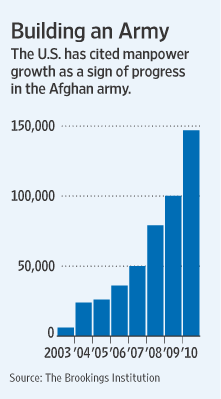
While the coalition's plans approved at a summit in Lisbon last month call for Afghan forces to assume responsibility throughout the country by end 2014, the only area where they already are in the lead is the capital, Kabul, and its surrounding districts.
Even here, Defense Minister Abdul Rahim Wardak said, the underequipped Afghan forces still heavily rely on the coalition for functions such as logistics, air support and bomb disposal...
The current Afghan army, which Mr. Wardak described as "lighter than light," has no tanks or APCs. The country's air force possesses 40 Russian-made helicopters and 12 transport or training planes...
New rifles give Army snipers in Afghanistan needed range
USA Today, Dec. 9
http://www.usatoday.com/news/military/2010-12-09-sniper09_ST_N.htm
The Army is shipping powerful new rifles to its snipers in Afghanistan to kill insurgents who are firing from greater distances and shooting at troops more frequently than in the early years of the war.
The XM2010 sniper rifle can hit a target 3,937 feet away, which is a quarter-mile farther than the current Army sniper rifle shoots.
The added distance is important because insurgents have been shooting down from ridges and mountaintops where gravity helps their bullets travel farther and beyond the range of Army snipers...
The Army's 2,500 snipers are to start receiving the XM2010 early next year, said Tamilio, who manages weapons programs for the Army. The M24 has been in service since 1988.
Among other improvements contained in the new sniper rifle are more powerful telescope and a device on the muzzle that dampens the noise and flash of a shot, helping to conceal the U.S. sniper...
More:
http://defense-update.com/wp/20101004_xm2010_m24.html

Mark
Ottawa

George Wallace
Army.ca Dinosaur
- Reaction score
- 257
- Points
- 910
Articles found December 9, 2010
Pakistan hospital hit by deadly bomb blast in Hangu
10 December 2010 Last updated at 08:03 ET
BBC News South Asia
Article Link
At least 10 people have been killed by a car bomb near a hospital in north-west Pakistan, say local officials.
Eighteen people were injured by the blast in the Shia Muslim-dominated Hangu district, Khyber Pakhtunkhwa province, according to police.
Investigators said the blast, which damaged the hospital building, was a sectarian attack.
It comes after the start of the Islamic holy month of Muharram, which is especially important for Shias.
English-language TV channel Express 24/7 reported that a suicide attacker had rammed an explosive-laden vehicle into the hospital.
"The bomber blew up his car at the hospital gate," local police chief Abdul Rashid told news agency AFP.
It would be the fourth major suicide attack this week in Pakistan.
On Monday, two bombers killed more than 40 people as they attacked anti-Taliban militia talks in Mohmand, in the north-western tribal belt.
On Tuesday, a suicide attacker failed in an attempt to assassinate the chief minister of Pakistan's south-western province of Balochistan.
On Wednesday, a bomber blew himself up near a minibus in the town of Kohat, not far from Hangu, killing at least 16 people.
More on LINK
Pakistan hospital hit by deadly bomb blast in Hangu
10 December 2010 Last updated at 08:03 ET
BBC News South Asia
Article Link
At least 10 people have been killed by a car bomb near a hospital in north-west Pakistan, say local officials.
Eighteen people were injured by the blast in the Shia Muslim-dominated Hangu district, Khyber Pakhtunkhwa province, according to police.
Investigators said the blast, which damaged the hospital building, was a sectarian attack.
It comes after the start of the Islamic holy month of Muharram, which is especially important for Shias.
English-language TV channel Express 24/7 reported that a suicide attacker had rammed an explosive-laden vehicle into the hospital.
"The bomber blew up his car at the hospital gate," local police chief Abdul Rashid told news agency AFP.
It would be the fourth major suicide attack this week in Pakistan.
On Monday, two bombers killed more than 40 people as they attacked anti-Taliban militia talks in Mohmand, in the north-western tribal belt.
On Tuesday, a suicide attacker failed in an attempt to assassinate the chief minister of Pakistan's south-western province of Balochistan.
On Wednesday, a bomber blew himself up near a minibus in the town of Kohat, not far from Hangu, killing at least 16 people.
More on LINK
Articles found December 10, 2010
Taliban appears caught off guard by NATO offensive in western Kandahar province
Article Link
By: Murray Brewster, The Canadian Press Posted: 9/12/2010
ZANGABAD, Afghanistan - NATO's offensive through restive western Kandahar this fall seems to have caught the Taliban off guard.
American and Canadian troops uncovered several large stockpiles of semi-prepared homemade bombs during their push into the area known as the horn of Panjwaii.
Many of the explosives were either very old or missing their power sources.
Maj. Pierre Leroux, the commander of Alpha Company from the 1st Battalion, Royal 22e Regiment, says it appears insurgents in the notorious Zangabad area simply up and left their compounds — perhaps in a hurry — when the initial U.S. assault wave hit.
"This push was a surprise for them," Leroux said in an interview Thursday with The Canadian Press. "They were probably expecting something last summer."
The offensive to clear the Taliban has unfolded in stages since the early summer, with different regions of the war-racked province cleared at different times.
The final phase, which is currently underway in western Panjwaii, has seen a combined force of Canadian, American and Afghan troops replace U.S. paratroopers, who stormed into the region in October.
Leroux said everything went quiet over the last few weeks and not all of it can be attributed to the onset of winter. He said he believes the insurgents have retreated to regroup.
They have faced only sporadic roadside bomb attacks since deploying earlier in the week.
"Right now, it's too calm," Leroux said. "It can't last. I think, at this moment, they're reorganizing."
Alpha company, along with Afghan army units, have started digging in at a former Taliban compound that once housed a madrassa. The walls inside the white concrete building, which was pitted with gunfire, are still scratched with Islamic sayings and slogans.
On Thursday, Master Cpl. Kyle Getchell of the 1st Combat Engineering Regiment was filling sand bags to cover the blown-out windows of the school.
More on link
Christmas cookies shipped to troops in Afghanistan
Article Link
Soldier 'jumped on' when cookie tin opened
Posted 1 day ago Petrolia Topic Staff
One hundred Canadian soldiers deployed in Afghanistan will get shortbread cookies made by Petrolia's Karen Wilson (aka the Cookie Lady) and her 'Baking Brigade,' in time for Christmas.
There are currently about 2,900 Canadian troops stationed abroad over the Christmas holiday season and many of them with the Joint Task Force in Kandahar have e-mailed Wilson to say thanks.
Among the most recent is one from Master-Cpl. Scott Atkinson, who said "...when the boys here in the Operations Centre saw I had your cookies, I was jumped on to get at them. They are well known to say the least. It's also a good bit of home to get things like this.
"This will be the second Christmas in three years I have spent here in Kandahar and it does feel good to get a little something."
Also sent from Kandahar, Capt. Lance Knox's e-mail to the Cookie Lady thanked her for "...both the wonderful treats and the warm support to the troops. Your cookies reminded me very much of my wife's treats and brought back some fond memories. Please thank all those who were involved in this process."
More on link
U.S. 101st Airborne Division taking heavy casualties in Afghanistan
Posted on 2010/12/10 by markosun
Article Link
The U.S. 101st Airborne Division (airmobile) with the famous nickname “The Sreaming Eagles” has arrived in Afghanistan in full force. The division is the last component of President Obama’s surge strategy in the war-torn south Asian nation. The 101st has seen intense action in the Afghan provinces of Kandahar, Kunar and Paktika. The last 2 mentioned provinces are in the northeast of the country straddling the Pakistani border. The area used to be Taliban country, but the fight is on for the territory.
Throughout 2010 and 2011, more than 20,000 Soldiers from Fort Campbell’s 101st Airborne Division will deploy to Afghanistan, the first time an entire Army division has deployed to Operation Enduring Freedom within one year. Just for the record, the total troop strength for the Canadian Land Force Command is 19,000. In effect, one U.S. airborne division has more combat troops than the whole Canadian Army.
The 101st arrived in Afghanistan in 2001 and took part in the major combat operation code-named Operation Anaconda. Canadian soldiers — specifically sniper teams— played an important role in that battle. •
More on link
Kandahar kingpins at odds with Canada over democracy: Wikileaks
By The Canadian Press November 29, 2010
Article Link
KANDAHAR, Afghanistan -- U.S. diplomats think some of the most powerful figures in Kandahar are not interested in democracy or the rule of law, and may have worked against attempts to deliver both to the Afghan people, according to Wikileaks documents.
It's one of the many claims arising from the unprecedented leak of U.S. diplomatic cables by the whistle-blower website which is causing shock waves around the world.
Canadian politicians, soldiers and aid workers agree that their mission to Afghanistan is to bring representative government and justice to a people who have long been crushed under the boots of the Soviets, local warlords or the Taliban. Yet, the classified cables released by Wikileaks noted that the younger half-brother of President Hamid Karzai advocated a return to the old tribal system of governance and law — something a majority of Afghans see as corrupt and a relic of the past.
Canada has invested heavily in the training of police, lawyers and judges. It has contributed funding for elections and set up programs to encourage good governance. Ahmed Wali Karzai, who is the kingpin of Kandahar politics as head of the provincial council, questioned the need for all of that in meetings with U.S. and Canadian civilian representatives.
"Democracy was new for Afghanistan, and that people in the region did not understand the point of having one election, let alone two," Ahmed Wali Karzai was quoted as saying in a cable dated Sept. 23, 2009. The diplomats quoted him as saying: "The people do not like change. They think, the president is alive, and everything is fine. Why have an election?" Karzai turned down a request for an interview Monday, as did Canada's civilian representative in Kandahar, Tim Martin.
More on link
Taliban appears caught off guard by NATO offensive in western Kandahar province
Article Link
By: Murray Brewster, The Canadian Press Posted: 9/12/2010
ZANGABAD, Afghanistan - NATO's offensive through restive western Kandahar this fall seems to have caught the Taliban off guard.
American and Canadian troops uncovered several large stockpiles of semi-prepared homemade bombs during their push into the area known as the horn of Panjwaii.
Many of the explosives were either very old or missing their power sources.
Maj. Pierre Leroux, the commander of Alpha Company from the 1st Battalion, Royal 22e Regiment, says it appears insurgents in the notorious Zangabad area simply up and left their compounds — perhaps in a hurry — when the initial U.S. assault wave hit.
"This push was a surprise for them," Leroux said in an interview Thursday with The Canadian Press. "They were probably expecting something last summer."
The offensive to clear the Taliban has unfolded in stages since the early summer, with different regions of the war-racked province cleared at different times.
The final phase, which is currently underway in western Panjwaii, has seen a combined force of Canadian, American and Afghan troops replace U.S. paratroopers, who stormed into the region in October.
Leroux said everything went quiet over the last few weeks and not all of it can be attributed to the onset of winter. He said he believes the insurgents have retreated to regroup.
They have faced only sporadic roadside bomb attacks since deploying earlier in the week.
"Right now, it's too calm," Leroux said. "It can't last. I think, at this moment, they're reorganizing."
Alpha company, along with Afghan army units, have started digging in at a former Taliban compound that once housed a madrassa. The walls inside the white concrete building, which was pitted with gunfire, are still scratched with Islamic sayings and slogans.
On Thursday, Master Cpl. Kyle Getchell of the 1st Combat Engineering Regiment was filling sand bags to cover the blown-out windows of the school.
More on link
Christmas cookies shipped to troops in Afghanistan
Article Link
Soldier 'jumped on' when cookie tin opened
Posted 1 day ago Petrolia Topic Staff
One hundred Canadian soldiers deployed in Afghanistan will get shortbread cookies made by Petrolia's Karen Wilson (aka the Cookie Lady) and her 'Baking Brigade,' in time for Christmas.
There are currently about 2,900 Canadian troops stationed abroad over the Christmas holiday season and many of them with the Joint Task Force in Kandahar have e-mailed Wilson to say thanks.
Among the most recent is one from Master-Cpl. Scott Atkinson, who said "...when the boys here in the Operations Centre saw I had your cookies, I was jumped on to get at them. They are well known to say the least. It's also a good bit of home to get things like this.
"This will be the second Christmas in three years I have spent here in Kandahar and it does feel good to get a little something."
Also sent from Kandahar, Capt. Lance Knox's e-mail to the Cookie Lady thanked her for "...both the wonderful treats and the warm support to the troops. Your cookies reminded me very much of my wife's treats and brought back some fond memories. Please thank all those who were involved in this process."
More on link
U.S. 101st Airborne Division taking heavy casualties in Afghanistan
Posted on 2010/12/10 by markosun
Article Link
The U.S. 101st Airborne Division (airmobile) with the famous nickname “The Sreaming Eagles” has arrived in Afghanistan in full force. The division is the last component of President Obama’s surge strategy in the war-torn south Asian nation. The 101st has seen intense action in the Afghan provinces of Kandahar, Kunar and Paktika. The last 2 mentioned provinces are in the northeast of the country straddling the Pakistani border. The area used to be Taliban country, but the fight is on for the territory.
Throughout 2010 and 2011, more than 20,000 Soldiers from Fort Campbell’s 101st Airborne Division will deploy to Afghanistan, the first time an entire Army division has deployed to Operation Enduring Freedom within one year. Just for the record, the total troop strength for the Canadian Land Force Command is 19,000. In effect, one U.S. airborne division has more combat troops than the whole Canadian Army.
The 101st arrived in Afghanistan in 2001 and took part in the major combat operation code-named Operation Anaconda. Canadian soldiers — specifically sniper teams— played an important role in that battle. •
More on link
Kandahar kingpins at odds with Canada over democracy: Wikileaks
By The Canadian Press November 29, 2010
Article Link
KANDAHAR, Afghanistan -- U.S. diplomats think some of the most powerful figures in Kandahar are not interested in democracy or the rule of law, and may have worked against attempts to deliver both to the Afghan people, according to Wikileaks documents.
It's one of the many claims arising from the unprecedented leak of U.S. diplomatic cables by the whistle-blower website which is causing shock waves around the world.
Canadian politicians, soldiers and aid workers agree that their mission to Afghanistan is to bring representative government and justice to a people who have long been crushed under the boots of the Soviets, local warlords or the Taliban. Yet, the classified cables released by Wikileaks noted that the younger half-brother of President Hamid Karzai advocated a return to the old tribal system of governance and law — something a majority of Afghans see as corrupt and a relic of the past.
Canada has invested heavily in the training of police, lawyers and judges. It has contributed funding for elections and set up programs to encourage good governance. Ahmed Wali Karzai, who is the kingpin of Kandahar politics as head of the provincial council, questioned the need for all of that in meetings with U.S. and Canadian civilian representatives.
"Democracy was new for Afghanistan, and that people in the region did not understand the point of having one election, let alone two," Ahmed Wali Karzai was quoted as saying in a cable dated Sept. 23, 2009. The diplomats quoted him as saying: "The people do not like change. They think, the president is alive, and everything is fine. Why have an election?" Karzai turned down a request for an interview Monday, as did Canada's civilian representative in Kandahar, Tim Martin.
More on link
- Reaction score
- 147
- Points
- 710
ARTICLES FOUND DEC. 11
Afghanistan: Progress -more needs to be done
Conference of Defence Associations' media round-up, Dec. 10
http://www.cdaforumcad.ca/cgi-bin/yabb2/YaBB.pl?num=1292005799/0#0
Afghanistan, Pakistan Get Bleak Intelligence Brief
AP, Dec. 11
http://www.foxnews.com/world/2010/12/11/afghanistan-pakistan-bleak-intelligence-brief/
Mark
Ottawa
Afghanistan: Progress -more needs to be done
Conference of Defence Associations' media round-up, Dec. 10
http://www.cdaforumcad.ca/cgi-bin/yabb2/YaBB.pl?num=1292005799/0#0
Afghanistan, Pakistan Get Bleak Intelligence Brief
AP, Dec. 11
http://www.foxnews.com/world/2010/12/11/afghanistan-pakistan-bleak-intelligence-brief/
WASHINGTON -- New U.S. intelligence reports paint a bleak picture of the security conditions in Afghanistan and say the war cannot be won unless Pakistan roots out militants on its side of the border, according to several U.S. officials who have been briefed on the findings.
The reports, one on Afghanistan, the other on Pakistan, could complicate the Obama administration's plans to report next week that the war is turning a corner. U.S. military commanders have challenged the new conclusions, however, saying they are based on outdated information that does not take into account progress made in recent months, says a senior U.S. official who is part of the review process.
The analyses were detailed in briefings to the Senate Intelligence Committee this week and some of the findings were shared with members of the House Intelligence Committee, officials said.
All the officials interviewed spoke on condition of anonymity to discuss the classified documents.
The reports, known as National Intelligence Estimates, are prepared by the Director of National Intelligence and used by policymakers as senior as the president to understand trends in a region. The new reports are the first ones done in two years on Afghanistan and six years on Pakistan, officials said. Neither the Director of National Intelligence nor the CIA would comment on either report...
In describing the Afghanistan report, military officials said there is a disconnect between the findings, completed in recent weeks, and separate battlefield assessments done by the war commander, Gen. David Petraeus, and others that contain more up-to-date and sometimes more promising accounts.
A military official familiar with the reports said the gloomier prognosis in the Afghanistan report became a source of friction as a preliminary version was passed among government agencies.
Marine Gen. James Cartwright, vice chairman of the Joint Chiefs of Staff, acknowledged the contrast between the Afghan estimate and Petraeus' reports.
"It's a very disciplined, structured process, so it's got a cutoff date that's substantially earlier in the game than, say, the military review," Cartwright said in a recent interview.
He said officials will have to grapple with whether intelligence and battlefield reports are starting to diverge or whether the gloomier intelligence analysis is "more an artifact of time. Those are the questions that we'll have to work our way through and either feel comfortable about or not feel comfortable about."..
Mark
Ottawa
- Reaction score
- 147
- Points
- 710
For U.S. Troops in Afghanistan, Coalition Forces Are Mixed Blessing
Time, Dec. 8
http://www.time.com/time/world/article/0,8599,2035859,00.html
Mark
Ottawa
Time, Dec. 8
http://www.time.com/time/world/article/0,8599,2035859,00.html
U.S. forces have long expected to do the heavy lifting on the NATO mission in Afghanistan, but even then, the Army battalion that arrived in Ghazni province last summer were troubled by what they found. The Taliban were resurgent in areas that U.S. forces had pacified before handing control to Polish forces a year earlier. “It was as if the [Polish] were waiting for us to come back and release them from their base” and then take the credit, says one U.S. officer, describing how failure to patrol the roads has allowed a route between coalition bases to become choked with roadside bombs. Americans had to return to take charge, he said, because the Poles are “just kind of hanging around.”
Such criticism is common among U.S. officers who have served in Afghanistan, and it is directed not only at Polish forces but also at other NATO forces, some of which are hamstrung by so-called caveats that range from prohibitions against fighting at night to traveling without an ambulance, thereby precluding foot patrols. The Polish force is not bound by any of these constraints, but U.S. officers say the Poles’ top-down approach to war-fighting is ill-suited to a counter-insurgency campaign that requires real-time decision-making by mid- and lower-level officers on the ground. They add that the Poles’ six-month deployments strain continuity, and that logistics snafus make them dependent on U.S. support…
Mark
Ottawa
- Reaction score
- 147
- Points
- 710
ARTICLES FOUND DEC. 12
Nawa turns into proving ground for U.S. strategy in Afghan war
Washington Post, Dec. 12 (long piece)
http://www.washingtonpost.com/wp-dyn/content/article/2010/12/11/AR2010121103041.html?wpisrc=nl_cuzhead&sid=ST2010121103059
Mark
Ottawa
Nawa turns into proving ground for U.S. strategy in Afghan war
Washington Post, Dec. 12 (long piece)
http://www.washingtonpost.com/wp-dyn/content/article/2010/12/11/AR2010121103041.html?wpisrc=nl_cuzhead&sid=ST2010121103059
IN NAWA, AFGHANISTAN When Gen. David H. Petraeus makes his case that the military's strategy in Afghanistan is succeeding, he cites the evolution of this community of mud-walled homes and wheat fields:
June 2009: In the throes of the Taliban. A few dozen British soldiers holed up inside a small base in the center of Nawa. Nightly gun and grenade fights. Schools and markets closed. Residents terrorized.
The following 17 months: A 1,000-strong surge battalion of U.S. Marines arrives July 2009. Focuses on protecting the civilian population. American and British advisers build local government. Tens of millions of dollars are pumped in to fund reconstruction projects.
Today: One of the safest districts in southern Afghanistan. Marines who live at former British base have not fired a single bullet while on foot patrol in the past five months. Classrooms packed. Bazaar thriving.
Spring 2011: Afghan forces assume principal responsibility for security. Marines provide emergency backup.
To Petraeus, the top U.S. and NATO commander in Afghanistan, what has occurred here validates his contention that a comprehensive counterinsurgency strategy can reverse Taliban momentum and stabilize Afghanistan after years of downward drift. In presentations to senior members of President Obama's national security team who are participating in an evaluation of the war, he has displayed a PowerPoint slide titled, "Nawa: Proof of COIN [counterinsurgency] Concept."
"We started achieving progress with security, then governance, and then citizen confidence - that's literally how it plays out," Petraeus said in a recent interview at his headquarters in Kabul. "It's the kind of progression we're trying to achieve in other areas."
It is undeniable that Nawa has undergone a remarkable transformation since the Marines swept in, and it represents what is possible in Afghanistan when everything comes together correctly. But five visits by this reporter since July 2009 suggest that the changes in this district are fragile and that much of what has transpired here is unique rather than universal.
"Nawa is not like the rest of Afghanistan," said district governor Abdul Manaf. "It is a great success because many things have happened here that have not happened in other places."
The ratio of troops, both American and Afghan, to the population is higher than in most places. The Afghan army battalion that is partnered with the Marine battalion here has greater experience than many other units in the area. And unlike the vast majority of districts, the contingents of Afghan soldiers and policemen are at full strength.
On the civilian side, Nawa is blessed with a far more harmonious relationship among its tribes than most other districts; Manaf is regarded by U.S. and Afghan officials as an unusually competent governor; and the U.S. Agency for International Development has poured in more money here, per capita, for reconstruction and short-term employment projects than any other part of the country.
Many civilian officials who track the war at the White House, the State Department and the CIA remain unconvinced that other parts of Afghanistan will turn around as quickly as Nawa has. They argue that weak local governance, tribal rivalries, inept development projects and incompetent Afghan security forces remain the norm.
Petraeus disagrees. He contends that many of the positive developments in Nawa - improved security, governance and development - can be replicated in the country's other insurgent-controlled districts.
But for those conducting the White House review, a central question is whether this place actually proves that counterinsurgency strategy can work across Afghanistan and end a conflict that has become the longest war in American history...
Mark
Ottawa
Articles found December 13, 2010
Afghan women’s teaching centre aims to offer safe haven
Article Link
By Doug Schmidt, Windsor Star December 12, 2010
KANDAHAR CITY, Afghanistan — As skilled craftsmen spread wet plaster over walls of fresh bricks and lay baked stone tiles on new bedroom floors, a Canadian-funded women’s dormitory at the Kandahar Teachers Training Centre is getting closer to being opened by March, in time for the start of the next Afghan school year.
In a place and at a time when just being a schoolgirl carries a risk of a beating or worse — girls have had acid splashed on their faces as they leave school in this country — the aim here is to attract more female student teachers by offering the city’s first opportunity to study without having to negotiate Kandahar’s often dangerous streets to get to classes.
Bibi-Sadia, 22, says she can’t wait to resume her teacher studies.
Hungry for further education after completing high school in neighbouring Helmand province, Bibi-Sadia first went to Kandahar University, the only such institution in the country’s south, to study to become a doctor. With no dorms for female students, and the main campus located in the remote outskirts of this sprawling city, she didn’t stay long.
“I realized then, why not become a good teacher?” she told Postmedia News through an interpreter.
But not one of Kandahar’s nearly 40 teacher colleges offers campus accommodation for women. Undeterred, Bibi-Sadia found a place with relatives in the city and began studies a year ago. The situation, however, with the daily skulking through city streets to get to school, soon became “hopeless,” she said, and she returned home again.
More on link
We're humble -- not inferior
Article Link
Ottawa Citizen December 13, 2010
Re: U.S. cables dwell on 'inferiority complex,' Dec. 2.
In my experience, the only Canadians who seem to have an inferiority complex are those media personalities who apparently compare their relative obscurity to their American cousins. Americans seem to love hero worship and tend to make heroes out of anyone. Their television news readers earn millions of dollars and become famous for being famous. That is certainly not the case in Canada.
The word I would use to describe most Canadians I know is "humble."
Humility, when contrasted with the sort of bombastic pretentiousness that goes along with cults based on fame alone, is not very sexy. Canadian arts and sciences have had a disproportionate influence on the United States. It has, by no means, been a one-way street. Indeed, the silly attempts to toot our own horn with media-stoked flag-waving come across as disingenuous precisely because the American way of being boastful is not in keeping with the simple security of a mature humility. What gives us confidence is our balanced humility, not a myth-based pride based on smoke and mirrors.
Canadians, by and large, do not jump on bandwagons but tend to think for themselves. Canadians do expect their governments to behave reasonably and for the common wealth of all. When any arm of our government acts outside the law, we are shocked and outraged precisely because we do not believe the sovereign is above the law, or free to make laws that do not represent the will of the majority. Our prime minister of the time stood against the invasion of Iraq, not to annoy the Americans who were being led off a cliff by their military-industrial complex, but simply because there were no reasonable grounds to invade Iraq. We did send troops to Afghanistan because that is where Bin Laden and al-Qaeda were known to be.
More on link
Canadian Taxpayers Now Buying Mafia Style Protection in Afghanistan
Article Link
Sunday, December 12, 2010
If propping up a corrupt government in Afghanistan wasn't enough shame for Canadians, we now learn that what we have helped to create in that country, is something resembling the Mafia underworld, far worse than anything we could have imagined.
The Borgata
The Borgata is a Mafia "family", with an established hierarchy, a body of foot soldiers and associates, all ensuring the smooth running of their operations.
The Godfather of the Afghan Borgata, is Hamid Karzai, the questionably elected President of Afghanistan. His underboss is his own brother, Ahmed Wali, who is engaged in a variety of criminal activities from drug running to featherbedding, and is thought to be one of the most powerful men in the country.
He is also the man given a 50 million dollar contract to provide security for Canada's signature project, the Dahla Dam, through his "business", the Watan Group.
More on link
NATO targets Kandahar assassin squads
Article Link
Murray Brewster The Canadian Press
KANDAHAR, AFGHANISTAN—NATO has given itself a licence to kill those who are murdering government workers in Kandahar, but the mayor of this embattled city says those lurking under the assassin’s masks are not all Taliban.
The general commanding Canadian troops in the war-wasted region calls hunting down insurgent assassination squads “an absolute focus.”
“I have some very capable intelligence resources linked in with the Americans, linked in with the international community; (and) we have these guys on the run,” said Brig.-Gen. Dean Milner in a recent interview with The Canadian Press. “We are targeting these guys nightly. We’re going after them.”
American and other NATO commanders have long been frustrated by the wave of assassinations that’s gripped Kandahar over the past few years.
Two deputy mayors — or emirs — were murdered this year, crimes that brought about a spate of mass resignations by municipal employees.
Since 2004, at least 300 tribal elders, moderate mullahs, advisers and government employees have been shot or blown up by roadside bombs.
More on link
Obama’s gamble in Afghanistan ‘paying off’
PAUL KORING WASHINGTON— From Monday's Globe and Mail Sunday, Dec. 12, 2010
Article Link
Barack Obama’s high-risk war wager that sent tens of thousands of U.S. troops surging into Afghanistan is showing signs of success, U.S. officials say. The raging Taliban insurgency is being defeated, but foreign troops are still years away from heading for the exit.
“Our joint efforts are paying off,” said Robert Gates, U.S. Secretary of Defence and the only cabinet secretary kept on by Mr. Obama from the former Bush administration. “[I’m] convinced that our strategy is working and that we will be able to achieve key goals set out by President Barack Obama last year.”
More on link
$52bn of American aid and still Afghans are dying of starvation
Article Link
Patrick Cockburn reports from Kabul on the rampant corruption that has left the country on its knees
Monday, 13 December 2010
The most extraordinary failure of the US-led coalition in Afghanistan is that the expenditure of tens of billions of dollars has had so little impact on the misery in which 30 million Afghans live. As President Barack Obama prepares this week to present a review of America's strategy in Afghanistan which is likely to focus on military progress, US officials, Afghan administrators, businessmen and aid workers insist that corruption is the greatest threat to the country's future.
In a series of interviews, they paint a picture of a country where $52bn (£33bn) in US aid since 2001 has made almost no impression on devastating poverty made worse by spreading violence and an economy dislocated by war. That enormous aid budget, two-thirds for security and one-third for economic, social and political development, has made little impact on 9 million living in absolute poverty, and another 5 million trying to survive on $43 (£27) a month. The remainder of the population often barely scrapes a living, having to choose between buying wood to keep warm and buying food.
Afghans see a racketeering élite as the main beneficiaries of international support and few of them are optimistic about anything changing. "Things look all right to foreigners but in fact people are dying of starvation in Kabul," says Abdul Qudus, a man in his forties with a deeply lined face, who sells second-hand clothes and shoes on a street corner in the capital. They are little more than rags, lying on display on the half-frozen mud.
More on link
Afghan Lawmakers Demand Karzai Inaugurate New Parliament
December 13, 2010
Article Link
Around 100 Afghan lawmakers today demanded that President Hamid Karzai inaugurate a new parliament by December 19, despite continuing disputes over the results of a fraud-marred election.
Afghanistan has effectively been without a parliament since the disputed September 18 vote.
There have been reports over the weekend of the attorney general's office asking the country's top court to annul the results, but the group of lawmakers today said neither body has the authority to "interfere in the election process."
The top prosecutor, a close ally of the president, says he wants to investigate the Independent Election Commission, alleging that its members were bribed.
The IEC threw out some 1.3 of 5.6 million votes cast and disqualified 24 early winners who between them took around 10 percent of seats in the 249-member parliament.
More on link
Afghan women’s teaching centre aims to offer safe haven
Article Link
By Doug Schmidt, Windsor Star December 12, 2010
KANDAHAR CITY, Afghanistan — As skilled craftsmen spread wet plaster over walls of fresh bricks and lay baked stone tiles on new bedroom floors, a Canadian-funded women’s dormitory at the Kandahar Teachers Training Centre is getting closer to being opened by March, in time for the start of the next Afghan school year.
In a place and at a time when just being a schoolgirl carries a risk of a beating or worse — girls have had acid splashed on their faces as they leave school in this country — the aim here is to attract more female student teachers by offering the city’s first opportunity to study without having to negotiate Kandahar’s often dangerous streets to get to classes.
Bibi-Sadia, 22, says she can’t wait to resume her teacher studies.
Hungry for further education after completing high school in neighbouring Helmand province, Bibi-Sadia first went to Kandahar University, the only such institution in the country’s south, to study to become a doctor. With no dorms for female students, and the main campus located in the remote outskirts of this sprawling city, she didn’t stay long.
“I realized then, why not become a good teacher?” she told Postmedia News through an interpreter.
But not one of Kandahar’s nearly 40 teacher colleges offers campus accommodation for women. Undeterred, Bibi-Sadia found a place with relatives in the city and began studies a year ago. The situation, however, with the daily skulking through city streets to get to school, soon became “hopeless,” she said, and she returned home again.
More on link
We're humble -- not inferior
Article Link
Ottawa Citizen December 13, 2010
Re: U.S. cables dwell on 'inferiority complex,' Dec. 2.
In my experience, the only Canadians who seem to have an inferiority complex are those media personalities who apparently compare their relative obscurity to their American cousins. Americans seem to love hero worship and tend to make heroes out of anyone. Their television news readers earn millions of dollars and become famous for being famous. That is certainly not the case in Canada.
The word I would use to describe most Canadians I know is "humble."
Humility, when contrasted with the sort of bombastic pretentiousness that goes along with cults based on fame alone, is not very sexy. Canadian arts and sciences have had a disproportionate influence on the United States. It has, by no means, been a one-way street. Indeed, the silly attempts to toot our own horn with media-stoked flag-waving come across as disingenuous precisely because the American way of being boastful is not in keeping with the simple security of a mature humility. What gives us confidence is our balanced humility, not a myth-based pride based on smoke and mirrors.
Canadians, by and large, do not jump on bandwagons but tend to think for themselves. Canadians do expect their governments to behave reasonably and for the common wealth of all. When any arm of our government acts outside the law, we are shocked and outraged precisely because we do not believe the sovereign is above the law, or free to make laws that do not represent the will of the majority. Our prime minister of the time stood against the invasion of Iraq, not to annoy the Americans who were being led off a cliff by their military-industrial complex, but simply because there were no reasonable grounds to invade Iraq. We did send troops to Afghanistan because that is where Bin Laden and al-Qaeda were known to be.
More on link
Canadian Taxpayers Now Buying Mafia Style Protection in Afghanistan
Article Link
Sunday, December 12, 2010
If propping up a corrupt government in Afghanistan wasn't enough shame for Canadians, we now learn that what we have helped to create in that country, is something resembling the Mafia underworld, far worse than anything we could have imagined.
The Borgata
The Borgata is a Mafia "family", with an established hierarchy, a body of foot soldiers and associates, all ensuring the smooth running of their operations.
The Godfather of the Afghan Borgata, is Hamid Karzai, the questionably elected President of Afghanistan. His underboss is his own brother, Ahmed Wali, who is engaged in a variety of criminal activities from drug running to featherbedding, and is thought to be one of the most powerful men in the country.
He is also the man given a 50 million dollar contract to provide security for Canada's signature project, the Dahla Dam, through his "business", the Watan Group.
More on link
NATO targets Kandahar assassin squads
Article Link
Murray Brewster The Canadian Press
KANDAHAR, AFGHANISTAN—NATO has given itself a licence to kill those who are murdering government workers in Kandahar, but the mayor of this embattled city says those lurking under the assassin’s masks are not all Taliban.
The general commanding Canadian troops in the war-wasted region calls hunting down insurgent assassination squads “an absolute focus.”
“I have some very capable intelligence resources linked in with the Americans, linked in with the international community; (and) we have these guys on the run,” said Brig.-Gen. Dean Milner in a recent interview with The Canadian Press. “We are targeting these guys nightly. We’re going after them.”
American and other NATO commanders have long been frustrated by the wave of assassinations that’s gripped Kandahar over the past few years.
Two deputy mayors — or emirs — were murdered this year, crimes that brought about a spate of mass resignations by municipal employees.
Since 2004, at least 300 tribal elders, moderate mullahs, advisers and government employees have been shot or blown up by roadside bombs.
More on link
Obama’s gamble in Afghanistan ‘paying off’
PAUL KORING WASHINGTON— From Monday's Globe and Mail Sunday, Dec. 12, 2010
Article Link
Barack Obama’s high-risk war wager that sent tens of thousands of U.S. troops surging into Afghanistan is showing signs of success, U.S. officials say. The raging Taliban insurgency is being defeated, but foreign troops are still years away from heading for the exit.
“Our joint efforts are paying off,” said Robert Gates, U.S. Secretary of Defence and the only cabinet secretary kept on by Mr. Obama from the former Bush administration. “[I’m] convinced that our strategy is working and that we will be able to achieve key goals set out by President Barack Obama last year.”
More on link
$52bn of American aid and still Afghans are dying of starvation
Article Link
Patrick Cockburn reports from Kabul on the rampant corruption that has left the country on its knees
Monday, 13 December 2010
The most extraordinary failure of the US-led coalition in Afghanistan is that the expenditure of tens of billions of dollars has had so little impact on the misery in which 30 million Afghans live. As President Barack Obama prepares this week to present a review of America's strategy in Afghanistan which is likely to focus on military progress, US officials, Afghan administrators, businessmen and aid workers insist that corruption is the greatest threat to the country's future.
In a series of interviews, they paint a picture of a country where $52bn (£33bn) in US aid since 2001 has made almost no impression on devastating poverty made worse by spreading violence and an economy dislocated by war. That enormous aid budget, two-thirds for security and one-third for economic, social and political development, has made little impact on 9 million living in absolute poverty, and another 5 million trying to survive on $43 (£27) a month. The remainder of the population often barely scrapes a living, having to choose between buying wood to keep warm and buying food.
Afghans see a racketeering élite as the main beneficiaries of international support and few of them are optimistic about anything changing. "Things look all right to foreigners but in fact people are dying of starvation in Kabul," says Abdul Qudus, a man in his forties with a deeply lined face, who sells second-hand clothes and shoes on a street corner in the capital. They are little more than rags, lying on display on the half-frozen mud.
More on link
Afghan Lawmakers Demand Karzai Inaugurate New Parliament
December 13, 2010
Article Link
Around 100 Afghan lawmakers today demanded that President Hamid Karzai inaugurate a new parliament by December 19, despite continuing disputes over the results of a fraud-marred election.
Afghanistan has effectively been without a parliament since the disputed September 18 vote.
There have been reports over the weekend of the attorney general's office asking the country's top court to annul the results, but the group of lawmakers today said neither body has the authority to "interfere in the election process."
The top prosecutor, a close ally of the president, says he wants to investigate the Independent Election Commission, alleging that its members were bribed.
The IEC threw out some 1.3 of 5.6 million votes cast and disqualified 24 early winners who between them took around 10 percent of seats in the 249-member parliament.
More on link
- Reaction score
- 147
- Points
- 710
AWACS for Afghanistan
Germany May Refuse NATO Request for Help
Spiegel Online, Dec. 13
http://www.spiegel.de/international/germany/0,1518,734279,00.html#ref=nlint
Mark
Ottawa
Germany May Refuse NATO Request for Help
Spiegel Online, Dec. 13
http://www.spiegel.de/international/germany/0,1518,734279,00.html#ref=nlint
NATO has called on Berlin to contribute up to 100 personnel to a planned international deployment of AWACS reconnaissance aircraft over Afghanistan. Berlin looks set to refuse the request because the mission would probably require a parliamentary mandate, for which it would be hard to muster support.
US General David Petraeus, the top military commander of NATO forces in Afghanistan, has requested German assistance in the aerial surveillance of Afghanistan's airspace with AWACS reconnaissance aircraft.
He wants to up to 100 German military personnel to join a new NATO mission of AWACS planes next year. Up until now, US forces have provided AWACS reconnaissance to monitor Afghanistan's increasingly busy airspace. AWACS is an acronym for Airborne Early Warning and Control System.
The country still doesn't have a comprehensive radar system to regulate civilian air traffic. That is leading to delays and congestion, which is why the NATO planes are urgently needed [emphasis added].
The German government had tried to stop the US from making the request in recent weeks in order to avoid the embarrassment of refusing it. Berlin fears it will be difficult to muster the necessary German political support for the mission, which may require a new parliamentary mandate.
Germany has the third largest presence in Afghanistan after the United States and Britain. In February, the German parliament approved a new mandate that increased the troop ceiling by 850 to 5,350 soldiers.
http://www.spiegel.de/international/world/0,1518,674116,00.html
The mission is deeply unpopular in Germany, as it is in most of the other nations with troops in Afghanistan.
German Refusal Would Put AWACS Mission at Risk
German officials had tried to deflect the request by arguing that all its military personnel in Afghanistan were needed to help train Afghan security forces. Germany's refusal could put the entire NATO AWACS mission at risk.
NATO's multinational AWACS force is based in Geilenkirchen, Germany, and German personnel make up about a third of staff. The US and Britain have already offered to contribute staff for the NATO mission. The planes are unarmed and each is capable of monitoring an area of more than 300,000 square kilometers -- about the size of Poland...
Mark
Ottawa
Similar threads


- Replies
- 56
- Views
- 5K


- Replies
- 3
- Views
- 1K


