• Thanks for stopping by. Logging in to a registered account will remove all generic ads. Please reach out with any questions or concerns.

Trump administration 2024-2028

Welcome to the latest iteration of the Counter Revolution...

Trump’s Conservative Counterrevolution​

It’s being waged on more fronts than Reagan’s.

Donald Trump’s presidency is the latest political phase in a decades-long cultural and political counterrevolution. In some respects, it mirrors the capture of the national Republican Party by the insurgent conservative movement that formed in response to the New Deal and Democratic foreign policy after the Second World War and that reached its zenith in the presidency of Ronald Reagan. At the time of Reagan’s political triumph, some observers called it the “Reagan Revolution.” But the Reagan Revolution then, like Trump’s populist agenda today, was really a counterrevolution that first gained control of a Republican Party and that until then had refused to do battle against the administrative state formed by the New Deal and the Great Society and refused to seek victory in the Cold War.

The Reagan counterrevolution began in the aftermath of the Second World War. It started as intellectual-philosophical opposition to the exponential growth of the federal bureaucracy, as advocated by F. A. Hayek in The Road to Serfdom, and criticism of the Democratic Party’s defensive policy of containment most compellingly presented by James Burnham in The Struggle for the World, The Coming Defeat of Communism, and Containment or Liberation? Perhaps the postwar counterrevolutionary movement’s most important and influential book was Whittaker Chambers’s Witness, which argued that the most fundamental question was whether the United States would descend into a secular nightmare at the altar of reason or recognize that God was the center of the universe.

Early conservative magazines such as Isaac Don Levine’s Plain Talk, William Bradford Huie’s American Mercury, and John Chamberlain’s Freeman sparked the nascent conservative counterrevolutionary movement in the late 1940s and early 1950s, paving the way for the movement’s flagship journal, William F. Buckley Jr.’s National Review, where Henry Hazlitt, among others, promoted free markets, free enterprise, and smaller government, and James Burnham presented a strategy for winning the Cold War.

 
The author is discounting the possibility (probability) of them losing control of government, and a mutiny within the Republican party in 2028.
 
The author is discounting the possibility (probability) of them losing control of government, and a mutiny within the Republican party in 2028.

I liked how he went back to the 'New Deal' to explain the emergence of an undercurrent of conservative reaction.

My guess is that it will outlive Trump as he is just another in a long line of 'front men' ...
 
I love the FA stage


Changes that align with the Trump administration’s national agenda have come to agencies that regulate food in the United States.

The US Department of Agriculture (USDA) and the US Food and Drug Administration (FDA) have made staff cuts identified by the Department of Government Efficiency (DOGE), which is tasked with eliminating “waste, fraud and abuse” in government agencies in order to drive efficiencies and reduce government spending. At USDA, 16,000 employees accepted the agency’s “deferred resignation” offers, while a reported 30,000 positions were to be eliminated. Office closures and relocations also are part of the downsizing effort.

“I welcome DOGE’s efforts at USDA because we know that its work makes us better, stronger, faster and more efficient,” said Agriculture Secretary Brooke Rollins in February. “I will expect full access and transparency to DOGE in the days and weeks to come.”

At FDA, the Health and Human Services Department terminated 3,500 employees on April 1. Included in the reductions were scientists who tested products for adulteration and communications staff tasked with informing consumers about health risks and new products.

Both agencies asked certain professionals to return to work after finding their roles essential to protecting public health. Meanwhile, shifts in policy followed restructuring of the workforces of both USDA and FDA.

Crashing headfirst into the FO stage.


There have been about 7,400 cases of foodborne illness associated with outbreaks so far this year, according to data from the FDA and the US Centers for Disease Control and Prevention. That’s nearly five times higher than the annual average of about 1,500 cases between 2021 and 2025.


Ah yes, the thrill of deregulation.
 

PANAMA CITY, Aug 13 (Reuters) - The U.S. military has enough assets to maintain a naval blockade of Iran indefinitely, Defense Secretary Pete Hegseth said on Thursday, adding ships could be rotated in and out of the region as needed.
Hegseth's comments suggest he is advising U.S. President Donald Trump that the ‌U.S. military can keep applying economic pressure on Iran for as long as needed to help so-far failed negotiations to end the conflict, begun in February.


"Indefinitely the United States Navy can maintain a blockade like that because we'll rotate ships in and out, as we have, and we'll continue to," Hegseth told reporters.
He spoke in Panama after addressing the crew aboard the USS Gridley, a guided-missile destroyer, which had previously deployed to the Middle East.
Again, this is after reports of US sailors trying to jump off of ships.


Also, from June 2025, what a long time ago that seems now...


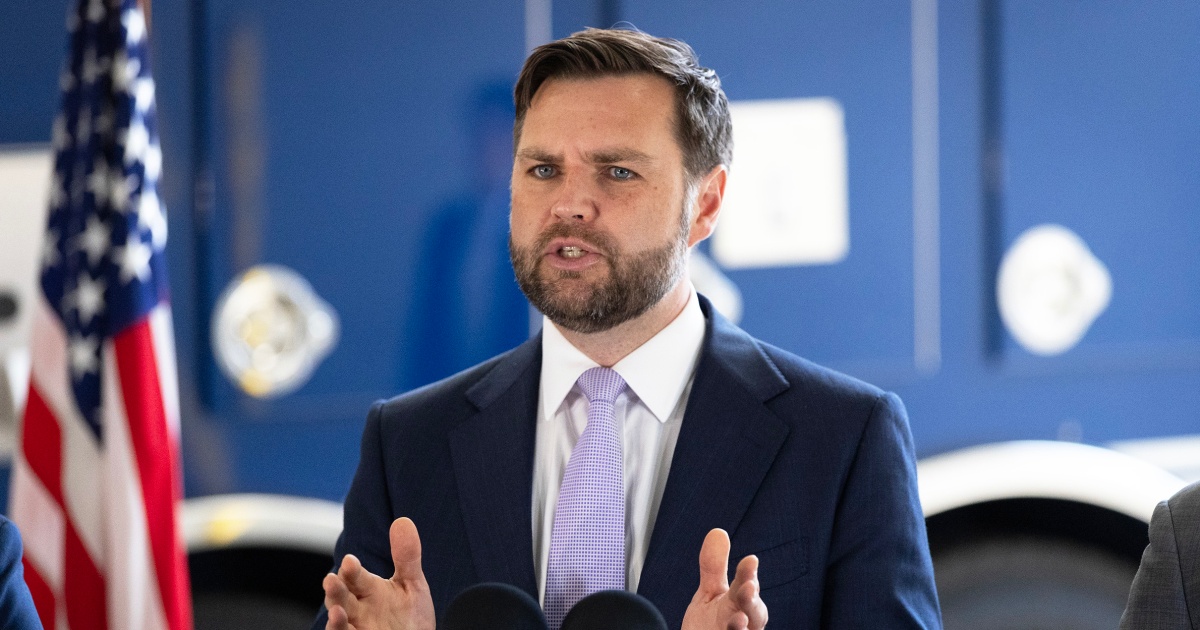
“I certainly empathize with Americans who are exhausted after 25 years of foreign entanglements in the Middle East,” Vance said on “Meet the Press.” “I understand the concern, but the difference is that back then, we had dumb presidents, and now we have a president who actually knows how to accomplish America’s national security objectives.”

A clash with Iran, Vance added, “is not going to be some long, drawn-out thing. We’ve got in, we’ve done the job of setting their nuclear program back. We’re going to now work to permanently dismantle that nuclear program over the coming years, and that is what the president has set out to do. Simple principle: Iran can’t have a nuclear weapon.”

That really aged like milk.
 
Back
Top