• Thanks for stopping by. Logging in to a registered account will remove all generic ads. Please reach out with any questions or concerns.

Trump administration 2024-2028

So... Canada is destroying itself by letting millions into the country.

The only way for millions of people to enter a country is over a land border.

Han Island is uninhabited.

Therefore, Canada has a problem with its land neighbour having a lack of border control.


So... Canada is destroying itself by letting millions into the country.

The only way for millions of people to enter a country is over a land border.

Han Island is uninhabited.

Therefore, Canada has a problem with its land neighbour having a lack of border control.


You're reaching. You know as well as I do most fly into the country.

I agree with closed immigration, with exceptions made for specific occupations; and deportations.
 
So... Canada is destroying itself by letting millions into the country.

The only way for millions of people to enter a country is over a land border.

Han Island is uninhabited.

Therefore, Canada has a problem with its land neighbour having a lack of border control.


And, of course, the stats indicate otherwise:

Canada's population growth continues to slow​

The population of Canada reached an estimated 41,798,407 people on July 1, 2026, an increase of 189,425 people (+0.5%) from July 1, 2025. This is the lowest annual July-to-July (or June to June before 1946) growth in the total size of the population since 1944/1945 (+126,000; +1.0%) and the lowest growth in percentage since 1915/1916 (+20,000; +0.3%). The July-to-July growth in 2025/2026 is lower than the annual growth from July 1, 2020, to July 1, 2021 (+211,226; +0.6%), which included border restrictions in place to slow the spread of COVID-19.

From April 1, 2026, to July 1, 2026, the population of Canada increased by 80,343 people (+0.2%). This was the lowest growth in a second quarter since the second quarter of 2020 (+21,697; +0.1%), right at the start of the COVID-19 pandemic. The rapid changes in the population growth rate since 2020 are almost entirely attributable to changes in international migration.

Changing international migration trends have also resulted in the median and average ages in Canada increasing over the past two years. An aging population had been the typical pattern in the past, but very high international migration levels from 2021/2022 to 2024/2025 resulted in either decreases or stabilization of the average and median ages. Canada's population is aging once again—the median age was 40.9 years on July 1, 2026, and the average age was 42.1 years.

 
Low population growth for a brief time so we can catch up on policy and infrastructure is good and necessary, but we’re gonna need to get back to more robust population growth sooner rather than later for all the normal economic reasons. There needs to be a solid, multi-layered plan for that, fed led with as much provincial buy-in as can reasonably be achieved.
 
Low population growth for a brief time so we can catch up on policy and infrastructure is good and necessary, but we’re gonna need to get back to more robust population growth sooner rather than later for all the normal economic reasons. There needs to be a solid, multi-layered plan for that, fed led with as much provincial buy-in as can reasonably be achieved.

I agree.

Give major financial breaks for having kids. Multiply those breaks for every kid.

Target your immigration on professional sectors we need. Target it only to working aged people, with no health complications.
 
Figure out why so many successful people around the world want to go to the US. Emulate that to the best of our ability. This is radical, I know, because it would mean rethinking our economic policies.
 
I agree.

Give major financial breaks for having kids. Multiply those breaks for every kid.

Target your immigration on professional sectors we need. Target it only to working aged people, with no health complications.
You need to tie this policy to some form of contributing to society though, not just encouraging more single parent baby factories.

Pay more to individuals who are working and raising a family. Make incentives to those who own family businesses where the children are part of the business (be it farming, fishing, small business owners, etc). I was going to say make it means based, but logically, you want to incentivize all families to increase the birth rate, not just the poor.

Maybe also make it attractive to have one stay at home parent or caregiver (such as a grandparent).
 
You need to tie this policy to some form of contributing to society though, not just encouraging more single parent baby factories.

Pay more to individuals who are working and raising a family. Make incentives to those who own family businesses where the children are part of the business (be it farming, fishing, small business owners, etc). I was going to say make it means based, but logically, you want to incentivize all families to increase the birth rate, not just the poor.

Maybe also make it attractive to have one stay at home parent or caregiver (such as a grandparent).

Solid points. I don't have a perfect answer, just an opinion on the direction I'd like to see us go. I agree, If we're going to use public policy to encourage larger families, it should reward both raising children and contributing to society through work, business ownership, or caregiving. I'd rather see incentives that strengthen stable family formation, make it easier to raise children, and recognize the value of parents or grandparents who provide care. The goal shouldn't be simply more births, but more families that have the support and stability needed to succeed.
 
Low population growth for a brief time so we can catch up on policy and infrastructure is good and necessary, but we’re gonna need to get back to more robust population growth sooner rather than later for all the normal economic reasons. There needs to be a solid, multi-layered plan for that, fed led with as much provincial buy-in as can reasonably be achieved.
Qualified individuals able to 'add economic value' to Canada when they hit the ground running. We do not need 'parental/grandparent reunification.' That creates an undo burden on our federal/provincial finances and our health care systems.
 
Low population growth for a brief time so we can catch up on policy and infrastructure is good and necessary, but we’re gonna need to get back to more robust population growth sooner rather than later for all the normal economic reasons. There needs to be a solid, multi-layered plan for that, fed led with as much provincial buy-in as can reasonably be achieved.

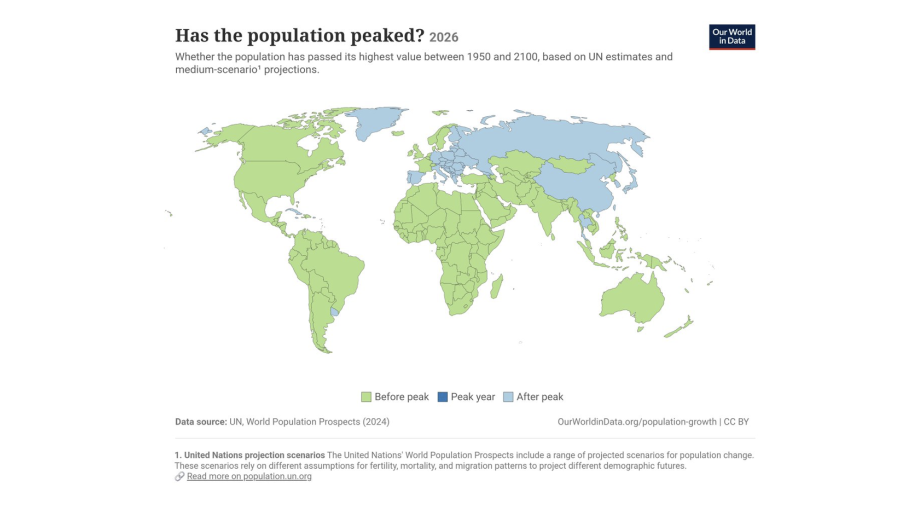
Looks like the 'doomsayers' predicting planetary destruction due to overpopulation will be disappointed ;)


Global fertility rates fall below the replacement rate for the first time​


The global fertility rate has fallen below the replacement rate for the first time as a Demographic Crisis gathers momentum that will see the world’s popoulation shrink in size from here.

A new paper called "Terra Incognita: The Economics of a Shrinking World" by Jesus Fernandez-Villaverde of the University of Pennsylvania and Patrick Norrick of Northwestern University, prepared for the Annual Review of Economics and circulated this month, concluded: "As of 2026, humanity is likely below replacement fertility. That has never happened before, not in wars or pandemics."

The replacement rate is usually quoted as 2.1 births per woman, which is the figure for a rich country with low child mortality; globally, the authors put it nearer 2.20 to take into account the higher mortality rates in poor countries - and the world's own fertility rate is now at roughly that level. The UN's central projection still has the crossing two decades away.

If Fernandez-Villaverde and Norrick are right, world population peaks at about 9bn around 2056 and then falls, "first slowly, then fast". The UN's medium variant has it rising to about 10.3bn into the mid-2080s. That is not a rounding difference; it is thirty years and 1.3bn people, and it is the difference between a problem for someone else's career and a problem for this one.

 
Solid points. I don't have a perfect answer, just an opinion on the direction I'd like to see us go. I agree, If we're going to use public policy to encourage larger families, it should reward both raising children and contributing to society through work, business ownership, or caregiving. I'd rather see incentives that strengthen stable family formation, make it easier to raise children, and recognize the value of parents or grandparents who provide care. The goal shouldn't be simply more births, but more families that have the support and stability needed to succeed.
Some initial thoughts:
1. If the federal government is helping to subsidized licensed daycares for $10/day rates then what about stay at home guardians? Was doing some rough math here and if it's $20/hr per workerx8 kids supervised x8 hours a day it's more like $30 not accounted for (rough math of $20/kid x1.5 for employer taxes +1/3 cost for overhead). Make it even $10/day claimed in lieu and it helps especially if multiple kids involved.
2. Allow school supplies to be deducted per kid to X amount. It cost $250 for ours this year despite recycling leftovers from last year. Adds up fast
3. Allow team enrollment costs (at basic house league rates only...not elite academy) for every sport and/or community group involved. Eligible to all family members regardless of age on the basis of healthy active folks = lower health care costs long term.
4. I need to double check things but I was told years ago a self employed person doesn't qualify for EI benefits despite being required to pay them. Want to say this has changed for some situations such as maternity leave but would be an area to examine so it involves.
5. Disability allowance - Alberta allows between $1740-1940/month for eligible people. Instead of paying direct maybe look at options for caregiver assistance at reduced rates. The benefits work out to $87/day based upon 20 working days/month so take a lump sum number per day that a person could assign credits too. For example if I have a disabled child do I get $20 disability allowance for that child which can be claimed or reassigned to a grandparent/uncle/family friend if they look after the child for a week? while the parent has a break.

Few more I need to think about more...I hate tax breaks as a principal as it would indicate I paid too much up front...and/or the CRA makes it very manpower intensive to claim. Would prefer something more like some European countries where tax items like your T4 are uploaded to the government and you then get a completed tax return you validate or correct if errors/missing information. Counter balance to this is many organizations I'd donate a few bucks to but they don't need all my identification like SIN etc.
 
Figure out why so many successful people around the world want to go to the US. Emulate that to the best of our ability. This is radical, I know, because it would mean rethinking our economic policies.
The American Dream.

The problem is it is generally an illusion, as our economy isn’t sustainable, and private and public debt is insane.


Don’t get me wrong, there are many many great things about America but both the DNC and RNC are ruining it as quick as they can.
 
The American Dream.

The problem is it is generally an illusion, as our economy isn’t sustainable, and private and public debt is insane.


Don’t get me wrong, there are many many great things about America but both the DNC and RNC are ruining it as quick as they can.
For my 2cents, things peaked throughout the 90s and then began swirling the toilet bowl.
 
For my 2cents, things peaked throughout the 90s and then began swirling the toilet bowl.
Addendum:

I often wonder wonder what things would have been like if Bush the Younger didn't go into Iraq at all. Sole focus on Afghanistan only.

Would the Syria Civil War have occurred? Would ISIS have occurred? So many variables and so many unknowns.

US would have saved in direct and indirect costs over 3$ Trillion dollars and tens of thousands may still be alive today, including roughly 5k US and Allied soldiers.
 
Back
Top