• Thanks for stopping by. Logging in to a registered account will remove all generic ads. Please reach out with any questions or concerns.

U.S. Replaces Commander in Afghanistan in War Overhaul

GAP

Army.ca Legend
Donor
Mentor
Fallen Comrade
Reaction score
24
Points
380
U.S. Replaces Commander in Afghanistan in War Overhaul
By ELISABETH BUMILLER Published: May 11, 2009
Article Link

WASHINGTON — The Pentagon is replacing the top American commander in Afghanistan, Gen. David McKiernan, less than a year after he took over, marking a major overhaul in military leadership of a war that has presented President Obama with a worsening national security challenge.

Defense officials said that General McKiernan was removed because of what they described as a conventional approach to what has become one of the most complicated military challenges in American history. He is to be replaced by Lt. Gen. Stanley A. McChrystal, a former commander of the Joint Special Operations Command who recently ran all special operations in Iraq.

The decision reflects a belief that the war in Afghanistan has grown so complex that it needs a commander drawn from the military’s unconventional warfare branch.

“Our mission there requires new thinking and new approaches by our military leaders,” said Defense Secretary Robert M. Gates at a news conference this afternoon announcing General McKiernan’s dismissal.

Mr. Gates and Adm. Mike Mullen, the chairman of the Joint Chiefs of Staff, offered few reasons for General McKiernan’s ouster beyond generalities that “fresh eyes” were needed. “Nothing went wrong and there was nothing specific,” Mr. Gates said. It was simply his conviction, he added, “that a new approach was probably in our best interest.”
More on link
 
"Ouch" indeed...

Short and sweet from the AFPS:
WASHINGTON, May 11, 2009 – Defense Secretary Robert M. Gates today recommended Army Lt. Gen. Stanley McChrystal to replace Army Gen. David D. McKiernan as the top U.S. commander in Afghanistan, citing the need for fresh leadership as the U.S. takes a new approach to the region.

Gates recommended that McChrystal, currently the director of the Joint Staff, replace McKiernan as commander of NATO’s International Security Assistance Force and U.S. forces in Afghanistan.

The defense secretary said he reached the decision following consultations with Navy Adm. Mike Mullen, chairman of the Joint Chiefs of Staff; Army Gen. David H. Petraeus, commander of U.S. Central Command; and after gaining approval of President Barack Obama.

“I made these decisions only after careful consideration of a great number of factors, including the advice of Admiral Mullen and General Petraeus,” he said. “In the end, I believe my decisions are in the best interest of our national security and the success of our mission in Afghanistan.”

Gates also recommended David Rodgriguez, the defense secretary’s senior military advisor, for the position of deputy commander U.S. Forces Afghanistan.
 
Politics of course. If the civilian leadership doesnt like the way things are going, change horses. Of course there is no guarantee that things will go better with a new commander.

It has been my observation that armor officers did a great job taking down Saddam,they have singularly failed to manage COIN. Every general officer I can think of that has commanded troops in Afghanistan were all infantry officers. The current Ambassador LTG [ret] Eikenberry served in Afghanistan and probably helped to undercut McKiernan.
 
T6 ....given what you have said is realistic, is it also realistic to consider changing the approach....for whatever reason?
 
Obama is preparing the groundwork for a pullout from Afghanistan IMO. We dont really have a strategic goal in Afghanistan like we did in Iraq. From the start in Afghanistan we have waged a war of attrition against the taliban. We have done a poor job of fighting the information war. For the people in Afghanistan the choice we offer is fundamentalism vs a more enlightened way of life. This appeals to the folks in Kabul but doesnt sit well with the clans in the mountain valleys. We lack the money and patience for modernizing the country and in many cases the clans dont want much beyond access to medical care. Here is a Stratfor article.

Stratfor
---------------------------


THE STRATEGIC DEBATE OVER AFGHANISTAN

By George Friedman

After U.S. airstrikes killed scores of civilians in western Afghanistan this past week, White House National Security Adviser Gen. James L. Jones said the United States would continue with the airstrikes and would not tie the hands of U.S. generals fighting in Afghanistan. At the same time, U.S. Central Command chief Gen. David Petraeus has cautioned against using tactics that undermine strategic U.S. goals in Afghanistan -- raising the question of what exactly are the U.S. strategic goals in Afghanistan. A debate inside the U.S. camp has emerged over this very question, the outcome of which is likely to determine the future of the region.

On one side are President Barack Obama, Defense Secretary Robert Gates and a substantial amount of the U.S. Army leadership. On the other side are Petraeus -- the architect of U.S. strategy in Iraq after 2006 -- and his staff and supporters. An Army general -- even one with four stars -- is unlikely to overcome a president and a defense secretary; even the five-star Gen. Douglas MacArthur couldn't pull that off. But the Afghan debate is important, and it provides us with a sense of future U.S. strategy in the region.

Petraeus and U.S. Strategy in Iraq

Petraeus took over effective command of coalition forces in Iraq in 2006. Two things framed his strategy. One was the Republican defeat in the 2006 midterm congressional elections, which many saw as a referendum on the Iraq war. The second was the report by the Iraq Study Group, a bipartisan group of elder statesmen (including Gates) that recommended some fundamental changes in how the war was fought.

The expectation in November 2006 was that as U.S. President George W. Bush's strategy had been repudiated, his only option was to begin withdrawing troops. Even if Bush didn't begin this process, it was expected that his successor in two years certainly would have to do so. The situation was out of control, and U.S. forces did not seem able to assert control. The goals of the 2003 invasion, which were to create a pro-American regime in Baghdad, redefine the political order of Iraq and use Iraq as a base of operations against hostile regimes in the region, were unattainable. It did not seem possible to create any coherent regime in Baghdad at all, given that a complex civil war was under way that the United States did not seem able to contain.

Most important, groups in Iraq believed that the United States would be leaving. Therefore, political alliance with the United States made no sense, as U.S. guarantees would be made moot by withdrawal. The expectation of an American withdrawal sapped U.S. political influence, while the breadth of the civil war and its complexity exhausted the U.S. Army. Defeat had been psychologically locked in.

Bush's decision to launch a surge of forces in Iraq was less a military event than a psychological one. Militarily, the quantity of forces to be inserted -- some 30,000 on top of a force of 120,000 -- did not change the basic metrics of war in a country of about 29 million. Moreover, the insertion of additional troops was far from a surge; they trickled in over many months. Psychologically, however, it was stunning. Rather than commence withdrawals as so many expected, the United States was actually increasing its forces. The issue was not whether the United States could defeat all of the insurgents and militias; that was not possible. The issue was that because the United States was not leaving, the United States was not irrelevant. If the United States was not irrelevant, then at least some American guarantees could have meaning. And that made the United States a political actor in Iraq.

Petraeus combined the redeployment of some troops with an active political program. At the heart of this program was reaching out to the Sunni insurgents, who had been among the most violent opponents of the United States during 2003-2006. The Sunni insurgents represented the traditional leadership of the mainstream Sunni tribes, clans and villages. The U.S. policy of stripping the Sunnis of all power in 2003 and apparently leaving a vacuum to be filled by the Shia had left the Sunnis in a desperate situation, and they had moved to resistance as guerrillas.

The Sunnis actually were trapped by three forces. First, there were the Americans, always pressing on the Sunnis even if they could not crush them. Second, there were the militias of the Shia, a group that the Sunni Saddam Hussein had repressed and that now was suspicious of all Sunnis. Third, there were the jihadists, a foreign legion of Sunni fighters drawn to Iraq under the banner of al Qaeda. In many ways, the jihadists posed the greatest threat to the mainstream Sunnis, since they wanted to seize leadership of the Sunni communities and radicalize them.

U.S. policy under former Defense Secretary Donald Rumsfeld had been unbending hostility to the Sunni insurgency. The policy under Gates and Petraeus after 2006 -- and it must be understood that they developed this strategy jointly -- was to offer the Sunnis a way out of their three-pronged trap. Because the United States would be staying in Iraq, it could offer the Sunnis protection against both the jihadists and the Shia. And because the surge convinced the Sunnis that the United States was not going to withdraw, they took the deal. Petraeus' great achievement was presiding over the U.S.-Sunni negotiations and eventual understanding, and then using that to pressure the Shiite militias with the implicit threat of a U.S.-Sunni entente. The Shia subsequently and painfully shifted their position to accepting a coalition government, the mainstream Sunnis helped break the back of the jihadists and the civil war subsided, allowing the United States to stage a withdrawal under much more favorable circumstances.

This was a much better outcome than most would have thought possible in 2006. It was, however, an outcome that fell far short of American strategic goals of 2003. The current government in Baghdad is far from pro-American and is unlikely to be an ally of the United States; keeping it from becoming an Iranian tool would be the best outcome for the United States at this point. The United States certainly is not about to reshape Iraqi society, and Iraq is not likely to be a long-term base for U.S. offensive operations in the region.

Gates and Petraeus produced what was likely the best possible outcome under the circumstances. They created the framework for a U.S. withdrawal in a context other than a chaotic civil war, they created a coalition government, and they appear to have blocked Iranian influence in Iraq. But these achievements remain uncertain. The civil war could resume. The coalition government might collapse. The Iranians might become the dominant force in Baghdad. But these unknowns are enormously better than the outcomes expected in 2006. At the same time, snatching uncertainty from the jaws of defeat is not the same as victory.

Afghanistan and Lessons from Iraq

Petraeus is arguing that the strategy pursued in Iraq should be used as a blueprint in Afghanistan, and it appears that Obama and Gates have raised a number of important questions in response. Is the Iraqi solution really so desirable? If it is desirable, can it be replicated in Afghanistan? What level of U.S. commitment would be required in Afghanistan, and what would this cost in terms of vulnerabilities elsewhere in the world? And finally, what exactly is the U.S. goal in Afghanistan?

In Iraq, Gates and Petraeus sought to create a coalition government that, regardless of its nature, would facilitate a U.S. withdrawal. Obama and Gates have stated that the goal in Afghanistan is the defeat of al Qaeda and the denial of bases for the group in Afghanistan. This is a very different strategic goal than in Iraq, because this goal does not require a coalition government or a reconciliation of political elements. Rather, it requires an agreement with one entity: the Taliban. If the Taliban agree to block al Qaeda operations in Afghanistan, the United States will have achieved its goal. Therefore, the challenge in Afghanistan is using U.S. power to give the Taliban what they want -- a return to power -- in exchange for a settlement on the al Qaeda question.

In Iraq, the Shia, Sunnis and Kurds all held genuine political and military power. In Afghanistan, the Americans and the Taliban have this power, though many other players have derivative power from the United States. Afghan President Hamid Karzai is not Iraqi Prime Minister Nouri al-Maliki; where al-Maliki had his own substantial political base, Karzai is someone the Americans invented to become a focus for power in the future. But the future has not come. The complexities of Iraq made a coalition government possible there, but in many ways, Afghanistan is both simpler and more complex. The country has a multiplicity of groups, but in the end only one insurgency that counts.

Petraeus argues that the U.S. strategic goal -- blocking al Qaeda in Afghanistan -- cannot be achieved simply through an agreement with the Taliban. In this view, the Taliban are not nearly as divided as some argue, and therefore their factions cannot be played against each other. Moreover, the Taliban cannot be trusted to keep their word even if they give it, which is not likely.

From Petraeus' view, Gates and Obama are creating the situation that existed in pre-surge Iraq. Rather than stunning Afghanistan psychologically with the idea that the United States is staying, thereby causing all the parties to reconsider their positions, Obama and Gates have done the opposite. They have made it clear that Washington has placed severe limits on its willingness to invest in Afghanistan, and made it appear that the United States is overly eager to make a deal with the one group that does not need a deal: the Taliban.

Gates and Obama have pointed out that there is a factor in Afghanistan for which there was no parallel in Iraq -- namely, Pakistan. While Iran was a factor in the Iraqi civil war, the Taliban are as much a Pakistani phenomenon as an Afghan one, and the Pakistanis are neither willing nor able to deny the Taliban sanctuary and lines of supply. So long as Pakistan is in the condition it is in -- and Pakistan likely will stay that way for a long time -- the Taliban have time on their side and no reason to split, and are likely to negotiate only on their terms.

There is also a military fear. Petraeus brought U.S. troops closer to the population in Iraq, and he is doing this in Afghanistan as well. U.S. forces in Afghanistan are deployed in firebases. These relatively isolated positions are vulnerable to massed Taliban forces. U.S. airpower can destroy these concentrations, so long as they are detected in time and attacked before they close in on the firebases. Ominously for the United States, the Taliban do not seem to have committed anywhere near the majority of their forces to the campaign.

This military concern is combined with real questions about the endgame. Gates and Obama are not convinced that the endgame in Iraq, perhaps the best outcome that was possible there, is actually all that desirable for Afghanistan. In Afghanistan, this outcome would leave the Taliban in power in the end. No amount of U.S. troops could match the Taliban's superior intelligence capability, their knowledge of the countryside and their willingness to take casualties in pursuing their ends, and every Afghan security force would be filled with Taliban agents.

And there is a deeper issue yet that Gates has referred to: the Russian experience in Afghanistan. The Petraeus camp is vehement that there is no parallel between the Russian and American experience; in this view, the Russians tried to crush the insurgents, while the Americans are trying to win them over and end the insurgency by convincing the Taliban's supporters and reaching a political accommodation with their leaders. Obama and Gates are less sanguine about the distinction -- such distinctions were made in Vietnam in response to the question of why the United States would fare better in Southeast Asia than the French did. From the Obama and Gates point of view, a political settlement would call for either a constellation of forces in Afghanistan favoring some accommodation with the Americans, or sufficient American power to compel accommodation. But it is not clear to Obama and Gates that either could exist in Afghanistan.

Ultimately, Petraeus is charging that Obama and Gates are missing the chance to repeat what was done in Iraq, while Obama and Gates are afraid Petraeus is confusing success in Iraq with a universal counterinsurgency model. To put it differently, they feel that while Petraeus benefited from fortuitous circumstances in Iraq, he quickly could find himself hopelessly bogged down in Afghanistan. The Pentagon on May 11 announced that U.S. commander in Afghanistan Gen. David McKiernan would be replaced, less than a year after he took over, with Lt. Gen. Stan McChrystal. McKiernan's removal could pave the way for a broader reshuffling of Afghan strategy by the Obama administration.

The most important issues concern the extent to which Obama wants to stake his presidency on Petraeus' vision in Afghanistan, and how important Afghanistan is to U.S. grand strategy. Petraeus has conceded that al Qaeda is in Pakistan. Getting the group out of Pakistan requires surgical strikes. Occupation and regime change in Pakistan are way beyond American abilities. The question of what the United States expects to win in Afghanistan -- assuming it can win anything there -- remains.

In the end, there is never a debate between U.S. presidents and generals. Even MacArthur discovered that. It is becoming clear that Obama is not going to bet all in Afghanistan, and that he sees Afghanistan as not worth the fight. Petraeus is a soldier in a fight, and he wants to win. But in the end, as Clausewitz said, war is an extension of politics by other means. As such, generals tend to not get their way.


This report may be forwarded or republished on your website with attribution to www.stratfor.com.

Copyright 2009 Stratfor.

 
tomahawk6 said:
Obama is preparing the groundwork for a pullout from Afghanistan IMO. We dont really have a strategic goal in Afghanistan like we did in Iraq. From the start in Afghanistan we have waged a war of attrition against the taliban. We have done a poor job of fighting the information war. For the people in Afghanistan the choice we offer is fundamentalism vs a more enlightened way of life. This appeals to the folks in Kabul but doesnt sit well with the clans in the mountain valleys. We lack the money and patience for modernizing the country and in many cases the clans dont want much beyond access to medical care. Here is a Stratfor article.

A good assessment. I think they'll focus this next phase on building up the 'snitch network' and preparing the proxy armies to fight on our behalf, and then withdrawing gracefully having declared the Afghan mil/pol 'self-reliant'. Then we can run this war the way it should be run, as a low level conflict that can be managed by foreign affairs departments, CIA, SOF and contractors over a much longer period of time.
 
http://www.armytimes.com/news/2009/05/military_mcchrystal_afghanistan_051409w/

Experts: McChrystal will refocus Afghan war

By Sean D. Naylor - Staff writer
Posted : Thursday May 14, 2009 16:49:36 EDT
 
Forward Operating Base Lagman, Qalat, Afghanistan — In selecting Lt. Gen. Stan McChrystal to run the war in Afghanistan, Pentagon leaders have chosen an exceptional officer who is likely to shake up things in Kabul immediately, according to a handful of U.S. experts.

But from some quarters, there was criticism of the way that the man McChrystal is replacing, Army Gen. David McKiernan, commander of U.S. and NATO forces, was ousted.

McChrystal is a career special operations officer who served several tours in the 75th Ranger Regiment and rose to command the unit in the late 1990s before taking charge of Joint Special Operations Command — which controls the military’s most secretive special operations units — for an unprecedented five years from 2003 through 2008.

That tenure coincided with the war in Iraq. It was McChrystal’s troops who hunted down Saddam Hussein, his sons Uday and Qusay, and al-Qaida in Iraq leader Abu Musab al-Zarqawi.

JSOC’s headquarters is at Pope Air Force Base, adjacent to Fort Bragg, N.C. But McChrystal spent much of his time in command forward, leading the hunt for high-value targets in Iraq and Afghanistan.

One man who witnessed McChrystal’s hard-driving style and mission focus up close during that period was Maj. Greg Cannata, who served a six-month tour as a staff officer in McChrystal’s Iraq task force and is now the senior U.S. officer in Task Force Zabul, headquartered at this remote hilltop base.

Cannata described McChrystal as “an outstanding choice” to command the U.S. and coalition effort in Afghanistan.

“There are a lot of things that I took away from my time in his command and have now felt myself, even involuntarily, instructing them to other people, because they’re really valuable lessons,” Cannata said.

In particular, he cited the task force’s “Find, fix, finish, exploit, analyze,” or “F3EA,” approach to the manhunting mission, and McChrystal’s single-minded focus on that mission.

In Iraq, it was the norm in McChrystal’s task force for the higher headquarters to provide assets down to subordinate elements to empower them to be successful, rather than to centrally hoard those enablers, Cannata said. “That’s what I look forward to from Gen. McChrystal coming” to Afghanistan, he said.

One Pentagon official noted that when Defense Secretary Robert Gates plucked McKiernan from his position as head of U.S. Army Europe to run the war in Afghanistan 11 months ago, it preceded a major effort by Gates “to solicit serious and lasting European commitments for Afghanistan.”

Those efforts have “come up well short of expectations,” the official said, with the result that McKiernan’s European contacts and expertise had outlived their usefulness, and fueling the view that a new approach was needed — one to which McChrystal’s special operations experience is more suited.

‘The numbers problem’
“One key for McChrystal ... is to begin to solve the numbers problem in southern and eastern Afghanistan,” said Seth Jones, an Afghanistan expert at the Rand Corp. and author of the forthcoming “In the Graveyard of Empires — America’s War in Afghanistan.”

“There currently are not enough coalition and Afghan national forces to hold territory and protect the local population,” Jones said. “This likely means turning to one place: local tribes and villages to defend themselves from Taliban advances.

“It has the potential to set Afghanistan back several decades if done poorly and set in motion the civil war that ripped apart the country in the early 1990s. But it may also have the potential to improve local security if done through legitimate tribal institutions. McChrystal’s Special Forces background means that he may be more attuned to this type of unconventional approach.”

A former defense official said that people in Gates’ office, on the Joint Staff, in the U.S. Central Command operations directorate and in the U.S. Embassy in Kabul were “surprised” at McKiernan’s “inability to envision a truly [counterinsurgency] program.”

Some of the changes he expects McChrystal to make: “Look for [unclassified] special operations forces, particularly Special Forces, to play a greater and more visible role in ‘hearts and minds’ and foreign internal defense. Also look for a more visionary approach to the [counternarcotics] problem.”

The former defense official noted that the Central Command chain of command included no “decision-makers” who were special operations officers.

“Look for Stan to change that, at least in theater,” he said.

A U.S. government counterinsurgency expert who asked that his name not be used said higher headquarters staffers in Afghanistan should brace for their new boss’s arrival.

“There is likely to be a shakeup in the senior-level staffs — an increase in their workloads and tempo of their operations, while trimming away all but the most essential personnel, especially as he establishes his ‘rotational staff’ system,” the expert said.

McKiernan’s departure
But an Army officer with long experience in the Afghanistan theater was less sanguine about what improvements McChrystal would be able to deliver, and was highly critical of the way the Pentagon leadership handled the announcement of McKiernan’s replacement.

“I’m just appalled at the way McKiernan was treated,” the officer said. “It was an incredibly shabby performance by Gates and especially by [Chairman of the Joint Chiefs Adm. Mike] Mullen. ... It did not have to be couched in terms of relief at all. They could have said that they wanted to get the new commander in prior to the election cycle, etc.”

McKiernan had been expected to stay in command for another year. Gates described his replacement as “an accelerated change of command” during a House committee hearing May 13. “There was certainly no intent to convey anything negative or to denigrate him in any way.”

But the Army officer with long experience in the Afghanistan theater compared McKiernan’s treatment with that of Gen. George Casey, who was replaced as commander of Multi-National Forces-Iraq in February 2007.

“Casey’s tenure in Iraq was not nearly as successful as McKiernan’s in Afghanistan, yet he was rewarded with the Army Chief of Staff job,” the Army officer said. “McKiernan was having a positive impact on the execution of the campaign, had identified the forces required and was in the process of carrying out needed reorganizations when they fired him.

“In the beginning of McKiernan’s command tenure, the Pentagon didn’t resource him, and then when they finally agreed to resource him with what he said he needed, they fired him before he could fully execute his plans for those resources — half of which hadn’t arrived in country yet.”

The officer questioned what impact McChrystal would be able to make. “There may be some cosmetic things, but there’s not really much McChrystal can do differently,” he said.

However, the officer said that at least McChrystal will not suffer from the lack of resources that McKiernan did.

Indeed, Gates and Mullen will be obliged to fully resource McChrystal, the officer said.

“They’ll have to. If McChrystal fails, it’s all on them.”

There was little concern that McChrystal’s background in the Rangers and at JSOC, which have the reputation of being “hyperkinetic” direct-action forces, would prevent him from embracing the nuances of “population-focused” counterinsurgency doctrine, in which the primary goal is protecting the population, rather than killing the enemy.

Cannata said that based on his experience with McChrystal’s task force in Iraq, intelligence was given a far higher priority than lethal force. The task force in Iraq “was partly a kinetic force, ... but it was much more a finesse force than anything else. That’s why I think General McChrystal will be an outstanding choice.”

Others also said it would be a mistake to write McChrystal off as a gung-ho door-kicker. “Stan’s Ranger experience won’t help, necessarily, but his quick mind, lack of ego and willingness to look outside his [officer basic course] training will,” the former defense official said.

The Army officer with long experience in the Afghanistan theater said he is confident that McChrystal “is both smart and mature enough” to see the differences between JSOC’s manhunting mission and the counterinsurgency fight in Afghanistan “and realize it’s a vastly expanded problem set.”

“He’s a good man, he’ll do a good job — just don’t expect miracles from him,” the officer said. “Nobody can provide miracles in Afghanistan. It’s a hard slog.”
 
Note second part of this Torch post:

"Afghanistan: new commander, enduring challenges"/US unilateralism
http://toyoufromfailinghands.blogspot.com/2009/05/afghanistan-new-commander-enduring.html

Mark
Ottawa
 
Obama to Meet With New U.S. Commander for Afghanistan

One week after naming him to lead American forces in Afghanistan, President Obama will have
his first Oval Office meeting on Tuesday with Lt. Gen. Stanley A. McChrystal.

The new Afghanistan commander will join Defense Secretary Robert M. Gates at his weekly meeting
with the president. The appearance, confirmed by an administration official Monday evening, marks
the first face-to-face session between the president and Lt. Gen. McChrystal, who was selected to
replace General David McKiernan in leading the Afghanistan effort.

The meeting, of course, is closed. But look for the White House to release a photograph of the three
men as they discuss the new strategy for Afghanistan.
 
US general set for Afghan command

_45923815_007486294-1.jpg

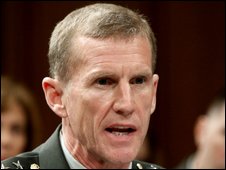
Gen McChrystal will be in command of US and Nato forces

The next leader of US and Nato forces in Afghanistan, Gen Stanley McChrystal, is due to take over
command there. He takes over from Gen David McKiernan, who was sacked by the US defence
secretary after one year and whose time coincided with a surge in violence.

Afghan President Hamid Karzai told Gen McChrystal the priority would be to reduce civilian casualties.
Gen McChrystal has said his measure of effectiveness would be "the number of Afghans shielded from
violence".

'Practical measures'

Gen McChrystal is a four-star general and former special forces commander. He will command 56,000 US
troops and 32,000 Nato-led forces currently in the country. He will also oversee US President Barack
Obama's new strategy of increasing troops in Afghanistan as forces in Iraq are drawn down.

On Sunday, Mr Karzai's office said the Afghan government would "fully co-operate" with the "very important
goal" of reducing civilian casualties. Gen McChrystal pledged "practical measures to prevent civilian casualties
during counterinsurgency operations". The issue has been a key source of friction between Afghanistan and
the foreign forces.

Nato and US troops are struggling to contain the Taliban insurgency in the country. Last week,
Gen McChrystal told the BBC Radio 4's Today programme that counter-insurgency was key. "When
we are in position, one of the things we'll do is review all of our rules of engagement and all the
instructions to our units, with the emphasis that we are fighting for the population. "That involves
protecting them both from the enemy and from unintended consequences of our operation, because
we know that although an operation may be conducted for the right reason, if it has negative effects
it can have a negative outcome for everyone."

Among the 400 senior staff Gen McChrystal will bring with him to Afghanistan will be
Adm Gregory Smith who has been assigned to improve communications efforts.
 
Back
Top