• Thanks for stopping by. Logging in to a registered account will remove all generic ads. Please reach out with any questions or concerns.

US Army Back in the Ship Killing Business

tomahawk6

Army.ca Legend
Inactive
Reaction score
66
Points
530
I would rather the USN be the anti-ship weapon but this is a low cost way to create capability.

http://nationalinterest.org/blog/the-buzz/third-offset-breakthrough-us-army-using-existing-technology-18263

At the CSIS’s Third Offset Conference last week, Defense Secretary Ash Carter announced that Will Roper’s Strategic Capabilities Office has found a solution to the United States’ shortfall in coastal artillery. The simplicity is almost obvious: modify the Army’s existing Army Tactical Missile System (ATACMS) with a anti-ship seeker. This means, as Sydney Freedberg wrote for Breaking Defense, that “after at least two years of pressure from Congress and vague promises from Pentagon leaders, and for the first time since the Coast Artillery Corps was disbanded 66 years ago, the Army is officially back in the business of killing ships.” As I wrote two years ago on this issue, there were quite a few ways of reestablishing this capability, but Carter’s people might have found one of the best.
 
tomahawk6 said:
I would rather the USN be the anti-ship weapon but this is a low cost way to create capability.

http://nationalinterest.org/blog/the-buzz/third-offset-breakthrough-us-army-using-existing-technology-18263

At the CSIS’s Third Offset Conference last week, Defense Secretary Ash Carter announced that Will Roper’s Strategic Capabilities Office has found a solution to the United States’ shortfall in coastal artillery. The simplicity is almost obvious: modify the Army’s existing Army Tactical Missile System (ATACMS) with a anti-ship seeker. This means, as Sydney Freedberg wrote for Breaking Defense, that “after at least two years of pressure from Congress and vague promises from Pentagon leaders, and for the first time since the Coast Artillery Corps was disbanded 66 years ago, the Army is officially back in the business of killing ships.” As I wrote two years ago on this issue, there were quite a few ways of reestablishing this capability, but Carter’s people might have found one of the best.

Are you sure you don't want to consider reactivating billions of dollars worth of coastal fortifications instead? :) https://en.wikipedia.org/wiki/Seacoast_defense_in_the_United_States
 
daftandbarmy said:
Are you sure you don't want to consider reactivating billions of dollars worth of coastal fortifications instead? :) https://en.wikipedia.org/wiki/Seacoast_defense_in_the_United_States

Not I.If we wouldnt keep the Nike sites in service and we struggle to maintain our inventory of military installations,why create more problems ? Even the Coast Guard has cut back on manned light houses.If I were inclined to support coastal defense weapons I would go with a land based Tomahawk SSM.This capability outlined in the article would be beneficial for Taiwan or the ROK where they might actually need to use this to inflict max damage on an invader.
 
tomahawk6 said:
Not I.If we wouldnt keep the Nike sites in service and we struggle to maintain our inventory of military installations,why create more problems ? Even the Coast Guard has cut back on manned light houses.If I were inclined to support coastal defense weapons I would go with a land based Tomahawk SSM.This capability outlined in the article would be beneficial for Taiwan or the ROK where they might actually need to use this to inflict max damage on an invader.

But nothing says 'you are not welcome' like a battery of 11 inch disappearing guns. :)
 
A couple of these at Esquimalt, 5 tribe can form a Coastal defense battery and become a full fledged Regiment, gun crew on Class B Mon-fri and Class A for the weekends.  [:D

Mexican-Navy-Orders-Naval-Guns-from-BAE-Systems-522x370.jpg
 
Except that their is no crew for that gun. It is entirely automated and remotely fired.
 
SeaKingTacco said:
Except that their is no crew for that gun. It is entirely automated and remotely fired.

Skyshield_AA.jpg


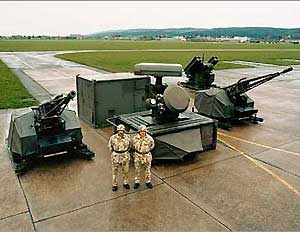
Two shift operators and a coffee pot.

1 Sensor Package

2 Guns and a Missile Package.

I'm guessing that the operators could handle a larger weapons group and another sensor package

A full troop would be 10 operators and a pair of EME types.  Oh, and somebody to bring the coffee.
 
Someone still needs to clean it, grease and do an inspection of the spare parts and cotter pins.
 
Colin P said:
Someone still needs to clean it, grease and do an inspection of the spare parts and cotter pins.

Nope.  Maintenance and sustainment are not pointy end, and therefore can be cut in a drastic manner, to provide more pointy-end folks with little equipment, and that which they have will be broken.

Clearly, you missed the memo...
 
daftandbarmy said:
But nothing says 'you are not welcome' like a battery of 11 inch disappearing guns. :)

I disagree. Patton was right when he said that "Fixed fortifications are a monument to the stupidity of man". You want your coastal defences to be mobile, it keeps the other guy guessing and prevents him from dropping a precision weapon on everyone of your pre-surveyed coastal defence sites on day one of the war.

There are existing options out there for Harpoon:

800px-RDN_mobile_misbat.jpg


But the ATACMS option seems really cool too. It's a true multi-role weapon and might even be a good fit for Canada should the Long Range Precision Rocket System project ever rise from the dead.
 
Patton could be quite the idiot at times, just look at his machine gun tank fetish among other things. For coastal defense, even today you will need some at key points to deal with unexpected threat. You do need a mobile contingent to back up the fixed installations. Even in WWII they had mobile rail guns as part of the coastal defense and 2 US rail guns where stationed at Fairview in Prince Rupert Harbour.
 
NASAMS-03.jpg


NASAMS set up - which also has a Coastal Defence crossover capability.

Since the introduction in Norway, another four countries in
NATO and EU have acquired NASAMS. NASAMS is renowned
for its use of the Raytheon AMRAAM missile, but is furthermore
operational with command and control of a range of
guns and short and medium range missiles, such as e.g. L-70
guns, RBS 70 and HAWK. It has also proven integration with
directed-energy weapons (DEWs) and longer range systems,
such as e.g. Patriot. A total of eight nations have acquired the
KONGSBERG command and control solution adapted to their
requirements.

The System

A standard NASAMS unit has a modular design comprising
a command post FDC, an active 3D radar AN/MPQ64F1
Sentinel, a passive electro-optic and infra-red sensor and
a number of missile canister launchers with AMRAAM
missiles. Normally, four NASAMS units are netted in
a battalion network.

The system is tied together with a uniquely designed
”hard-real-time” communication network to ensure minimum
latency over large distances for maximum performance of the
AMRAAM missile.

This modular design permits mission oriented task force
organization of NASAMS, allowing the operators to
maximize the effect of the components and tailor
the system to the task.

The Multi-Role FDC (Fire Distribution Center)
The Multi-Role FDC is a fielded and proven Command and Control (C2) entity that is
based upon flexibility, scalability, interoperability, and an open SW/HW architecture
to ease insertion of new technology.

The FDC includes necessary functionality to conduct real-time data handling, as data
link management, sensor control, air picture production, track identification and
classification, friendly protection, threat ordering, weapon allocation, weapon &
engagement control, and kill assessment. The FDC Software is an open architecture,
facilitating new functionality implementation.

The FDC has proven domain functionality within Integrated Air and Missile Defense,
Field Artillery, Air Command and Control, Strike Missiles Control, Close Air Support,
Maneuver Forces Battle Management, and Army Aviation

SEA AND LAND MISSIONS

The primary missions for NSM™ CDS are maritime interdictions against sea targets from small
and light ships made of Glass Fiber Reinforced Plastics (GFRP) to large naval combatants like
destroyers and frigates and ships with thick hull like icebreakers.

Secondly, land targets are handled by the NSM™ CDS. The land attack capability is primarily
based on use of the military GPS. Typical land targets are stationery, soft targets like harboring
depot buildings, command and control facilities, sensor sites and air defence sites. Ships
secured alongside jetty are categorized as a land target, enabling a high precision harbor
attack capability.

ADVANCED REAL TIME NETWORK WITH PLUG & FIGHT ARCHITECTURE

The user friendly system is designed to operate in an advanced, real time network with plug
& fight capability. The main core nodes in the network are the FDCs, to which any sensor
or launcher can be integrated. The network of up to 4 FDCs establishes a single integrated
maritime picture enabling and enhancing a common situational awareness.

NETWORK ENGAGEMENT CAPABI LITY

Each of the FDCs can, when authorized, locally engage up to 12 different targets or use up to
12 missiles against the same target in a salvo. Through a defined senior FDC in the network
the mechanisms to plan and control up to 48 NSM™ engagements simultaneously against up
to 48 different targets, is possible. The network further utilizes the NSM™ embedded features
for different salvo sizes per target. Including the possibility for simultaneous time on target,
using salvo engagements or network enabled coordinated engagements for maximum
attrition.

FLEXIBLE CONFIGURATION

The NSM™ CDS system’s modularity in both hardware and software ensures a cost-effective
focus on system growth in the areas of BMC4I, other sensors and other effectors.
With the open architecture, the FDC provides future system configuration flexibility.
Different software modules can easily be changed or replaced without interfering with the
other modules.

http://www.kongsberg.com/en/kds/products/groundbasedairdefencesystems/nasams/

What this seems to be suggesting, at least to me, is that the next most important acquisition for the Royal Regiment of Canadian Artillery is the GBADs Fire Control System which I believe would have much in common with the CSCs Fire Control System.
 
Canada would station a mobile coastal defense unit in Wainwright, just to be sure....
 
Colin P said:
Canada would station a mobile coastal defense unit in Wainwright, just to be sure....

Only for the proof of concept trials.

After that we'd have to send it to Trenton to prove deployability by C-17...
 
My understanding is that ATACMS is a rather slow and ballistic trajectory missile, would that not be rather easy to shoot down with any point defense system?
 
Colin P said:
Canada would station a mobile coastal defense unit in Wainwright, just to be sure....

Makes sense since there are already a bunch of Navy types running around in the field wearing black toques.

[:D
 
cupper said:
Makes sense since there are already a bunch of Navy types running around in the field wearing black toques.

[:D

NO .....WE WILL NOT MERGE TOPICS.

[Xp
 
Back
Top