• Thanks for stopping by. Logging in to a registered account will remove all generic ads. Please reach out with any questions or concerns.

War on Free Speech

Does that also apply to things like "From the river to the sea"? ;)
Are they directly calling for the deaths of others? Or do they want one unified country in a specific location?

That chant itself isn’t violence, the context it is used in can help clarify it, but you would have to add in the actual call to violence.
 
Are they directly calling for the deaths of others? Or do they want one unified country in a specific location?

That chant itself isn’t violence, the context it is used in can help clarify it, but you would have to add in the actual call to violence.
Good nuance & fair.

Most of the time, though, on all sides, bumper sticker slogans get the adversarial “but we know what they REALLY mean” treatment, which brings it back to the eye of the beholder to “read” the context.

“From the river to the sea,” meet “replacement.”
 
Good nuance & fair.

Most of the time, though, on all sides, bumper sticker slogans get the adversarial “but we know what they REALLY mean” treatment, which brings it back to the eye of the beholder to “read” the context.

“From the river to the sea,” meet “replacement.”
The other thing with slogans/sayings is you also end up with people chanting them/using them that don’t realize the full reality of them.

For example I used to use the phrase ‘jipped’ for getting ripped off. It was only fairly recently that I learned it came from gypsy and it was derogatory. It had never been directly connected to the gypsies before that for me, I had only ever heard it in the context of being ripped off.
 
The other thing with slogans/sayings is you also end up with people chanting them/using them that don’t realize the full reality of them.

For example I used to use the phrase ‘jipped’ for getting ripped off. It was only fairly recently that I learned it came from gypsy and it was derogatory. It had never been directly connected to the gypsies before that for me, I had only ever heard it in the context of being ripped off.
We used to use worse when we were ripped off, jipped or gypped was one. The other one I won't mention.
 
Does that also apply to things like "From the river to the sea"? ;)

"judicious" and "discriminating" used to be accolades.

Great piece in the National Post by Terry Newman.

Apparently she has found a legitimate debating society in Canada. You only have to wait until year 3 or 4 or university to be allowed to take part.

The course is called "Dangerous Ideas".


"A new course you probably wouldn’t expect to exist at a Canadian university just wrapped up. “Dangerous Ideas” invited students to tackle difficult and polarizing topics by debating both sides, and the students loved it — suggesting that they would rather examine and discuss ideas than be told that they’re off-limits"

"Dangerous Ideas is an upper-level combined political science and philosophy seminar course created by Brad Epperly and Renaud-Philippe Garner, who work at the University of British Columbia’s Okanagan campus in Kelowna, B.C. According to its syllabus, the course allows students to tackle controversial topics that some people might deem dangerous, including freedom of speech, anti-racism, academic freedom, Zionism and colonialism."

"A 2025 survey found that more than half of students were reluctant to discuss transgenderism and the Israel-Hamas conflict. Almost half wouldn’t even talk about politics, and a majority were in favour of limiting free expression on campuses."

"A 2023 Angus Reid survey found that 58 per cent Canadians believed it was acceptable for universities to ban speakers who promote offensive views on race and gender."

....

"Dangerous ideas bypasses any attempt at deplatforming because, in signing up for the course, students are made aware that they will be engaging with issues they may not automatically agree with and will also have to examine their own firmly held beliefs.

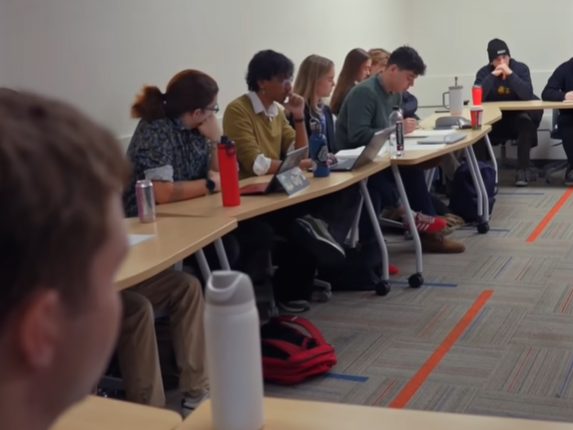
"The seminar works like this: Students are randomly assigned a side to argue on a topic and organized into debate teams. Those not assigned a topic that week judge which side was most persuasive. Students are given readings before each debate and are required to submit their team’s arguments before the debate takes place."

....

One student said, “I think debate is very important because in today’s society emotions have really dominated politics, and a lot of the time people are actually unable to explain why they think a certain way, other than because they feel a certain way.”

Another student said that what the course taught was the difference between defending your ideas and yourself.

The third one said she was surprised by how willing students were to engage with controversial ideas and found that many of the issues were a lot more nuanced than she originally thought. She feels the course is unique because it was set up in such a way that the students were all in it together, and this made them feel comfortable sharing their beliefs, something she said can normally be “really, really scary.”

...

Now if only we can get logic and rhetoric taught in junior high along with debating courses like this.

 

Bertrand Russell: 'Do not fear to be eccentric in opinion, for every opinion now accepted was once eccentric'​

 
"judicious" and "discriminating" used to be accolades.

Great piece in the National Post by Terry Newman.

Apparently she has found a legitimate debating society in Canada. You only have to wait until year 3 or 4 or university to be allowed to take part.

The course is called "Dangerous Ideas".


"A new course you probably wouldn’t expect to exist at a Canadian university just wrapped up. “Dangerous Ideas” invited students to tackle difficult and polarizing topics by debating both sides, and the students loved it — suggesting that they would rather examine and discuss ideas than be told that they’re off-limits"

"Dangerous Ideas is an upper-level combined political science and philosophy seminar course created by Brad Epperly and Renaud-Philippe Garner, who work at the University of British Columbia’s Okanagan campus in Kelowna, B.C. According to its syllabus, the course allows students to tackle controversial topics that some people might deem dangerous, including freedom of speech, anti-racism, academic freedom, Zionism and colonialism."

"A 2025 survey found that more than half of students were reluctant to discuss transgenderism and the Israel-Hamas conflict. Almost half wouldn’t even talk about politics, and a majority were in favour of limiting free expression on campuses."

"A 2023 Angus Reid survey found that 58 per cent Canadians believed it was acceptable for universities to ban speakers who promote offensive views on race and gender."

....

"Dangerous ideas bypasses any attempt at deplatforming because, in signing up for the course, students are made aware that they will be engaging with issues they may not automatically agree with and will also have to examine their own firmly held beliefs.

"The seminar works like this: Students are randomly assigned a side to argue on a topic and organized into debate teams. Those not assigned a topic that week judge which side was most persuasive. Students are given readings before each debate and are required to submit their team’s arguments before the debate takes place."

....

One student said, “I think debate is very important because in today’s society emotions have really dominated politics, and a lot of the time people are actually unable to explain why they think a certain way, other than because they feel a certain way.”

Another student said that what the course taught was the difference between defending your ideas and yourself.

The third one said she was surprised by how willing students were to engage with controversial ideas and found that many of the issues were a lot more nuanced than she originally thought. She feels the course is unique because it was set up in such a way that the students were all in it together, and this made them feel comfortable sharing their beliefs, something she said can normally be “really, really scary.”

...

Now if only we can get logic and rhetoric taught in junior high along with debating courses like this.

If we give more autonomy to children to think for themselves, and stop treating them like babies, I.E. no more "mustard vs ketchup" debates, and try to promote critical thinking skills, maybe we'd see less bigotry, not only in the CAF, but everywhere

Remember when people treated sexual education and drugs this way?
 
If we give more autonomy to children to think for themselves, and stop treating them like babies, I.E. no more "mustard vs ketchup" debates, and try to promote critical thinking skills, maybe we'd see less bigotry, not only in the CAF, but everywhere

Remember when people treated sexual education and drugs this way?
The problem isn’t the lack of autonomy it is the fact that they will be targeted if they speak against the grain on whatever the topic is.

Students don’t want to go into these topics because they know they will be censored, vilified, have educational/vocational consequences, etc.
 
In the last two years, for one of my assignments, I chose the opposing view of my classmates for an assigned discussion in graduate school. I was articulate, well reasoned and earned top marks for my position. The backlash and follow-on adverse working relationship with those students was tense. In a program requiring allot of group work.
 
The problem isn’t the lack of autonomy it is the fact that they will be targeted if they speak against the grain on whatever the topic is.

Students don’t want to go into these topics because they know they will be censored, vilified, have educational/vocational consequences, etc.
There has always been peer pressure against people taking a position other than status quo. By ridiculing the other side we avoid having to make an informed decision on our own. Even these hallowed pages reflect that tendency. Perhaps the solution is to encourage the upcoming generations to be confident in their position without worrying about your neighbour's opinion and encourage them to respect whilst not having to agree with, the other opinion. Putting a mandatory debating class into a senior public school and continuing it through high school might be a way to do this.
 
There has always been peer pressure against people taking a position other than status quo. By ridiculing the other side we avoid having to make an informed decision on our own. Even these hallowed pages reflect that tendency. Perhaps the solution is to encourage the upcoming generations to be confident in their position without worrying about your neighbour's opinion and encourage them to respect whilst not having to agree with, the other opinion. Putting a mandatory debating class into a senior public school and continuing it through high school might be a way to do this.
There is a difference between peer pressure and active punishment. Everything you say and do is permanent now. Someone records you that can be the end of any potential career, or other penalties, complaints to HR, the teachers/principals, etc. everything can violate some policy somewhere now.

The kids don’t want to engage anymore because they have adapted and understand that stepping out of ‘line’ (at least in public/person) can be the end.
 
Both my kids have very independent views and don't go along with what their peer group thinks, but they are also careful about what they say publicly and on social media.
 
There has always been peer pressure against people taking a position other than status quo. By ridiculing the other side we avoid having to make an informed decision on our own. Even these hallowed pages reflect that tendency. Perhaps the solution is to encourage the upcoming generations to be confident in their position without worrying about your neighbour's opinion and encourage them to respect whilst not having to agree with, the other opinion. Putting a mandatory debating class into a senior public school and continuing it through high school might be a way to do this.
This is what school should be; I mean, it should be an objective of schooling, anyways.
The problem isn’t the lack of autonomy it is the fact that they will be targeted if they speak against the grain on whatever the topic is.

Students don’t want to go into these topics because they know they will be censored, vilified, have educational/vocational consequences, etc.
Why are they scared? It's because they're not educated on it. I'll tell you, if my or your teacher told you guys to promote autonomy, self-expression, and all those other things, people would be more willing to express your opinion...

It can start with little things, and slowly work up to major issues; if you're six or seven years old, and the teacher says "what if we changed our Canadian focused history in class to a more broad international one," and then talk about it, you're most likely not gonna be thinking about getting cancelled on Twitter or whatever, because you're so little, and if it's done enough times, it'll be normalized enough that people can express their opinions like enlightened people. It can be older topics, and work itself to modern topics too, if even at that age people would be scared of talking about modern subjects. Nobody is gonna cry if they had to roleplay a debate between if, in a fictional city, they should build a bus stop at place A or place B, or how the budget should be laid out, or if someone were shopping at a grocery store deciding if they should buy the big or small cut of meat.

Conflict resolution, public speaking, decision making, debating, and those subjects should be a main class in school — it's not developed at school, and for a lot of people, especially children and teenagers who don't use forums or are interested in politics or history, is rarely developed at all. I'm sure everyone reading this has met a lot of people, military or otherwise, who can't seem to make up their own minds on things, can't judge things, can't make decisions, and all those things.
 
Back
Top