They improved the quality of humour in general which, in many cases, was based on alot of hard truths that others weren't willing to lean into...
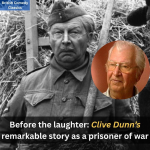
“Don’t panic!” Clive Dunn is remembered by millions as Dad’s Army’s excitable Lance Corporal Jones but before the laughter, Dunn lived through four years of fear, hunger, and endurance as a prisoner of war during the Second World War — an experience that shaped both his humour and his humanity.
Born in 1920 into a theatrical family, acting was in his blood. His parents were music hall performers, and by the late 1930s Clive was already appearing in repertory theatre. But when war broke out in 1939, the 19-year-old actor decided he couldn’t stand aside while others served. He enlisted in the British Army in 1940, joining the 4th Queen’s Own Hussars — the same regiment later made famous by Winston Churchill.
Dunn was posted to Greece, part of the British force sent to resist the advancing German army. In April 1941, his unit fought at the Corinth Canal before being surrounded and captured. He was just twenty-one. For the next four years, he would live behind barbed wire, mostly in Austria, enduring bitter winters, starvation, and isolation — and yet somehow managing to find moments of comedy and courage.
At one point, thanks to sympathetic fellow prisoners working in the camp’s records office, Dunn was deliberately “lost” in the German system — his papers removed so that he effectively didn’t exist. For months, he lived “in smoke,” hiding every time there was a roll call to avoid being transferred to another camp. “All sorts went on that the Nazis were unaware of,” he later said. One of the prisoners showed him a crystal radio set hidden inside a hollowed-out book in the library. Each night, the men secretly tuned in to the BBC, sharing news from home across the camp within minutes.
Dunn threw himself into the camp’s makeshift theatre. He performed in a production of The Skin Game and later played the female lead — a gypsy princess — in an ambitious Christmas show of Ivor Novello’s Glamorous Nights, complete with costumes, orchestra and chorus. “It was the highlight of the camp,” Dunn recalled. The production was so successful that the men planned a full week’s run, but tragedy struck when the stove in the theatre caught fire, burning the building to the ground.
Determined to lift spirits again, the prisoners organised a concert. Dunn borrowed a few jokes from a friend, Johnny McGeorge, just minutes before American bombers accidentally hit the camp, killing forty prisoners — including McGeorge. “I’d just walked away from his hut,” Dunn said quietly years later. “Three minutes earlier, and I’d have gone with him.” Remembering his training as a medic, Dunn rushed to the cratered ground, rescuing the wounded and helping the camp surgeon operate on the injured. “We even had better Red Cross drugs than the Germans,” he said. “We used to slow down recoveries to give the men more time off work.”
Eventually, exhausted from hiding, Dunn asked to be made an “official” prisoner again. He was sent to a small village, Gundorf, where he worked on a farm for a kind family who treated him well and fed him properly. For the first time in years, he felt a sense of calm. “It had a peaceful atmosphere,” he recalled. “For a little while, I could almost forget there was a war.”
When the German front began to collapse in the spring of 1945, Dunn’s guards announced they were leaving. He marched with other prisoners across villages, picking up dozens more along the way until their lone guard, weary of war, simply said, “Auf wiedersehen,” and deserted. The prisoners carried on westward, scavenging food and bartering whatever they could. Dunn even stole a handcart to carry supplies, and in one village discovered a pile of Red Cross parcels dumped as rubbish. Incredibly, one of them was addressed to him — sent by his church — containing 400 Sweet Caporal cigarettes. He shared them among the men, using the cigarettes as bartering currency for food. At another farm, the men lit small fires and boiled potatoes they’d found on carts — “our first decent meal in weeks,” he said.
The long march ended at a camp in Markt Pongau, surrounded by barbed wire. The prisoners didn’t know it, but the Germans intended to use them as hostages in the war’s final days. Starving again, Dunn and several others escaped through a gap in the wire and broke into a warehouse in search of food. All they found were sacks of sugar, which he lived on for three days — “raw or boiled in water, or in tea if we were lucky.”
After nearly a week in the camp, with most of the guards gone, American troops in jeeps finally arrived. The men were free.
Dunn was transported through Salzburg and Belgium before returning to England. The war in Europe was over, but Japan was still fighting, and Dunn remained in the army. After a short leave to visit his parents, he was assigned to a base in northern England — where his new “vital duty,” he joked, was picking up bits of paper around the perimeter for weeks on end. Despite requesting to be discharged on medical grounds, he served until late 1946, finishing his service as a medical orderly in Devizes.
When peace finally allowed him to return to acting, he re-registered with Equity, changing his name from Robert Dunn to Clive Dunn. Within a few years, he was back on stage and radio, and by the late 1960s, his gentle, comic warmth made him a household name in Dad’s Army.
“The one thing the war taught me,” he said later, “was that I was a coward. There were so many terrifying things happening… all those bullets and bombs.” Yet his humility and humour told another story — one of bravery of a quieter kind.
Clive Dunn survived hardship, loss, and fear, yet came home determined to make people laugh. Behind the catchphrases and the chaos of Dad’s Army, there was a man who had truly seen war — and turned it into something the nation would never forget.

www.facebook.com



 interestingengineering.com

 en.wikipedia.org