• Thanks for stopping by. Logging in to a registered account will remove all generic ads. Please reach out with any questions or concerns.

Trump administration 2024-2028

You seem familiar with the area, do you think its more plausible he ended up in the States accidentally, was there illegally or the Coasties accidentally entered Canada?

I think that this event probably took place at or near the border. On which side, I do not know, and unless one of the parties has a system that properly recorded position for legal purposes, we will never know as it would be one's word against the other. While the Coat Guard boats at Burlington, VT (the station for the Lake) have GPS, I do not know if they have recording equipment.

Here is the largest of the two boats they operate, so you be the judge:

 
My bad. I blame it on the
I refer you to my post in the Canada/US Border Integrity thread.

FSTO: There is little current in Missisquoi Bay as it is not connected to the Richelieu River. Any current there comes from the Missisquoi River, which is a pretty trickle at this time of the year. Moreover, in the Richelieu River affected portion, the current makes you drift towards Canada, not the US. The Richelieu River empties the Lake Champlain into the St. Lawrence River, not the other way around.
beaucoup de biers at the les bar terraces overlooking the Richelieu. I was sure the flow was north to south?🥴
 
You are far from the first one to make that mistake. People look at the map, with the Richelieu being an almost perfectly North-South river, and remembering their early childhood education (water always flows down), assume that the flow is North to South.

Early in my law career, I worked at a law firm specializing in insurance work for general and commercial insurance companies. Most people don't know that but your liability as a boater is covered under your home owner's insurance, and since most boating incidents/accidents involve boaters on boaters, it is general insurance law firms that do most of those cases, not maritime law firms. As a result, most of these cases involve statements of claim that clearly originate in residential insurance law firms, with statements like "did not act reasonably, didn't do anything to prevent ... but actually did everything to cause it, etc. etc.".

One day, the lawyer who handled most of these case at the firm went on maternity leave, so , knowing my background, the partners decided to hand me the cases. I looked them over ... and started amending the statement of claims with allegations such as "our client was the stand-on vessel, while the other side was the give-way one"; or, "the vessel failed to show proper lights at night and failed to keep proper lookout", and always threw in "did not take the precautions of prudent seaman".

Well , some of the other firms smelled that something had changed and handed the files over to maritime law lawyers. They knew their maritime law and Rules of the Road better, but few were actually seamen. One of the cases involved a collision on the Richelieu River. We start informal settlement discussions with the other side maritime law lawyer and I get him to agree with me that the applicable rule is for waterways with current and therefore, the vessel going against the current is the Give-way vessel and the one with the current is the Stand-on. Then I get him to agree the fact that my client was coming from Lake Champlain towards St-Jean, while his client was doing the reverse.

At that point, I can feel in his demeanor that he his gleeful and certain that he got me. I then pop the final blow: The Richelieu River flows South to North, so his client is the Give-way vessel. He stops dead in his track and say he'll call me back. The next day, I got a full settlement.
 
Last edited:
One of the main issues is that there are no NDP MLAs in the rural/forest sector dependent parts BC.

None of the latte sipping, NDP voting, man bun/ Birkenstock wearing, tree hugging folks in urban BC care.

Erm…I feel dirty defending the NDP, but they have seats in the Kootenays, Vernon, North Coast and Vancouver Island outside of Victoria, which have significant forest industry activity.

 
The BC forest sector needs to invest in machinery so they can fill orders from other parts of the world and maybe the government can lend a helping hand to move them towards this.
Part of the issue is that overall employment per mill has decreased drastically in the last 30 years. Same within the logging front. And trucking front.

When I started my carear a log truck often only hauled 40m3 of wood....now I'm looking at 10 axle B-trains hauling 60m3 summer weight. Two of those trucks = one less driver.

Bunchers and skidders are bigger and more productive...and light years ahead of hand falling.

Sawmills don't even slab off the outer wood...its' chipped off so less handling, higher product return (chipped into pulp sized chips) and all automated log orientation. Lumber grading is now fully automatic. Even lumber stacker and wrapper jobs are automated in some mills.

End result is much lower employment per mill x mill expansion (making them even more sensitive to market conditions) = less votes at risk. Compounded by mostly urban growth changing seat weightings towards cities....

Will note it's a similar story in most Canadian provinces and not unique to BC.

So after the bad news what could be done?
1) change the tenure system from its' current annual dues rate (based upon preceeding years market prices) to a monthly like Alberta. This allows a much more responsive change to market conditions.
2) Bridge weights and infrastructure. Truck loads of all types are increasing but many crossings have not kept pace. This means expensive equipment can't always operate at full capacity depending on the route
3) Re-examine tenure policies around pre-commercial and commercial thinning especially around communities. I will note this comment I could apply to pretty much any province but when you look at European practices on high quality sites they are retrieving a significant amount of smaller diameter wood from these practices and these are a major component of their pulp industry. Generating more from the forest while reducing fuel for fires is a win in my book....but god is it a challenge to do from so many aspects.
4) Go back to the federal government and align First Nation Consultation. Ensure that a single set of referrals is needed for a project...not a referral for the provincial approval and then a separate, independent consultation by the Federal Government with the same groups. DFO I'm looking at you.
5) Clarify First Nation consultation practices between provinces and Federal gov't. Why are there different communities recognized differently between the two levels of Crown?
6) Coordinate with the rail companies to build more loading yards. It's amazing how many BC truck loads I see come to Alberta to be loaded at Edmonton...or Alberta loads I see going to Vancouver...due to loading yard space and rail car availability. Need more cars being loaded closer to mills to reduce overall hauling costs and drop expenses.
 
4) Go back to the federal government and align First Nation Consultation. Ensure that a single set of referrals is needed for a project...not a referral for the provincial approval and then a separate, independent consultation by the Federal Government with the same groups.
Perhaps in addition, in relation to all matters of FN consultation, particularly as it pertains to 'national building projects, the FN themselves could streamline and align who the government should consult with and seek consent from. There are individual bands, regional assemblies, provincial assemblies and a national assembly, not to mention the conflict between FN and Metis nations. In some cases, there is also conflict between elected councils and 'hereditary' chiefs.

It almost seems designed to be endlessly circular.
 
Part of the issue is that overall employment per mill has decreased drastically in the last 30 years. Same within the logging front. And trucking front.

When I started my carear a log truck often only hauled 40m3 of wood....now I'm looking at 10 axle B-trains hauling 60m3 summer weight. Two of those trucks = one less driver.

Bunchers and skidders are bigger and more productive...and light years ahead of hand falling.

Sawmills don't even slab off the outer wood...its' chipped off so less handling, higher product return (chipped into pulp sized chips) and all automated log orientation. Lumber grading is now fully automatic. Even lumber stacker and wrapper jobs are automated in some mills.

End result is much lower employment per mill x mill expansion (making them even more sensitive to market conditions) = less votes at risk. Compounded by mostly urban growth changing seat weightings towards cities....

Will note it's a similar story in most Canadian provinces and not unique to BC.

So after the bad news what could be done?
1) change the tenure system from its' current annual dues rate (based upon preceeding years market prices) to a monthly like Alberta. This allows a much more responsive change to market conditions.
2) Bridge weights and infrastructure. Truck loads of all types are increasing but many crossings have not kept pace. This means expensive equipment can't always operate at full capacity depending on the route
3) Re-examine tenure policies around pre-commercial and commercial thinning especially around communities. I will note this comment I could apply to pretty much any province but when you look at European practices on high quality sites they are retrieving a significant amount of smaller diameter wood from these practices and these are a major component of their pulp industry. Generating more from the forest while reducing fuel for fires is a win in my book....but god is it a challenge to do from so many aspects.
4) Go back to the federal government and align First Nation Consultation. Ensure that a single set of referrals is needed for a project...not a referral for the provincial approval and then a separate, independent consultation by the Federal Government with the same groups. DFO I'm looking at you.
5) Clarify First Nation consultation practices between provinces and Federal gov't. Why are there different communities recognized differently between the two levels of Crown?
6) Coordinate with the rail companies to build more loading yards. It's amazing how many BC truck loads I see come to Alberta to be loaded at Edmonton...or Alberta loads I see going to Vancouver...due to loading yard space and rail car availability. Need more cars being loaded closer to mills to reduce overall hauling costs and drop expenses.

Sadly, it's easier for companies to go to the States in many cases than weather the 'perfect storm' here, especially the political uncertainty that will continue since the NDP won the last election:

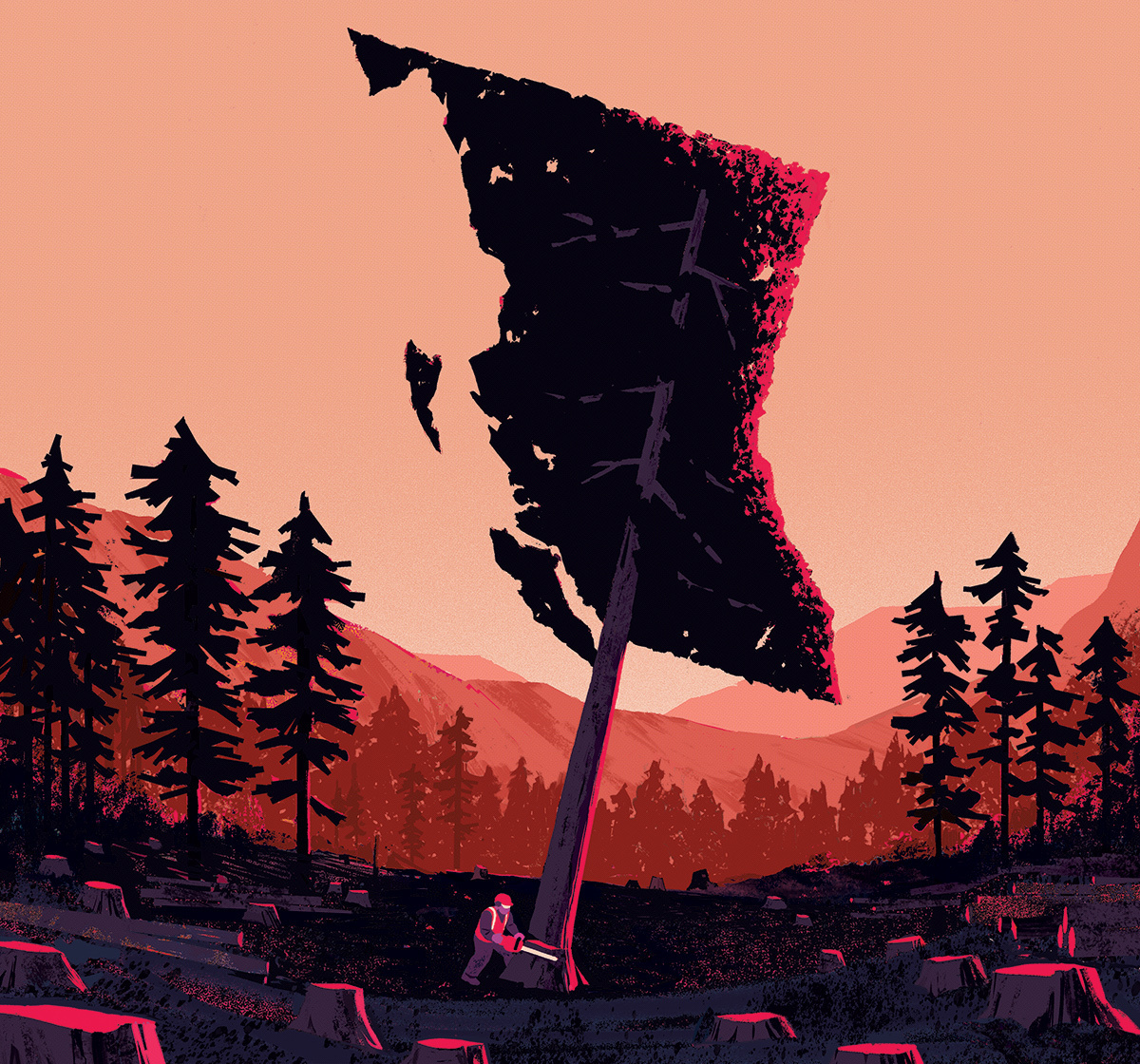
Clearing Out: BC’s Logging Industry Sets Its Sights on the US​

Facing ecological and political uncertainty at home, some of the province’s largest lumber producers are looking south

Through the spring and summer of 2021, facing ecological, financial, and political complications, some of BC’s largest lumber producers—Canfor, West Fraser, Interfor, Tolko, and Teal Jones—announced the expansion or establishment of sawmills not at home but in the southern United States, to process the yellow pine that grows quickly in the warmer climes of Texas and Louisiana. So far, these out-of-province investments total approximately $6 billion, a major expansion of operations that leaves the future of BC’s timber industry even more uncertain. The province’s companies have decided that this perfect storm is not one they care to weather or remediate. Instead, they are turning away from spearheading a sustainable logging industry in the province, toward calmer and greener pastures abroad.


It is interesting that no person here is tracking or mentioning the DNI release of evidence Obama admin fabricated the entire Russia collusion hoax and the referral to DOJ. Brennan, Comey, Clapper, et al might be in serious trouble for these seditious acts. Obama will likely skate free with immunity.
Here ya go & track away -- we'll see what comes out.
(Report referred to in the DNI info-machine material attached)

Meanwhile, as some would have claimed if Biden had done something similar, "lookit the new shiny thing, everybody!!!!" ;)
But you’re all hypothesizing about Trump being connected to Epstein in some way that is scandalous as if that wouldn’t have already been dragged out into the light these last 10 years.
Well, it WAS DJT who was saying all along that the Epstein stuff had to be released, right? And suggesting it was a massive cover-up of gigantic proportions? Or did I mishear/misread him all this time?
 

Attachments

Sadly, it's easier for companies to go to the States in many cases than weather the 'perfect storm' here, especially the political uncertainty that will continue since the NDP won the last election:

Clearing Out: BC’s Logging Industry Sets Its Sights on the US​

Facing ecological and political uncertainty at home, some of the province’s largest lumber producers are looking south

Through the spring and summer of 2021, facing ecological, financial, and political complications, some of BC’s largest lumber producers—Canfor, West Fraser, Interfor, Tolko, and Teal Jones—announced the expansion or establishment of sawmills not at home but in the southern United States, to process the yellow pine that grows quickly in the warmer climes of Texas and Louisiana. So far, these out-of-province investments total approximately $6 billion, a major expansion of operations that leaves the future of BC’s timber industry even more uncertain. The province’s companies have decided that this perfect storm is not one they care to weather or remediate. Instead, they are turning away from spearheading a sustainable logging industry in the province, toward calmer and greener pastures abroad.


As I understand it the biggest employment scheme under the US Civilian Conservation Corps during the great depression was tree planting. Mostly in the SE states due to cotton and tobacco fields lacking nutrients and unable to grow food crops well. Yellow pine was a preferred species (native to the SE states) and now...100 years later...these same fields are the basis of the SE states lumber industry.

There are a couple of key things to consider when comparing lumber in the SE vs. Canada
1) Yellow pine is a fast growing species so it's more prone to splitting when using air nailers resulting in a higher wastage rate. This is why Canadian lumber receives a premium on price as home builders have less waste
2) Most mills in the SE states are tiny by Canadian standards. Maybe Canada of the 1980's but there are few "super mills" as we see up here. Canadian producers can buy 2-3-4 mills down there and build one new mill with greater capacity and a fraction of manpower needed.
3) A key advantage is the mill proximity to market. The mills in Canada are very cost effective...but the trucking/rail delivery costs of finished products are not.
4) There is limited land ownership and obligation for the sawmill. Unlike Canadian tenures which have reforestation obligations and other long term planning costs most of the wood is purchased from private landowners. And the same landowners receive significant outreach education assistance from the USFS and state agencies. But you're not required to reforest things as the wood purchaser.
5) Total supply exceeds demand as I understand it. I'm hearing stories of companies paying basically rock bottom prices for prime sawlogs...but only paying for the prime log and getting the rest for free. Between hurricane damages and old forest there is a pile of wood looking for a home and the existing mills have not been able to consume it all. I'm hearing prices as low as $6/m3 to the landowner...even if I add two hours trucking onto that it's only about $16-20/m3. Locally it's 4x that cost delivered to a mill and in BC I'm hearing 8x costs. Heck reforestation alone is usually about $6-12/m3 cost for comparison
6) Currency exchange between US generated profits (in a low cost area) vs. Canadian costs up north (but paid with a weaker dollar) and where the headquarters are at. Can drive your earnings higher across the board while remaining competitive in both markets.
 
As I understand it the biggest employment scheme under the US Civilian Conservation Corps during the great depression was tree planting. Mostly in the SE states due to cotton and tobacco fields lacking nutrients and unable to grow food crops well. Yellow pine was a preferred species (native to the SE states) and now...100 years later...these same fields are the basis of the SE states lumber industry.

There are a couple of key things to consider when comparing lumber in the SE vs. Canada
1) Yellow pine is a fast growing species so it's more prone to splitting when using air nailers resulting in a higher wastage rate. This is why Canadian lumber receives a premium on price as home builders have less waste
2) Most mills in the SE states are tiny by Canadian standards. Maybe Canada of the 1980's but there are few "super mills" as we see up here. Canadian producers can buy 2-3-4 mills down there and build one new mill with greater capacity and a fraction of manpower needed.
3) A key advantage is the mill proximity to market. The mills in Canada are very cost effective...but the trucking/rail delivery costs of finished products are not.
4) There is limited land ownership and obligation for the sawmill. Unlike Canadian tenures which have reforestation obligations and other long term planning costs most of the wood is purchased from private landowners. And the same landowners receive significant outreach education assistance from the USFS and state agencies. But you're not required to reforest things as the wood purchaser.
5) Total supply exceeds demand as I understand it. I'm hearing stories of companies paying basically rock bottom prices for prime sawlogs...but only paying for the prime log and getting the rest for free. Between hurricane damages and old forest there is a pile of wood looking for a home and the existing mills have not been able to consume it all. I'm hearing prices as low as $6/m3 to the landowner...even if I add two hours trucking onto that it's only about $16-20/m3. Locally it's 4x that cost delivered to a mill and in BC I'm hearing 8x costs. Heck reforestation alone is usually about $6-12/m3 cost for comparison
6) Currency exchange between US generated profits (in a low cost area) vs. Canadian costs up north (but paid with a weaker dollar) and where the headquarters are at. Can drive your earnings higher across the board while remaining competitive in both markets.

In this sector, as you well know, the cost accountants drive the decision making.

Costs in Alberta are apparently $100/m3 lower than BC, and it's even better in the US.

Hard to compete with that if you're operating in a social justice/ reconciliation/ eco-maniac agenda driven jurisdiction...
 
In this sector, as you well know, the cost accountants drive the decision making.

Costs in Alberta are apparently $100/m3 lower than BC, and it's even better in the US.

Hard to compete with that if you're operating in a social justice/ reconciliation/ eco-maniac agenda driven jurisdiction...
That's a higher spread differential than I've been told by clients ($100/m3) but it is a significant difference. A few clients work both sides of the border and it's always been an interesting coffee discussion.
 
Here are a couple articles on the US situation:


The survey shows that Democrats’s net-favorability is far below water at -30 percent — the lowest ever recorded in polls going back to 1990 — after falling dramatically throughout Joe Biden’s presidency. Since the 2024 presidential election, Democrats’s approval numbers have deteriorated even further.

By just about every indicator, the U.S. economy is holding up remarkably well. When Donald Trump launched his global trade war, economists and markets said his tariff policy would slow the economy, drive up prices and dramatically reduce global trade.
And yet, stocks are at all-time highs, the country's employment is strong, its economy is expanding and the expected surge in inflation hasn't materialized.


There are contradictory claims out there, but if either article is to be taken at face value then #47 can't be doing that bad for the interests of his country.
 
Here are a couple articles on the US situation:


The survey shows that Democrats’s net-favorability is far below water at -30 percent — the lowest ever recorded in polls going back to 1990 — after falling dramatically throughout Joe Biden’s presidency. Since the 2024 presidential election, Democrats’s approval numbers have deteriorated even further.

By just about every indicator, the U.S. economy is holding up remarkably well. When Donald Trump launched his global trade war, economists and markets said his tariff policy would slow the economy, drive up prices and dramatically reduce global trade.
And yet, stocks are at all-time highs, the country's employment is strong, its economy is expanding and the expected surge in inflation hasn't materialized.


There are contradictory claims out there, but if either article is to be taken at face value then #47 can't be doing that bad for the interests of his country.
Just a bit lower than Trump’s 37%… 🤔


Looking forward to see the H2 numbers come out in the coming weeks.
 
Brian Lilley muses that perhaps it isn't all about Trump. Perhaps we're doing something wrong as well.


Trump is touting one page deals with the rest of the world before August 1st and tariffs in the 15% range.

Our slothocracy doesn't seem to be able to rise to the challenge. Trade deals, passports and military trucks all delivered with the same sense of urgency.

Even the Brits, our mentors, with a Labour government, managed to secure a deal prior to the G7 meeting and have maintained relations ever since.
 
Brian Lilley muses that perhaps it isn't all about Trump. Perhaps we're doing something wrong as well.


Trump is touting one page deals with the rest of the world before August 1st and tariffs in the 15% range.

Our slothocracy doesn't seem to be able to rise to the challenge. Trade deals, passports and military trucks all delivered with the same sense of urgency.

Even the Brits, our mentors, with a Labour government, managed to secure a deal prior to the G7 meeting and have maintained relations ever since.
We already have CUSMA, and it remains in effect. We’re negotiating the goods and services that fall outside of that; since CUSMA is the bulk of our trade, we have lees need to quickly accept a shitty deal to protect most of our trade overall. Other countries that don’t have existing comprehensive trade deals are getting browbeaten into worse deals than we need to accept. If part of Canada’s strategy is to let American be influenced by the way their tariffs self-inflict damage, well, it takes time for that to play out.
 
Here are a couple articles on the US situation:


The survey shows that Democrats’s net-favorability is far below water at -30 percent — the lowest ever recorded in polls going back to 1990 — after falling dramatically throughout Joe Biden’s presidency. Since the 2024 presidential election, Democrats’s approval numbers have deteriorated even further.

By just about every indicator, the U.S. economy is holding up remarkably well. When Donald Trump launched his global trade war, economists and markets said his tariff policy would slow the economy, drive up prices and dramatically reduce global trade.
And yet, stocks are at all-time highs, the country's employment is strong, its economy is expanding and the expected surge in inflation hasn't materialized.


There are contradictory claims out there, but if either article is to be taken at face value then #47 can't be doing that bad for the interests of his country.
It reminds me very much of the situation explained in the movie ‘The Bug Short’ about the bubble in the US mortgage market and how those in ‘the know’ kept wondering month after month why the bubble was not bursting….until one day it did.
I have a sense of déjà vu all over again. The music will stop and there will be a shortage of chairs.
 
Brian Lilley muses that perhaps it isn't all about Trump. Perhaps we're doing something wrong as well.


Trump is touting one page deals with the rest of the world before August 1st and tariffs in the 15% range.

Our slothocracy doesn't seem to be able to rise to the challenge. Trade deals, passports and military trucks all delivered with the same sense of urgency.

Even the Brits, our mentors, with a Labour government, managed to secure a deal prior to the G7 meeting and have maintained relations ever since.

Lilley hits a lot of bullseyes there. Interesting comments regarding the Cdn/UK trade deal and the Cdn dairy cartel.
 
The U.S./UK trade deal with 15% tariffs on the UK is considerably worse than what we already have in place for most goods and services. What are we supposed to be emulating there?

We'll probably find out after August 2nd.
 
Back
Top