MilEME09
Army.ca Fixture
- Reaction score
- 8,393
- Points
- 1,210
Harper with the zinger!
Always enjoy hearing Harper speak, also glad Carney has him as an advisor.
Always enjoy hearing Harper speak, also glad Carney has him as an advisor.


Agree and disagree at the same time. The crown would dearly like to be able to award greater benefits to those it sends into remote locations. And they used to provide benefits to incentivize people to relocate. Unfortunately unions got in the way, demanding equal benefits for anyone with the same job title. As a for instance, Transport Canada personnel working at Toronto Airport used to be able to claim mileage for weekend work because public transit did not service the air side buildings. That died when clerks on the Terminal side complained that they were discriminated against because they didn't qualify even though they may have lived in the same area. Union grieved and one and all mileage claims were suspended. (1970 or thereabouts) Many organisations apart from government suffer from the same problems between union and management. So yes, the crown keeps the strings pulled tight on the purse but we do sometimes contribute to our own misfortunes.The crown wants you to work for as little pay as possible.

It might be a good idea, but it might have limited impact. Fairbanks is about 32000 population; Anchorage is about 290000. Churchill is 850. How big would it have to get to make it attractive to a family?Quite right DP. But someone mentioned the US forces in Alaska earlier. Did you know that their posting to Fort Wainwright is considered a "foreign posting" in their system, with all the extra perks that come with it?
Maybe we need to do the same for our forces North of 60.
Are you familiar with the benefits already paid to CAF members in such locations?Quite right DP. But someone mentioned the US forces in Alaska earlier. Did you know that their posting to Fort Wainwright is considered a "foreign posting" in their system, with all the extra perks that come with it?
Maybe we need to do the same for our forces North of 60.

Harper with the zinger!
Always enjoy hearing Harper speak, also glad Carney has him as an advisor.

 www.theglobeandmail.com

Are you familiar with the benefits already paid to CAF members in such locations?
No. I am not.
I was running the numbers on this yesterday. Churchill would be about 28,000 in IPGHD benefits for a member with dependents, and about 18,000 for a member without. Much of that ends up getting spent to cover the actual increased costs- though CAF would, I expect, establish government housing at such a port. Still, IPGHD isn’t simply some great big bonus, and it only goes so far to compensate for the suck of isolation. Churchill would be considerably more isolated in real terms than, say, Yellowknife or Whitehorse. Churchill, while not as isolated in absolute terms as Iqaluit, is less than 1/10 the population.Chapter 11 – Isolated post instructions - Canada.ca
Chapter 11 – Isolated post instructionswww.canada.ca

I was running the numbers on this yesterday. Churchill would be about 28,000 in IPGHD benefits for a member with dependents, and about 18,000 for a member without.
Make no mistake; Churchill would be an isolated and probably crappy posting, particularly for families. Maybe CAF should consider a ‘fly in/fly out’ rotational model for many of the hypothetical staff like a lot of the work camps or some of the remote RCMP posts do? Families could live where it makes sense to live, and every two weeks people rotate in and out. Bust your ass for two weeks, fly home to Winnipeg or Edmonton for two weeks off. Might even be cheaper than cost moves up there.
Gross. Net will vary depending on one’s own tax circumstances.Net or gross ?
Yeah, I heard the Mounties were trying this for some of the less desirable postings you wouldn’t want to drag your family to. Worth exploring.Solid compromise.
Fortunately Canada has an entire industrial services sector that’s pretty good and building and sustaining a few hundred people in austere camps (with decent quality of life) way more remote than any of the locations under discussion. If CAF is serious about projecting more presence into the subarctic or Arctic, sustainment and infrastructure can be contracted out on the way to permanence as CAF builds the necessary capacity.Any CAF expansion in the North will hit those issues of limited housing, and limited infrastructure (both physical and social) to absorb an influx of CAF members and their families.
Adding 200 CAF members to Gagetown would be relatively straightforward; the same in Iqaluit would be significantly more challenging.
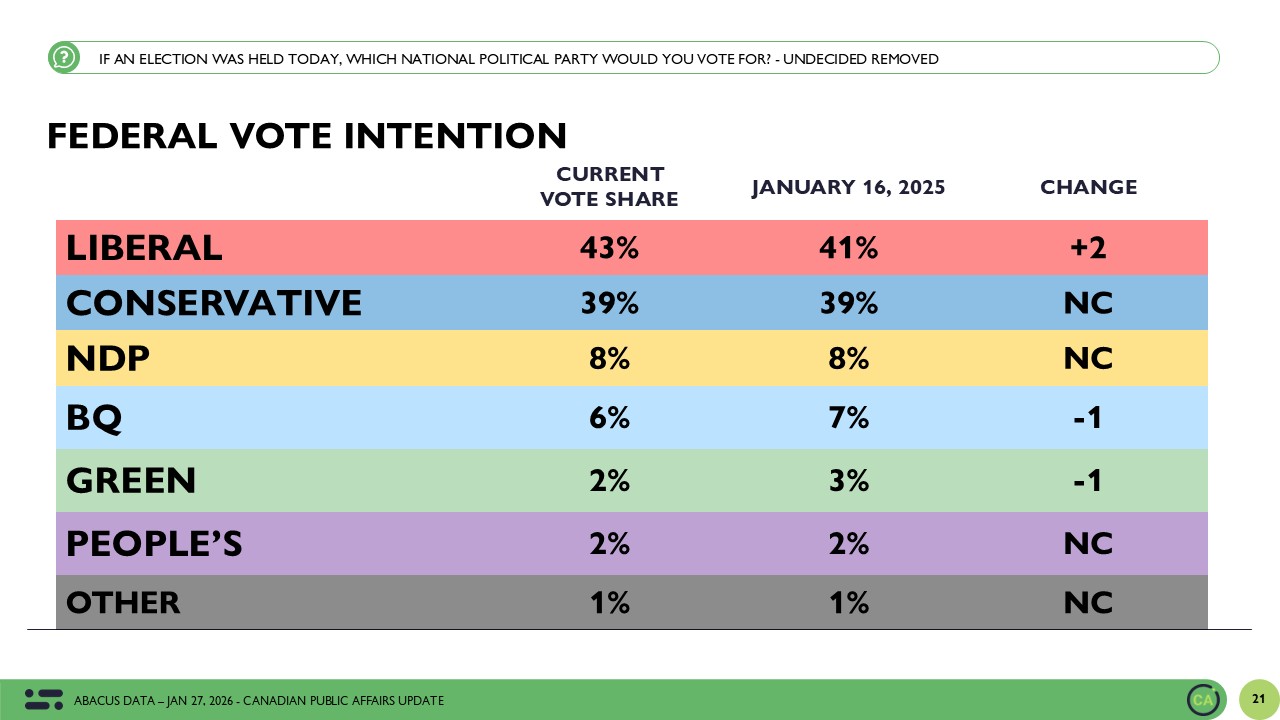
Abacus for Jan 22-27, 2026
Vote Intention
Liberal: 43%
Conservative: 39%
Leader Impressions
Carney: +23
Poilievre: -6
Government Approval
Approve: 54%
Disapprove: 31%
New Abacus Poll: Prime Minister Carney’s Standing Improves as Liberals Strengthen Ahead of Conservative Convention - Abacus Data
A new Abacus Data poll finds Mark Carney’s approval at a record high as Liberal support strengthens ahead of the Conservative convention.abacusdata.ca
Interestingly one of the few demographics that Poilievre has a positive impression (30 to 44), Carney is practically keeping pace (9% vs 10%). AB, MB and SK are doing a ton of heavy lifting for him. Liberals also appear to have largely recovered for the 18-29 range.

Best we can do is in-sourcing at three times the price and half the quality.Fortunately Canada has an entire industrial services sector that’s pretty good and building and sustaining a few hundred people in austere camps (with decent quality of life) way more remote than any of the locations under discussion. If CAF is serious about projecting more presence into the subarctic or Arctic, sustainment and infrastructure can be contracted out on the way to permanence as CAF builds the necessary capacity.

Similar to CFS Alert now.Fortunately Canada has an entire industrial services sector that’s pretty good and building and sustaining a few hundred people in austere camps (with decent quality of life) way more remote than any of the locations under discussion. If CAF is serious about projecting more presence into the subarctic or Arctic, sustainment and infrastructure can be contracted out on the way to permanence as CAF builds the necessary capacity.


Another for the chain, here's Mainstreet for Jan. 31-Feb. 2.

 www.mainstreetresearch.ca
This surge in support for the Carney Liberals is largely driven by a shift among voters under 35 who the Conservatives have led among for the past few years.
Atlantic Canada where the highest per capita active and retired Canadian forces personnel hail from appears to have taken the Trump insults about our participation in NATO personally”

 www.thestar.com
Deputy head of the Ontario NSP to run for the federal Liberals in Blair's riding.
Looks like they're stealing ideas from the CPC and people from the NSP, staking out a big tent.
How one defection to Mark Carney’s Liberals set off a political earthquake at Queen’s Park
MPP Doly Begum will run in the Scarborough Southwest byelection to replace Bill Blair, who stepped down yesterday.