• Thanks for stopping by. Logging in to a registered account will remove all generic ads. Please reach out with any questions or concerns.

Liberal (Minority/Majority) Government 2025 - ???

This has always happened, in many fields it makes complete sense and there is nothing we can do to prevent it other than putting up a wall and preventing people from leaving.

Tech/engineering? Much bigger sector in the States so there will be much more money to be made. Doctors? Yeah they can get paid more too. Actors, comedians, etc. yeah the States is the hub for all that and if you want to be a someone in those industries you basically have to go there (they also take from plenty of other developed nations too).

What your missing is we can’t afford to be like the states, no one can. Their deficits make ours seem like rounding errors and are only achievable due to them being the world currency. If they had to pay their share their taxes would skyrocket.

Lowering taxes a little wouldn’t change the people leaving, it would just mean less money in the pot.
All valid points.

I've given up on counting/tracking how many people I grew up with back in Windsor who left Canada for the US and have gone on to knock the cover off the ball in terms of success and wealth. Easily in excess of 2 dozen+ people. Heck, my first real girlfriend from high school stayed in the US after her CDN employer paid for her to do her MBA at Harvard. She simply transferred to their US, (it was a US company and she worked in their CDN offices in Toronto), HQ after graduating. She then went on to a number of greater responsibilities and successes at other US companies to where she now holds the title of 'President' for a large division in one of the oldest and most recognized banks in the US. If she had stayed here in Canada she would have had a stunted, limited number of options here. She was always a 'go-getter' and someone looking for the next challenge. I would venture to guess, knowing her role and the company, that her overall compensation is most likely 2-3X what she might make here. The US simply had alot more challenges and money available than Canada could ever offer.

For the others, alot, though not all, went for the challenges of trying to make it big in the 'big leagues' as well. It is sheer size that gets alot of them. Very few went because they didn't like Canada and its taxes - though for some that was the case.

What we experience is no difference than what Ireland/UK experiences or NZ/Australia and even Austria/Germany to a less extent. Its the smaller neighbour dealing with the large neighbour and all the extra's that can been seen across the way.

The best chance we have in dealing with it here is to try to aggressively rise the income levels/opportunities for those in the 40% of the population who pay nothing in income taxes so that this % falls to say only 25% of the population. This will place less strain on the 20% that is covering 65% of all income taxes in here. In combination, there really needs to be a lowering of the overall numbers of immigrants in the country and the rising of the skill set of those that are allowed in - couple that with a substantial effort retrain those individuals that are already here in Canada and are under-utilized.
 
All valid points.

I've given up on counting/tracking how many people I grew up with back in Windsor who left Canada for the US and have gone on to knock the cover off the ball in terms of success and wealth. Easily in excess of 2 dozen+ people. Heck, my first real girlfriend from high school stayed in the US after her CDN employer paid for her to do her MBA at Harvard. She simply transferred to their US, (it was a US company and she worked in their CDN offices in Toronto), HQ after graduating. She then went on to a number of greater responsibilities and successes at other US companies to where she now holds the title of 'President' for a large division in one of the oldest and most recognized banks in the US. If she had stayed here in Canada she would have had a stunted, limited number of options here. She was always a 'go-getter' and someone looking for the next challenge. I would venture to guess, knowing her role and the company, that her overall compensation is most likely 2-3X what she might make here. The US simply had alot more challenges and money available than Canada could ever offer.

For the others, alot, though not all, went for the challenges of trying to make it big in the 'big leagues' as well. It is sheer size that gets alot of them. Very few went because they didn't like Canada and its taxes - though for some that was the case.

What we experience is no difference than what Ireland/UK experiences or NZ/Australia and even Austria/Germany to a less extent. Its the smaller neighbour dealing with the large neighbour and all the extra's that can been seen across the way.

The best chance we have in dealing with it here is to try to aggressively rise the income levels/opportunities for those in the 40% of the population who pay nothing in income taxes so that this % falls to say only 25% of the population. This will place less strain on the 20% that is covering 65% of all income taxes in here. In combination, there really needs to be a lowering of the overall numbers of immigrants in the country and the rising of the skill set of those that are allowed in - couple that with a substantial effort retrain those individuals that are already here in Canada and are under-utilized.

I know a guy who went to the US and made a fortune in, I think, the IT sector.

I asked him what the difference is between the business environment in Canada and the US.

He said "In the US they kill you with encouragement... in Canada they treat you like dirt."
 
The erosion continues in other forms ...

Insolvencies jumped 11.5% annually in June, Canada’s bankruptcy monitor shows​

Consumers led the annual increase, though business filings were also on the rise year over year


Insolvencies in Canada are floating around levels not seen since the global financial crisis more than 15 years ago, new data shows.

The Office of the Superintendent of Bankruptcies released updated figures on Monday showing 13,254 insolvencies were filed in June, up 5.7% compared with May and 11.5% from a year ago.

Consumers — who make up the bulk of insolvency filings — led the annual increase, though business filings were also on the rise year over year.


I know a guy who went to the US and made a fortune in, I think, the IT sector.

I asked him what the difference is between the business environment in Canada and the US.

He said "In the US they kill you with encouragement... in Canada they treat you like dirt."
Spot on

I don't know how many times I've been told here by Canadian managers that I've had that 'I'm a squeaky wheel' because I call people out when deliverables are missed or that I'm trying to 'make others look bad' because I 'over deliver'. Never once have I heard that from a US based manager.

I have found over the years of being back here, that the Canadians that I enjoy working with the MOST are those who came from the Windsor to just east of London, Ontario area because without a doubt that ALL have an 'American' slant on how they conduct themselves and what they expect of their co-workers. The WORST Canadians that I have worked with are those that are 2+ generation Torontians - they are so full of themselves and are all 'collaborative based' on their manager style and expectations. They will hold meeting after meeting after meeting attempting to get everyone on side and in agreement on an issue before they make a decision - there is NO attempt by them to make a unilateral decision and direct others to go ahead and do it.
 
I'm actually a card carrying member of the LPC.
body-snatchers-b-1719035454788.gif
 
No clue.

But what have they done over the last 30yrs? This is not something that is new. It will always occur - no matter what we do. The bigger and brighter lights will always will appear to some. Its the 'being the biggest fish in the bigger pond'.
I am part of an association called the National Angel Capital Association. They have proposed a series of supports for entrepreneurs for inclusion in the next budget, mostly related to making it easier to access capital in Canada, so that the entrepreneurial class has some reasons to stay. So not nothing
 
Another difference many years ago I was told this by my GF who spent years in retail management after we finished talking with a young woman in store in the States.
In Canada you get an MBA in order to get out of retail management in the US you get an MBA in order to get into retail management.
 

Senate speaker spent close to $1M on 'courtesy calls' and other foreign travel, Taxpayers Federation finds

Raymonde Gagné, a self-professed 'avid traveller,' has made at least 14 international trips since she was appointed speaker of the Senate in 2023, records show


It's nice we can support an unelected officials expensive travel hobby.
 
Last edited:
Another difference many years ago I was told this by my GF who spent years in retail management after we finished talking with a young woman in store in the States.
In Canada you get an MBA in order to get out of retail management in the US you get an MBA in order to get into retail management.
Another thing to note is canada has a much smaller income disparity gap compared to the US.
 
Another thing to note is canada has a much smaller income disparity gap compared to the US.

We're lagging like crazy....

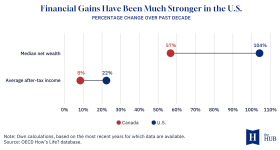
Beyond GDP: Americans’ net wealth has doubled over last decade, while Canadians’ lag far behind​

Canada’s growth trajectory relative to the U.S. is concerning, particularly when it comes to the measures most closely tied to income and work.

Specifically, over the past decade, Americans have seen much stronger financial gains compared to here at home. Average after-tax incomes stateside have risen by about 22 percent, and median net wealth has more than doubled.

In Canada, the progress has been far slower—about 8 percent and 57 percent, respectively. So, while some may criticize per capita GDP as an incomplete, abstract measure of income and prosperity, these OECD findings suggest that its decline is showing up in people’s paycheques, savings, and financial security.


1786662679258.png
 
We're lagging like crazy....

Beyond GDP: Americans’ net wealth has doubled over last decade, while Canadians’ lag far behind​

Canada’s growth trajectory relative to the U.S. is concerning, particularly when it comes to the measures most closely tied to income and work.

Specifically, over the past decade, Americans have seen much stronger financial gains compared to here at home. Average after-tax incomes stateside have risen by about 22 percent, and median net wealth has more than doubled.

In Canada, the progress has been far slower—about 8 percent and 57 percent, respectively. So, while some may criticize per capita GDP as an incomplete, abstract measure of income and prosperity, these OECD findings suggest that its decline is showing up in people’s paycheques, savings, and financial security.


View attachment 101742
Sigh...

Here I am to add context to your daily Canada bashing ritual.


Canada is the thirteenth richest nation in the world, according to a new report from Swiss bank, UBS.
Article content
According to the 2026 edition of the bank’s annual Global Wealth Report, global wealth grew rapidly in 2025, with personal wealth rising by over 10 per cent, the “fastest pace in years.”

The report points to North America as the richest region in the world, driven by the United States, which UBS says is the second richest country globally, with an average wealth per adult of US$696,277 ($988,000) in 2025. The U.S. sits behind Switzerland, which holds the top spot with an average wealth per adult of US$910,382 ($1.2 million).

Canada comes in at 13th place with an average wealth per adult of $567,000.
Yes we lag the USA. Also yes, we are outpacing most to the world.

and more on wealth inequality

The share of Canada’s adult population with assets above US$100,000 sits at about 55 per cent. Luxembourg is highest at more than 70 per cent, and Germany at the bottom with 45 per cent.
The yanks sit at 52 percent, despite having the advantage of all their assets being in USD.
 
How are we doing with insolvencies?
Consumer? USA is winning, but as an aside, most involvencies are consumer proposals in Canada, while I think the USA involves the courts more often.

Corporate? Canada is winning by far.

Business bankruptcies have risen steadily since 2023, reflecting a broad-based increase in financial stress across the economy. After reaching historically low levels during and immediately following the pandemic, filings have increased for three consecutive years, driven by higher interest rates, inflation, tighter credit conditions, rising labor costs, and mounting debt burdens. The first half of 2026 indicates that the upward trend remains intact, particularly among small and middle-market companies. The current trajectory suggests a prolonged restructuring cycle rather than a temporary blip.

U.S. business bankruptcy filing trends in 2026​

Business bankruptcy filings increased from 17,051 in 2023 to 22,762 in 2024 and 24,039 in 2025, representing cumulative growth of approximately 41% over two years. During the first six months of 2026, business filings reached 17,285, a 13% increase over the same period in 2025. At the current pace, full-year 2026 filings are likely to exceed 2025 levels.

Chapter 11 filings continue to rise​

Commercial Chapter 11 filings, often viewed as a leading indicator of corporate distress, increased 28% year-over-year during the first half of 2026. In the first quarter alone, Chapter 11 filings rose 37%, signaling growing pressure on companies seeking to restructure rather than liquidate.


In 2025, Canada's restructuring landscape painted apicture of two distinct economies. While householdfinancial pressures kept consumer insolvency filingshigh, corporate insolvency filings settled back to moretypical levels compared to the peak activity of 2024.Corporate insolvencies saw a slight dip in 2025,thanks to reduced borrowing costs, proactive lenderactions, and stabilized costs as both consumers andbusinesses adjusted their spending. The Office of theSuperintendent of Bankruptcy (OSB) noted a 23%drop in total corporate filings nationwide over the12 months leading to November 2025.
 
Back
Top