• Thanks for stopping by. Logging in to a registered account will remove all generic ads. Please reach out with any questions or concerns.

Canadian Centurion tank

Old Naval Guard

Jr. Member
Inactive
Reaction score
0
Points
110
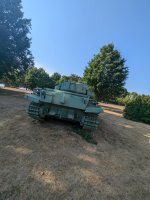
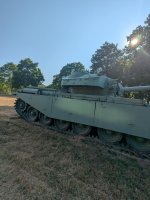
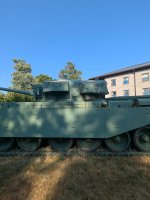
Hello, Ive been trying to find a Centurion tank 1/35 Scale. I am looking to make it as a tank in the Cdn army circa 1965, 4 brigade in Germany, during the Cold War. Does any one know what a tank like that would look like in terms of unit insignia, National Flag postion. I posted a pic of the Centurion. Don't know if its Canadian, but looks the part Cheers thanks in advance Old Naval Guard


(Moderator edit to correct misspelling of "Canadian" in thread title.)
 
The armoured regiment in 4 CIBG at the start of 1965 was the Fort Garry Horse. I am pretty sure it was replaced as a normal rotation by Lord Strathcona's Horse (Royal Canadians.) In 1965 the Centurions were being upgraded with a suite that included IR searchlight, ranging machine gun and extra armour. I think they already had the extra fuel bustle at the rear of the hull. (One of the projects I had at 4 CIBG HQ was the upgrade of the 75 or so Centurions to about Mk 15 status. As I had trouble spelling tank, I did a lot of study, which is why I can recall a bit of it.)

The tanks were painted in a dark camo pattern with, oddly, the radio antennas painted in a black and white barber pole design. They did not use the Canadian flag as an identifier, but instead used a red square with a gold maple leaf in it. The other identifier was a square with a top right - bottom left divider with yellow and red (I think. Give me a break as it was 45 years ago) as the two colours with a 2 superimposed on it. This identified it as the brigade armoured regiment. I can't recall details of the CFR number and the bridge classification, other than that the latter was a circle with the classification in it.
 
Thanks Old Sweat, just out of curiosity, They never used the Cdn Red Ensgin on the tanks as they did the maple leaf flag?/ The red patch with the gold maple leaf is of WW2 orgins is it  not ? Thanks and cheers Old Naval Guard
 
I do not recall seeing the Red Ensign on any vehicle. The red square probably was meant to identify the First Canadian Division; certainly we all wore the old red pactch on our sleeves back then. While the army had dropped the division and replaced it with independent brigade groups in the late fifties, there was a plan to reconstitute the division cicra 1965. Integration took care of that.
 
Early 70's was all camo. No reds or yellows. Flags, identifiers and bridge classes would be black on green or green on black. Bridge class, IIRC, was 52 or 54 inside a circle. I'm going to have to dig out my pictures to try find out styles and locations. (I spent all my time inside one, not outide ;) ) The outsides were painted standard two green and black camo with the insides painted a dull aluminum silver colour. 105 mm with fume extractor on the barrel , 100 gallon knock off fuel tank on the back and a basket around the whole rear of the turret. CFR's were painted on the front top left and right of the first (forward) track skirt in the style of (I can never forget it) 51-81355. At various times, depending on availability, we had either the full steel war track, or the track with three rubber pads per link. We stopped using white on the antennae and if they were painted it would have been with green or black. Sometimes they were, sometimes they weren't. Call signs ie: 12A were painted centrally on the middle sideskirt

 
I think we were still using Mk 6 Cents in 1965? There is a decent kit of the Mk 6 here, which actually includes the parts to make it a later Mk 11 if you want.

http://store.spruebrothers.com/135-afv-club-centurion-mk-52-6-nato-105mm-gun-35122-p7248.aspx

Interestingly about the FGH was they used a cam scheme that was relatively short lived. There's an interpretation of it in Pet (at least there was a few year back). Totally recommend tracking down this magazine, or, for $1UK, you can download the pdf:
http://shop.afvmodeller.com/customer/product.php?productid=17175&cat=&page=1

lastly, lots of help on this web page:
http://www.network54.com/Forum/169232/
 
Hi ONG here . I wish to make a M113 companion to my Centurion tanks. Can anyone describe how a Canadian Army M113 would have looked in 4Brigade circa 1966-67. Any pics would be useful. I have a pic,but its CF. Thanks in advance Old Naval Guard
 
Larry Strong said:
This should help some I hope.


http://www.armouredacorn.com/

Old Naval Guard

Do you just post or do you read any of what is given you?  This link gives you pictures of M113's, M109's, M577's, Leopards and Centurians.
 
Mea culpa, I only just looked at the gallery sorry about that and thanks very much. Old Naval Guard
 
In 1966 the decision was made to paint the 4 CIBG M113A1s in disruptive pattern. I believe the proposal came from 2 RCR. There was a fair amount to chatter and discussion re pattern, but eventually it got done. This was another project I got, probably because I was industrious and not quite stupid enough to screw everything up. A trial was done with various patterns and colour combinations. The one selected was picked because it fitted best into the North German terrain and fauna.

It was at about that same time that the Second World War style tac signs were changed to the current one based on military symbols and call signs.
 
Early 70's was all camo. No reds or yellows. Flags, identifiers and bridge classes would be black on green or green on black. Bridge class, IIRC, was 52 or 54 inside a circle. I'm going to have to dig out my pictures to try find out styles and locations. (I spent all my time inside one, not outide ;) ) The outsides were painted standard two green and black camo with the insides painted a dull aluminum silver colour. 105 mm with fume extractor on the barrel , 100 gallon knock off fuel tank on the back and a basket around the whole rear of the turret. CFR's were painted on the front top left and right of the first (forward) track skirt in the style of (I can never forget it) 51-81355. At various times, depending on availability, we had either the full steel war track, or the track with three rubber pads per link. We stopped using white on the antennae and if they were painted it would have been with green or black. Sometimes they were, sometimes they weren't. Call signs ie: 12A were painted centrally on the middle sideskirt
Im looking to build an early 70s Centurion, do you have any photos from this time period??
 
Im looking to build an early 70s Centurion, do you have any photos from this time period.

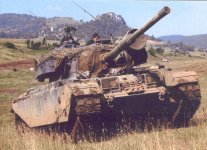
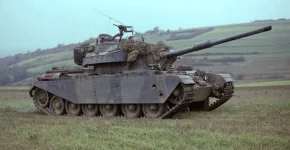
The two photos below are from after the 1970 move of the Canadians from Northern to Southern Germany.

By 1970, Canadian Centurions in Germany had been upgraded to Mk. 11 standard by having the front glacis up-armoured, the main armament upgunned with the installation of the L7A1 105mm gun with a .50-cal ranging machine-gun (RMG), and the installation of infrared kit.

The L7A1 gun is distinguishable by the squared edged, eccentrically mounted fume extractor (as opposed to the concentrically mounted one the 20-pdr) without barrel counterweights. The RMG is installed to the left on the mantlet.

The infrared kit consisted of the light mounted on the forward left side of the turret (it's in the rear cage in the second photo), the dual headlights with guards on the glacis, and 12" spotlights on the commander's cupola.

Other changes made to Canadian tanks, while not visible in the first photo, include the addition of a storage cage on the rear of the turret and a 100 gallon long range (LR) fuel tank on the rear of the tank itself (not visible in either). Sometimes you'll see Canadian tanks referred to as Mk. 11LR online. There were also foot holds cut into the side skirts.

Note that the Centurion has been fitted with the rubber padded "hush puppy" tracks. By 1970 the tanks in Europe were painted in a three-tone CF colour scheme. Two shades of green and black. Also note that the British style markings are gone and the antennae mounts are American.

If you have any further questions, feel free to ask.

Centurion Mk11 1975 snh5cb8.jpg
Centurion south of Wurzburg Oct 75.webp
 
Anyone have any advice for converting a Mk5 into a Canadian Centurion from the early 1970s ?
Actually it takes little conversion because Canada had some 241 Mark 5s (20 pdrs) in service here in Canada. It was only in Europe that some 75 Mark 11s (105mm) were deployed and used.

There is no shortage of pictures on the internet of our tanks in Germany like these here. For really detailed information my guess is that the Ontario Regiment Museum/Canadian Tank Museum in Oshawa would be your best bet.

🍻
 
The two photos below are from after the 1970 move of the Canadians from Northern to Southern Germany.

By 1970, Canadian Centurions in Germany had been upgraded to Mk. 11 standard by having the front glacis up-armoured, the main armament upgunned with the installation of the L7A1 105mm gun with a .50-cal ranging machine-gun (RMG), and the installation of infrared kit.

The L7A1 gun is distinguishable by the squared edged, eccentrically mounted fume extractor (as opposed to the concentrically mounted one the 20-pdr) without barrel counterweights. The RMG is installed to the left on the mantlet.

The infrared kit consisted of the light mounted on the forward left side of the turret (it's in the rear cage in the second photo), the dual headlights with guards on the glacis, and 12" spotlights on the commander's cupola.

Other changes made to Canadian tanks, while not visible in the first photo, include the addition of a storage cage on the rear of the turret and a 100 gallon long range (LR) fuel tank on the rear of the tank itself (not visible in either). Sometimes you'll see Canadian tanks referred to as Mk. 11LR online. There were also foot holds cut into the side skirts.

Note that the Centurion has been fitted with the rubber padded "hush puppy" tracks. By 1970 the tanks in Europe were painted in a three-tone CF colour scheme. Two shades of green and black. Also note that the British style markings are gone and the antennae mounts are American.

If you have any further questions, feel free to ask.

That is amazing information thank you so much, I'll be back tomorrow I have a couple things I will screenshot to see if they are viable references. You were saying by 1970 they were a 3 tone, maybe it's just hard to see because of the photo but I only see the green and black, do you know of a good camoflauge or paint color diagram for this camoflauge? My goal is to make my Opas tank when I figure out which troop and tank he was in when he was there, as well there really isn't a lot of Canadian markings by this time is there? I expected to see like a troop number or vehicle number or even a Canadian flag or RCD identifier somewhere, thank you for your response ill definitely be using this information, the tank im getting as a base is going to need to be reguned for sure as well as the headlights are stacked ontop of eachother rather then like the Canadian ones are here so I'll need to find a way to replicate the later headlights too
 
Actually it takes little conversion because Canada had some 241 Mark 5s (20 pdrs) in service here in Canada. It was only in Europe that some 75 Mark 11s (105mm) were deployed and used.

There is no shortage of pictures on the internet of our tanks in Germany like these here. For really detailed information my guess is that the Ontario Regiment Museum/Canadian Tank Museum in Oshawa would be your best bet.

🍻
Im actually trying to make an RCD Centurion from the 1970 posting before the Leopards came, my Opa was there before he passed in 1990, do you know if the Ontario Regiment museum has the paint scheme for this era of Centurion by chance?
 
You were saying by 1970 they were a 3 tone, maybe it's just hard to see because of the photo but I only see the green and black, do you know of a good camoflauge or paint color diagram for this camoflauge?
The colours changed quite a bit either side of the year 1970. There's a good article here on Canadian paint schemes with some advice for modellers. The NATO specified paint scheme of green, brown and black became de rigueur both in Canada and Germany. When I joined in 1965 the colours across the board were a one-tone olive drab. In 1970 we were repainting vehicles like crazy in Canada. In Germany they were slightly ahead of us. The colours are not always stable because vehicles quickly became dirty with dust and grime and faded a bit with time.

My own experience from that time frame was on the artillery's M109. There's an image here from one that has been decommissioned as a memorial and been properly painted. This is the way the NATO paint scheme would look when fresh and clean.

50030741636_8eb54be866_b.jpg

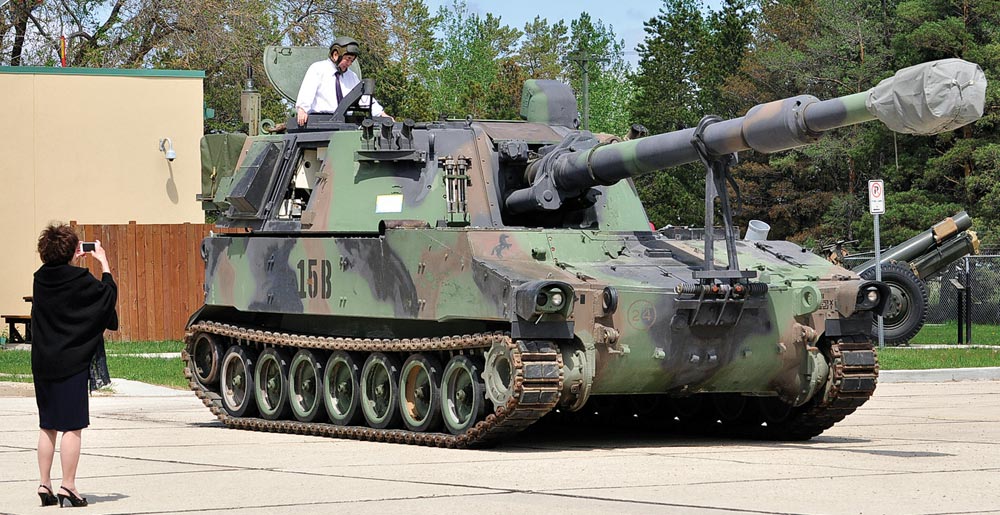
And one at the end of its days in Shilo.

M109-Lt-Gov-ride.jpg


I include this one so that you can see the minimalist tac signage we went to. On the side is the vehicle's tac sign (in this case the B detachment of the regiment's senior battery; "G" Bty) On the front right side (next to the headlight) is a small Canadian flag, just to its right is the bridge tonnage "24" in a circle, and on the right front (just this side of the other headlight) the NATO tactical symbol for a tracked self propelled regiment with a 3 on the left (for 3 RCHA) and a 1 on the right (for 1 CMBG). My recollection that that was basically the approved standard tac signage and location for all vehicles. (although unit quiffs would add the odd unique symbol. Note, for example, the small rearing stallion further up on the right which is a non-NATO standard symbol for horse artillery regiments.)

You can clearly see the difference in shading on the paint. The stuff was non-reflective and hard to keep pristinely clean.

Im actually trying to make an RCD Centurion from the 1970 posting before the Leopards came, my Opa was there before he passed in 1990, do you know if the Ontario Regiment museum has the paint scheme for this era of Centurion by chance?
I'm quite sure they would have very detailed information.

Happy modeling.

🍻
 
Back
Top