
• Thanks for stopping by. Logging in to a registered account will remove all generic ads. Please reach out with any questions or concerns.

Allied Officers Concerned by Lack of Afghan Forces

Yrys

Army.ca Veteran
Subscriber
Reaction score
35
Points
560
Allied Officers Concerned by Lack of Afghan Forces, NY Times
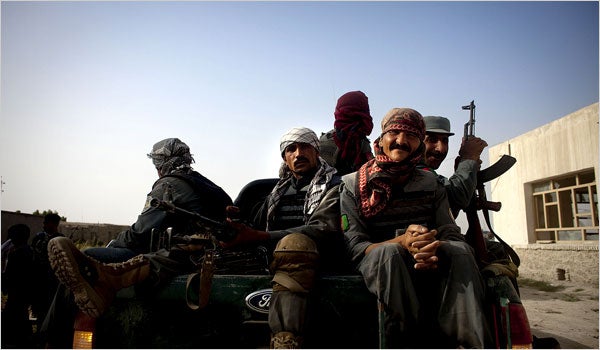
08afghan.600.jpg


NAWA, Afghanistan — One week after several battalions of Marines swept
through the Helmand River valley, military commanders appear increasingly
concerned about a lack of Afghan forces in the field.

“What I need is more Afghans,” said Brig. Gen. Larry Nicholson, commander
of the Marine expeditionary brigade in Helmand Province. He accompanied
the top American commander in Afghanistan, Gen. Stanley A. McChrystal,
during a visit with troops at Patrol Base Jaker here on Monday.

General Nicholson and others say that the long-term success of the operation
hinges on the performance of the Afghan security forces, which will have to
take over eventually from the American troops. General Nicholson said the
American force of almost 4,000 had been joined by about 400 effective
Afghan soldiers. “The net increase in Afghan security forces is zero” since
the brigade arrived a few months ago, he said. The lack of Afghan forces
“is absolutely our Achilles’ heel,” added Capt. Brian Huysman, commander
of Company C of the First Battalion, Fifth Marines in Nawa.

Captain Huysman said the Afghan forces were critically important in
establishing trust and communication with citizens. “We can’t read these
people; we’re different,” he said. “They’re not going to tell us the truth.
We’ll never get to build and transition” — the last phase of the operation —
“unless we have the Afghans.” American military officials say they want at
least a full brigade of Afghan forces in Helmand, thousands more than are
here now.

NATO forces said Tuesday that three foreign soldiers, two Canadians and a
Briton, died in a helicopter crash in the southern province of Zabul on Monday,
already the deadliest day for American forces in Afghanistan in nearly a year.
Of seven United States soldiers killed Monday, said Capt. Jon Stock, an American
military spokesman, six died in bomb explosions and one in a firefight.

The Marine operation that began last week appeared to overwhelm the Taliban
fighters who have long dominated this region, which provides a large part of
the raw opium the Taliban use to finance operations throughout the country.
But commanders believe that the Taliban made a calculated decision to
retreat, leaving the Marines with little resistance so far.

For now, many Taliban are believed to have pulled back to more remote locations,
like Marjah, a village west of here, to regroup and try to figure out how to reassert
themselves in an area so crucial to financing their guerrilla campaign. “This is the
engine that drives the Taliban,” General Nicholson said, referring to the lush canal-
fed land along the Helmand River that produces much of Afghanistan’s opium poppy
crop.

At the meeting in Nawa, General McChrystal asked for input from the assembled
officers. A British Army officer, Maj. Rob Gallimore, who leads a team training
Afghan soldiers, responded bluntly: While the success of the weeklong operation
had been “staggering,” he said, he was worried what would happen if the
necessary complement of Afghan forces did not materialize. “To drop it by a lack
of men would be criminal,” he said.

General McChrystal emphasized that the operation needed to show the local people
quickly that they had more to gain from life without the Taliban than with them. The
military “got a lot of fanfare” during the initial push last week, the general said, and
now has to deliver on its promises. “Militarily, you can think you can control areas,
but sociologically if you don’t control them, you’re not going to be able to do what
we need to do here,” he said.

General Nicholson added that the operation had a “narrow window of opportunity.”
In a month, he said, the people will say you “came in and chased the Taliban away.”

“But how is my life better? How is your presence benefiting me and my family?”

Abdul Waheed Wafa and Muhibullah Habibi contributed reporting from Kabul,
Afghanistan.
 
From BruceR at Flit:
http://www.snappingturtle.net/flit/archives/2009_07_08.html#006465

ANSF deployment limits: people starting to notice?

Today's essential Afghan reading

Mark
Ottawa
 
Managing expectations in Afghanistan can be difficult when new senior leaders expect the impossible overnight.  It takes time to train and convince Afghan troops to assume the burden of holding dangerous (if not deadly) ground with a few Hummers and a few rifles while the shiny well-equipped Marine Corps withdraw.
 
More from BruceR:

Tomorrow's essential Afghan reading, early
http://www.snappingturtle.net/flit/archives/2009_07_08.html#006466

Didn't want to wait until tomorrow. This is spot-on analysis, by Australian MGen (retd.) Jim Molan.
http://www.lowyinterpreter.org/post/2009/07/06/Thoughts-on-the-current-operations-in-southern-Afghanistan.aspx
I think it goes a long way toward explaining the odd remarks on the lack of ANSF in the NYT...

Mark
Ottawa
 
Ralph Peters:

http://www.nypost.com/seven/07092009/postopinion/opedcolumnists/untrustworthy_tribes_178289.htm

LAST week, 4,000 US Marines launched a major operation in Helmand, the poppy- queen province in southern Afghanistan. The Marines performed magnificently, reaching their objectives with minimal casualties -- mostly from the 110-degree heat. But something important was missing: Afghans in uniform.

A few hundred Afghan players showed up in the backfield. But the village elders saw American guns.

The Marine mission is to provide security for villagers, build trust and instill confidence in the Kabul government. This would all be far easier if the Afghan military and police were competent, trustworthy and present.

After 7½ years in Afghanistan and despite extensive efforts, we and our NATO allies have produced only a now-you-see-'em-now-you-don't Afghan army. The police are corrupt, partisan and loathed by the population.

We made better, if imperfect, progress in Iraq. Yet there, too, questions remain about the integrity of the military and the utility of the police.

What's the problem? Why haven't years of effort and billions of dollars, coupled with our training expertise, forged fully reliable military units and constabularies? The answer lies in our own military culture.

As an officer, I knew I could walk into any Army outfit and find 100 percent support for the assigned mission. It didn't matter whether or not we liked each other personally, or which state we were from, or what our religion or ethnicity happened to be. We were all American soldiers.

But the various peoples we called "Afghans" (or "Iraqis") have very different values. In Afghanistan, an ethnic Tajik lieutenant isn't sure he can rely on a Pashtun major. In Iraq, a Shia officer may not share all he knows about the enemy with a Sunni counterpart.

Our military system and its successes are built on trust. The other stuff's important: marksmanship, fire discipline, skilled maneuver, equipment, maintenance, etc. But the key element is teamwork. We win on the battlefield, because we can count on each other.

Sounds simple. It ain't.
 
I would suggest that respectable leadership is even more important.  It is one thing to train young Afghan soldiers and policemen, it is another to convince their leaders at all levels to place lives and livelihoods at risk in keeping with the aims of the contributing nations.
 
Frostnipped Elf said:
I would suggest that respectable leadership is even more important.  It is one thing to train young Afghan soldiers and policemen, it is another to convince their leaders at all levels to place lives and livelihoods at risk in keeping with the aims of the contributing nations.

In looking at previous operations, this has not been a factor.  In fact quite to opposite was true.  The Afghan leadership was very aggressive, and actually had to be reigned in and stopped from rushing in to attack Taliban positions.
 
So what's changed? Is it the way the US is handling the transition and buildup, or is it that the ANA is being asked to make a serious commitment that might blow back on them in the form of retaliation to them and their families, etc....
 
There has not been a large formation of ANA troops in Marine AO.  They had to be moved from other areas closer to Kandahar on a case by case, op by op basis. 
 
Torch post, based on three by BruceR:

More on ANSF training problems/Future scale of operations
http://toyoufromfailinghands.blogspot.com/2009/07/more-on-ansf-training-problemsfuture.html

Mark
Ottawa
 
I'd love to hear comments from anyone who's been downrange on this tidbit that jumped out at me from BruceR's essay-in-progress re:  what he sees as the "un-mix-and-match-ability" of different AFG units trained/mentored by different Coalition OMLTs in different regions/sectors:
.... For obvious reasons, the NATO country that's providing the ground force element in a specific province or region tends to also provide the ANA mentors. It's hard enough to bridge the cultural divides between Afghans and the West without also bringing in any potential element of friction between a battalion commander from one NATO country and a senior mentor from another. All well and good, but now you've tied that Afghan kandak and all its personnel to the province that country is operating in.

Suppose the Afghan Army high command wanted to reinforce a province like Helmand with another few Kandaks right now. Well, you've got two alternatives there. You can either deploy the Afghans unmentored, at which point it now becomes a new burden on the Western forces in that area to take a couple hundred soldiers away from their other duties, because they're sure as heck not going to be able to have ANA in the battlespace, intermixed with their own units, without that liaison. (Plus another couple hundred Western mentors in the originating region would be out of a job, which the donating country might not appreciate.)

Or you bring the other country's mentors along with you. Which could create all kinds of impossible-to-solve problems for NATO chains of authority and logistics. The mentoring nations may have caveats that prevent them from deploying to a combat zone, to start with. So in the end, the path of least resistance prevails, and the mentors -- and their Afghans -- stay right where they are ....
 
Tony: How well selected.  Have been wondering about that sort of thing for some time.

Mark
Ottawa
 
The size of the mentoring unit varies by province as does their success.  Mixing things up is a crap shoot. The readiness level of the Kandaks range from - able to function at section level to conduct un-mentored Battalion ops. 

An interesting look at Canadian Mentorship is shown here: http://www.afghanistan.gc.ca/canada-afghanistan/progress-progres/benchmarks-reperes/priorit1.aspx  Date Modified: 2009-03-04

Note for example: 

Benchmark 1 - Increase in the number of ANA kandaks (army battalions) in Kandahar capable of conducting near-autonomous security operations, and increase in the capability of their brigade headquarters.
Progress Indicator: The number of ANA kandaks (and their brigade headquarters) capable of planning, executing and sustaining near-autonomous operations.
Baseline: One of the five ANA kandaks is fully capable of planning, executing and sustaining near-autonomous operations (June 2008).
2011 Target: To have four of the five ANA kandaks (and their brigade headquarters) fully capable of planning, executing and sustaining near-autonomous operations.
Quarterly Result: The ANA brigade headquarters and one of the five kandaks are fully capable of planning, executing and sustaining near-autonomous operations.

Benchmark 3:
ANA responsible for security in more of the six key districts of Kandahar.
Progress Indicator: A progressive increase in the number of key districts in which the ANA is responsible for security, with fewer supporting ISAF troops.
Baseline: The ANA is responsible for security in one of the six key districts (June 2008).


Benchmark 6 - Increased Afghan National Police (ANP) capacity to provide effective police services in key districts of Kandahar.
Progress Indicator: The number of ANP trained in Kandahar.
Baseline: 25% of the ANP in key districts have completed Focused District Development (FDD) training (August 2008). [1]
Progress Indicator: The number of ANP forces in key districts capable of planning, executing and sustaining near-autonomous operations
Baseline: 0% of ANP forces in key districts are capable of planning, executing and sustaining near-autonomous operations (August 2008).
2011 Target: 80% of ANP forces in key districts are capable of planning, executing and sustaining near-autonomous operations.
Quarterly Result: The number of police units assessed as capable of conducting basic law and order operations (which equates to sustaining near-autonomous operations) has declined from two to one this quarter. This represents a total of 6% of the existing 17 police units in key districts (results based on November 2008 reporting).


Things change: From BruceR:

DOD June report, part 3
http://www.snappingturtle.net/flit/archives/2009_07_09.html#006469

More:
http://www.defenselink.mil/pubs/pdfs/Measuring_Stability_and_Security_in_Afghanistan_June_2009.pdf

UPDATE: The new 1230 report to Congress linked in this and the two posts below has been pulled from the DOD site today, after being put up yesterday. MTF, I'm sure, but until I know it's been made public (as it's supposed to be, in some form) I'll have to pull all the excerpts. The previous report, from January, is here,
http://www.defenselink.mil/pubs/OCTOBER_1230_FINAL.pdf in case you're curious, and says many of the same things about security, current ANSF weakness, and shortages of Western mentor teams.

Torch update from Damian Brooks:
http://toyoufromfailinghands.blogspot.com/2009/07/inadvertent-disclosure.html

Mark
Ottawa
 
Things change again, DoD report now available again, BruceR via The Torch:

More on ANSF training problems/Future scale of operations
http://toyoufromfailinghands.blogspot.com/2009/07/more-on-ansf-training-problemsfuture_09.html

Mark
Ottawa
 
More along these lines from the Washington Post on the AFG police side of the equation:
The extent of the push by 4,500 Marines into Taliban strongholds of southern Helmand will be determined, to a degree, by whether there are enough qualified Afghan forces to partner with and eventually leave behind to protect Afghan civilians. Brig. Gen. Lawrence D. Nicholson, commander of the Marine forces here, said urgent efforts are underway to dispatch additional Afghan forces to Helmand.

But here in Helmand's Garmsir district -- as in much of the south -- Afghan forces remain few in number, as well as short of training, equipment and basic supplies such as fuel and ammunition.

"Without the Marines, we cannot secure the stations," said Mohammed Agha, deputy commander of the roughly 80 Garmsir police officers. "We can't go to other villages because of the mines, and some people have weapons hidden in their houses. We can't go out of Garmsir, or we will be killed."

"It's a challenge to get people down here," said Hix, adding that units that deploy to southern Afghanistan often suffer higher rates of unauthorized absences. "The guys think there is a monster down here."
 
What a difference 9 months ago was in Garmsir region.

Then 8 Sep 08 - Link - http://www.iimefpublic.usmc.mil/public/infolineMarines.nsf/(ArticlesRead)/FC76D71B24F3310A852574C000572057?OpenDocument

"On September 8, 2008, the 24th MEU returned control of Garmsir to British forces, after having operated in the area for approximately 130 days. The town was deemed safe and more stable." 

With support from Afghanistan National Army, Security Force and Border Patrol, the British Army will again oversee security operations in this region, an area far more secure than the one they patrolled less than six months ago, a testament to the MEU’s success.

“The most important measure of success is the improved quality of life and return to normalcy for the citizens of Garmsir.  The reconstruction and development and the active role of the Government of the Islamic Republic of Afghanistan in making that happen were all made possible by the stable environment created and maintained by the MEU,” said Col. Peter Petronzio, commanding officer, 24th MEU, ISAF.

Marines may be leaving, but all forces involved have worked hard to ensure the only change the people of Garmsir see in security are the uniforms of the people protecting them."
 
Back
Top