- Reaction score
- 4,392
- Points
- 1,190
We have cutlasses on the CPFs...What no cutlasses?


We have cutlasses on the CPFs...What no cutlasses?


Now you just need eye patches and parrotsWe have cutlasses on the CPFs...

Not required for Class 1 and 2 drones (except for the Sgt needed to do the aircertification paperwork or somsuch).Because the Air Force.

The ComdRCAF is still the airworthiness authority (AA) and the Sgt is a reachback into the entire airworthiness program. Ie the processes the Minister wants done to cover his &$$Not required for Class 1 and 2 drones (except for the Sgt needed to do the aircertification paperwork or somsuch).

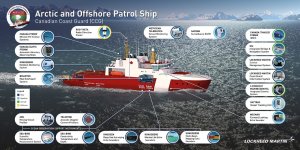
This is excellent. I'm suprised by the large numbers of surveillance gear types they have. EO/IR, Vessel Tracking Unit, Vessel Monitoring System, RDF, Automatic Voluntary Obeserving Ships system and of course their normal radar etc...View attachment 97033
LM Canada recently released an infographic showing some of the internal/external equipment differences between the CCG and RCN AOPS variants. Apologies for the quality, but it is the best they provided.
Amusingly as well, the CCG AOPS variants will also be using a derivative of CMS-330 designed for the Coast Guard. These new vessels will be a huge boost in capability for the CCG compared to their 1970's and 1980's veteran vessels of similar types.This is excellent. I'm suprised by the large numbers of surveillance gear types they have. EO/IR, Vessel Tracking Unit, Vessel Monitoring System, RDF, Automatic Voluntary Obeserving Ships system and of course their normal radar etc...
Yes I know a lot of these things are for SAR, fisheries and pollution monitoring, but they are dual use.
The team is designing and building the Coast Guard Information System and the Science Management System, which is a derivative of the Command Management System 330 a Canadian-built technology that is setting the industry standard today. Brian’s team is responsible for adapting this system for the CCG to enhance situational awareness through data display, capture, and assessment.

Not really, if you understand how the AOPS was purchased.It would be ironic that the CCG has theirs certified for helicopters before the RCN.


It's much stupider than that; there were issues with the lighting, comms, fire fighting, refueling and all kinds of other things that didn't actually work on delivery.The helicopter thing is just.........

End of the day lots of people and organizations dropped the ball. They should of been all over all aspects of the certification. We're working towards Hampton Grays transit to the west coast that is expected to have a CG helo and det onboard and what that looks like.It's much stupider than that; there were issues with the lighting, comms, fire fighting, refueling and all kinds of other things that didn't actually work on delivery.
A lot of them were requirements and all identified during SHOL trials on HDW; (along with over 4000 other defects). They were accepted anyway for political reasons, not changed in the subsequent builds for schedule/cost reasons, and the RCN didn't really care about it until the RCAF air worthiness folks said they couldn't waive the requirements and accept the risk like they normally do.End of the day lots of people and organizations dropped the ball. They should of been all over all aspects of the certification. We're working towards Hampton Grays transit to the west coast that is expected to have a CG helo and det onboard and what that looks like.

Here’s to hoping it’s not the same group assigned to the Rivers and their RCAF requirements.A lot of them were requirements and all identified during SHOL trials on HDW; (along with over 4000 other defects). They were accepted anyway for political reasons, not changed in the subsequent builds for schedule/cost reasons, and the RCN didn't really care about it until the RCAF air worthiness folks said they couldn't waive the requirements and accept the risk like they normally do.
AJISS was delayed in getting in place, then Thales had a hard time hiring people (or generally slow to do it), with a lot not having much marine/naval experience so has been slow going getting up to speed as well on that. The PMO gave $20M I think to fix some of these issues but it's a drop in the bucket.
For the first couple of years, they had their hands full fixing the engines/generators, main fitted system not working, anchor pocket causing flooding and other basic issues, so taking them a while to get to the helo side. We also didn't develop SOPs until MAX last year, which was when we realized there were other issues, so lot of challenges everywhere.
Not optimistic any lessons where learned, as we're running down the same path the JSS and doesn't look like that HCRFF equipment will be suitable either (and will need more trained people), but who knows, maybe it'll be better built by Seaspan to start with, and just can do tweaks, not full replacements for what doesn't work.

A lot of them were requirements and all identified during SHOL trials on HDW; (along with over 4000 other defects). They were accepted anyway for political reasons, not changed in the subsequent builds for schedule/cost reasons, and the RCN didn't really care about it until the RCAF air worthiness folks said they couldn't waive the requirements and accept the risk like they normally do.
AJISS was delayed in getting in place, then Thales had a hard time hiring people (or generally slow to do it), with a lot not having much marine/naval experience so has been slow going getting up to speed as well on that. The PMO gave $20M I think to fix some of these issues but it's a drop in the bucket.
For the first couple of years, they had their hands full fixing the engines/generators, main fitted system not working, anchor pocket causing flooding and other basic issues, so taking them a while to get to the helo side. We also didn't develop SOPs until MAX last year, which was when we realized there were other issues, so lot of challenges everywhere.
Not optimistic any lessons where learned, as we're running down the same path the JSS and doesn't look like that HCRFF equipment will be suitable either (and will need more trained people), but who knows, maybe it'll be better built by Seaspan to start with, and just can do tweaks, not full replacements for what doesn't work.
Not really, just different people not talking to each other, plans getting delayed, etc. Normal things I guess for organizations this size and budgets that big, but at the same time we also put way more faith in class society recommendations and ignore internal SMEs, who take into account what we actually do, so lead to things like helo crash FF systems that don't meet the actual RCN or RCAF requirements but tick some IMO boxes that don't actually apply.That sounds a lot like the Brit Ajax saga.
Too big to fail?

AOPS is probably not going there.I just saw that the Minister of Defense announced that a Canadian warship would be in Greenland next week for the opening of the Canadian consulate. I can only assume that , at this of year, it will be one of the AOPS.
Anyone knows which one?