daftandbarmy
Army.ca Fossil
- Reaction score
- 48,630
- Points
- 1,160
Are things bad enough that cannibalizing the cadet organization is really worth talking about?
Based on the size of the instructor in this photo you’d need a pretty hungry cannibal



Are things bad enough that cannibalizing the cadet organization is really worth talking about?

Thanks, didn't realize the cost was so high, plenty of land available to make out door ranges. Especially at some of the cadet camps in the Rockies.Figure a million dollars a lane at that point — on top of a ~10m initial investment.
On top of air handler issues, the confined space increases risks of TBI/CSE. Even suppressed carbine/rifle fire isn’t hearing safe / and so to make safe working conditions one end up with a much larger range.
So your 10 lane range is now widened to what 30-50 would have on an outdoor. And now you are at a $50-60M range just so you can cycle 10 shooters at a time through a PWT?
Outdoor ranges are vastly preferable.

No. COATS & Primary Reserve are separate sub-components of the Reserve Force.COATS ( Cadet Organizations Administration and Training Service) is operated by the Cadet Istructor Cadre who are voluntary members of the Primary Reserve …
we had them at one time. There is one here in Niagara still marked as a range but with the berms having been flattened. I doubt if that is the only one DND has sitting in the bushes.Thanks, didn't realize the cost was so high, plenty of land available to make out door ranges. Especially at some or the cadet camps in the Rockies.
Kipp range is in the middle of no where near lethbridge and used heavily, DND recently starting improving the site. However they are limited because of endangered wildlife living in the areawe had them at one time. There is one here in Niagara still marked as a range but with the berms having been flattened. I doubt if that is the only one DND has sitting in the bushes.

A lot of LEA’s are finding that while their indoor range was great for pistol shooting, rifle (even if designed to operate safely with rifle ammunition) cause massive concussion issues.Thanks, didn't realize the cost was so high, plenty of land available to make out door ranges. Especially at some or the cadet camps in the Rockies.

There is a Regional Cadet Support Unit in each region, I believe the majority are Class B, but I was under the impression that there was a few Reg Force scattered about in the organization?
The suggestion was to take "CIC PYs" - there is no such thing. The handful of Reg F PYs in cadet support units are not CIC; they are Reg F.There is a Regional Cadet Support Unit in each region, I believe the majority are Class B, but I was under the impression that there was a few Reg Force scattered about in the organization?
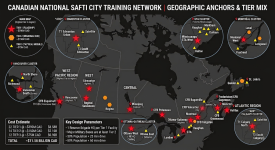
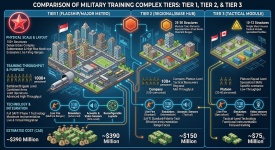
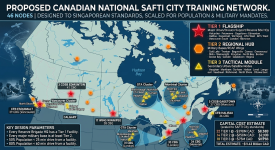
Why? That is a huge investment in indoor ranges with the greatest concentration of your proposal's investment going to places that have existing outdoor ranges (and many of those places have space for more outdoor ranges if needed).I played around with Gemini to see what building a network of indoor training ranges similar to the latest in Singapore would look like and cost for Canada.
Singapore (unlike Canada) is very land limited - they build up as they cannot go out.Why? That is a huge investment in indoor ranges with the greatest concentration of your proposal's investment going to places that have existing outdoor ranges (and many of those places have space for more outdoor ranges if needed).
I get that, but why propose building similar facilities in Petawawa, Valcartier, and Gagetown?Singapore (unlike Canada) is very land limited - they build up as they cannot go out.
They have two real training areas - and neither is big, as well due to their territory. Urban Operations and Subterranean Operations are very relevant, so making training facilities to support that is smart.

A lot of LEA’s are finding that while their indoor range was great for pistol shooting, rifle (even if designed to operate safely with rifle ammunition) cause massive concussion issues.
Making an outdoor range for rifle qualifications doesn’t require a massive footprint as one can add baffles that restrict the possibility of a round leaving the facility (CBP Facility at Harper’s Ferry WV has that sort of setup).
Why? That is a huge investment in indoor ranges with the greatest concentration of your proposal's investment going to places that have existing outdoor ranges (and many of those places have space for more outdoor ranges if needed).
Singapore (unlike Canada) is very land limited - they build up as they cannot go out.
They have two real training areas - and neither is big, as well due to their territory. Urban Operations and Subterranean Operations are very relevant, so making training facilities to support that is smart.

Whatever it is, it will need a new subcomponent of the ResF. SuppRes is to specific and is useful as a separate category for previously trained RegF or PRes. Canadian Rangers might do - I figure the training and equipping and terms of service as similar but all-in-all a new subcomponent is easy to make and can be clearly tailored.I'm just calling it that for lack of a better term. No idea what they will actually call it. I have a friend working at CMP on this and like I said they seem to see this as closer to Supp Res than PRes
I had trouble modeling anything over 100,000 (also assuming the PRes goes to about 80,000)Adding 300k to anything more than Supp Res requires a substantial rejigging of a whole bunch of institutional systems.

Given the SRP mandates ARes soldiers only shoot PWT1 every year. We only need 100m ranges. One or two 10 lane indoor ranges per major city would probably save a lot of transport costs.
Firstly, is that even an appropriate readiness standard going forward? Maybe CA reservists should have more allocated to them per year than an air force desk jockey like me in Ottawa.
Second, why not build more than just annual basic readiness? The more training that been be done locally, the more interest we'll have, the better the reserve experience and the more skilled they'll be. We should aim to be able to do all of BMQ and most of BMQ-L locally. Just throw in a field phase on weekends or in the summer.
If you want your new facilities connected to public transit, don't put them on the big army bases that you have proposed. Even Edmonton Transit does not go to CFB Edmonton, and the other big bases are not in cities.Third for me is proximity. There has to be some goal. Do we want half the population within a 30 min drive, 45 min transit ride, etc. of a training facility?
If you want your new facilities connected to public transit, don't put them on the big army bases that you have proposed. Even Edmonton Transit does not go to CFB Edmonton, and the other big bases are not in cities.
If you want your new facilities connected to public transit, don't put them on the big army bases that you have proposed. Even Edmonton Transit does not go to CFB Edmonton, and the other big bases are not in cities.