• Thanks for stopping by. Logging in to a registered account will remove all generic ads. Please reach out with any questions or concerns.

CH-124 Sea King Historical Thread

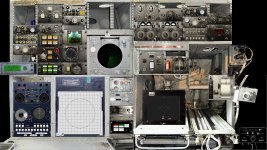
Anybody know the event and date:
View attachment 97849
I'm working on a side project... we're going to use the "off the shelf" flight sim we have at the museum and set up an "historical tour" flight. So as you fly in the harbour there will be different "task groups" portrayed from different time periods:
  • early Bonnie
  • late Bonnie
  • around 1990
  • Op Friction
  • Op Apollo
  • current and future fleet alongside
The aircraft (we'll use a Harvard in RCN livery) will fly the tour itself, but if somebody "takes control" of it you'll be able to buzz the ships (aka "brownie runs").

So I've been working on models. I have a Bonnie, DDE and DDH St Laurents, Protecteur and Preserver, early, Friction, and Trump 280s, 330s before and after HCM., Victoria, and an RCD but I'm not sure how close it is to the current design I'll use a DDE St Laurent and change the bridge, mast, and guns for Terra Nova, and then do ASROC and Friction versions. I need to find Kingstons, HDW, Asterix, and the new AORs.
What software are you using to create the ships?
 
What software are you using to create the ships?
I got the ones I've used so far from various sources so I didn't have to create them, just modify and import:
  • ModelConverterX to convery between formats
  • Paint to modify textures
  • Notepad for .txt and .xml files
  • MSFS SDK to import into MSFS

For the three versions of Terra Nova I need to work on, the original St Laurents were done in SketchUp so I'll probably use that.

When I have to do full drawing, Blender.

I also have MSFS Livery Tools and X-Plane WorldEditor.
 
I like to fly helicopters in Xplane 11 and often practice landing on the USS McInerney which always seems to be cruising just offshore from Yvr. I'd like to try modeling some vehicles for xplane and blender seems to be a popular option(albeit with a steep learning curve).
 
I like to fly helicopters in Xplane 11 and often practice landing on the USS McInerney which always seems to be cruising just offshore from Yvr. I'd like to try modeling some vehicles for xplane and blender seems to be a popular option(albeit with a steep learning curve).
We're providing info to a company developing a Sea King for MSFS. Developing aircraft for X-Plane requires two things; you need to do the models in Blender or another program, plus you need to do the flight model.

I seem to not be able to concentrate on one piece to get really good at it, but I have a lot of experience across a whole lot of simulation areas.

We do want to eventually do a more realistic simulation for deck landings. None of the current sims simulate the challenging part, which is the ship actually pitches and rolls. As well, the aircraft handles differently when it's on the wire.
 
The backstory of 12421, which is sometimes (incorrectly) called a CH-124C in places like wikipedia.

The first passive (sonobuoy processing) aircraft was 12411. It's primary fit was the Calypso processing system (built by Computing Devices Canada, now GDMS-C) and the ASN-123 (but not connected to each other). We have quite a bit of original reference material on that fit.

When that aircraft ditched off Bermuda (Ruzgys the first) in 1989 any further development obviously came to an end. Two things happened:
  • 6 aircraft in roughly that config, but with the UYS-503 (connected to the 123) and MAD were modified to the HELTAS (Helicopter Towed Array Support; not Gelicopter Twoed Array Sonar, as sometimes stated) standard (12401, 12424, 12430, 12434, 12437, and 12441). These were later stripped out for SCTF (Standing Contingency Task Force).
  • 1 aircraft, 12421, was modified to HAPS (Helicopter Acoustic Processing System), with the intention of continuing development. This retained the 123, but added dual UYS-503 processors with the capability to process a Plessey wet end; in effect, combining Alphas and Bravos (which the USN and RN had been doing with other systems for a while).

Apparently, 12421's trials really revolved around the dipping sonar and issues with it, and then petered out.

Eventually the fleet was fitted with the 123, but it again was not connected to the sonar (or other things), as all the development had gone into the acoustic processor. This was corrected around 2001 with new ASN-123 software and some wiring mods. 12421 was eventually converted back to an 'A' because the changing world highlighted the "lack of need" for that type of development (until it was needed again, 25 years later; Cyclone acoustic knowledge isn't great).
 
Some extra research on how we ended up with the ASN-501.

It's clear that the 501 wasn't a fall back from another plan, nor was it a result of Bonnie being taken out of service. It was "part of the plan" from the very start.

In the 127th Meeting of the Research Control Committee, 31 January 1963, item 127-3 "Navigation and Tactical Display System for ASW Helicopter" was presented.It specifically talked about having Sperry Gyroscope Company, who produced the ASN-501, investigate conversion of the ASN-30 (the USN nomenclature for the 501, first refered to as ASWTNS, Anti-subwarine Wareare Tactical Navigation System) for helicopter use. $80,000 was allocated for this work. There is a short briefing note attached to the minutes concerning this item.

Furthermore, the "Revised Staff Characteristics for an Escort Borne ASW Helicopter" dated 16 August, 1962, also includes a section labelled "Integrated Navigation and Tactical Display System. It is clear that it is written in such a way to indicate a system such as the ASN-501 (ASN-30). Notably, it also includes "it is desirable that an attack computer be provided to facilitate vectoring of surface or other air units to intercept the target." This was never provided per se, but the combination of the 501 and dedicated TACCO provided the capability eventually, although the radar was required to fully realize it.

Of note, I also bought a copy of the USN NAVAIR 01-230HLH-1 NATOPS Flight Manual SH-3D/H Helicopters, Ch 1 1 December 1984, which still included a description of the ASA-13, the system the USN had available when the CHSS-2 was acquired. The ASA-13, apart from reliability issues, would not have met the required characteristics. Its primary limitation was the inability to assist robustly in creating a plot. The ASN-501's red and green strobes are flexible enough to allow that and also other plotting functions, like the aforementioned attacks. However, to do so requires a heavier operator workload. The USN's eventual solution was the ASN-123, a digital computer which could do all these functions and more with a much lower workload (although optimized as a pilot information computer, not a robust battle management system; ASP and MDMS are the latter).

So, it is clear that from at least 1962 the RCN was intending the CHSS-2 to be an independent platform (there are other supporting documents) and seeking to fit it as such. They also were aware of the requirements to do so. The paperwork trail is there for them to understand the workload of doing so in a challenging flight environment (low altitude, IFR, other traffic). My next step is to find the documentation, if it still exists, as to why the decision was taken to add a TACCO with a dedicated console housing the 501. My gut feel is there isn't a single reason, but a convergence of events: need to have robust plotting capabilities, state of existing technology, availability of navs from the RCAF, impending disposal of Bonnie, and the RN model.

It is also not clear that when the RN model evolved into TANS (Tactical Air Navigation System), which was optimized for the use of a TACCO to do more robust battle management (primarily by integrating the radar with the plot), consideration was not given to acquiring it.

It does seem that the "accomplishment" of getting the "canadian" ASN-501 in the aircraft create a 25 year acceptance of that as "the best we could do."
 
Back
Top