• Thanks for stopping by. Logging in to a registered account will remove all generic ads. Please reach out with any questions or concerns.

Continental Defence Corvette

Further to the thought:

If the CUAS battle is of sufficient concern that our friends and allies are making efforts to create enough CUAS devices to supply point defences to critical infrastructure on shore, in both war and peace due to this gray area we currently inhabit, then do we need to consider at least the possibility of grafting CUAS packages on to Coast Guard vessels?

And the Russians have discovered a significant number of their cargo vessels being immobilized, far from their primary theatres, by USVs and UUVs.
 
And what kind of defense would they need?
That would depend on the threat environment.

In Canadian waters, likely little defence, and they be unlikely to be used outside of Canadian waters in a shooting war.

I agree that we can't treat every vessel, every potential target as a military target, but if we don't then it becomes critical civil infrastructure that presents as a target that needs defending.
Trying to defend everything leaves you defending nothing. You need to use your Int to tailor the defence to the threat, and accept that sometimes unpredicted things happen.

If the CUAS battle is of sufficient concern that our friends and allies are making efforts to create enough CUAS devices to supply point defences to critical infrastructure on shore, in both war and peace due to this gray area we currently inhabit, then do we need to consider at least the possibility of grafting CUAS packages on to Coast Guard vessels?
Who is going to crew those systems? They dont crew themselves, and the CCG doesn't sail around with a bunch of extra crew to have monitoring CUAS systems 24/7.

There is no point adding expensive systems that won't be crewed, and if we know to add the extra crew because of a specific threat, we know to not send the ship in the first place.
 
Trying to defend everything leaves you defending nothing. You need to use your Int to tailor the defence to the threat, and accept that sometimes unpredicted things happen.


Who is going to crew those systems? They dont crew themselves, and the CCG doesn't sail around with a bunch of extra crew to have monitoring CUAS systems 24/7.

There is no point adding expensive systems that won't be crewed, and if we know to add the extra crew because of a specific threat, we know to not send the ship in the first place.

how much civilian infrastructure in switzerland, sweden and finland, including residences, is bombproof

Switzerland, Sweden, and Finland possess the world's most extensive civilian "bombproof" infrastructure, designed during the Cold War to withstand conventional bombing, nuclear fallout, and chemical/biological weapons. Switzerland leads with full population coverage, while Finland and Sweden have systems protecting roughly 80–85% and 70% of their populations, respectively.
SWI swissinfo.ch +4
Switzerland: 100%+ Coverage (The "Bunker Nation")
  • Capacity: Switzerland is the only country with enough bunkers to accommodate over 100% of its population (roughly 114% coverage).
  • Infrastructure: Over 370,000 shelters exist, including private bunkers in residential buildings, hospitals, schools, and large public shelters.
  • Residences: A 1960s law mandated that all new residential buildings incorporate a shelter, or developers pay for a public spot. Many are located in apartment cellars, featuring heavy armored doors and ventilation systems.
  • Status: While some smaller, older private shelters are being phased out or repurposed, the network is regularly inspected and modernised, with many designed to withstand nuclear attack.
    SWI swissinfo.ch +4
Finland: ~85% Coverage
  • Capacity: Finland has over 50,500 protected shelters capable of housing roughly 4.8 million people.
  • Infrastructure: The majority (85%) are private shelters within residential buildings. Due to its geology, Finland frequently builds shelters within solid rock (granite bedrock).
  • Urban Focus: Major cities like Helsinki have significant coverage, with the capital alone possessing capacity for over 900,000 people.
    Institute for Security & Development Policy +2
Sweden: ~70–80% Coverage
  • Capacity: Sweden has roughly 64,000 shelters with space for approximately 7 million people.
  • Infrastructure: Shelters are mostly located in urban areas and apartment complexes, designed for both conventional and nuclear attacks.
  • Modernisation: The Swedish Civil Contingencies Agency (MSB) has recently launched initiatives to update and increase inspections of these Cold War-era structures, bringing some decommissioned shelters back into operation.
    The Eastern Frontier Initiative +3
Key Characteristics of "Bombproof" Infrastructure
These shelters are generally designed to include:
  • Reinforced Concrete: Thick walls (30–60 cm).
  • Blast Doors: Heavy steel, blast-resistant entrances.
  • NBC Protection: Nuclear, Biological, and Chemical filtration systems.
  • Self-Sufficiency: Air filtration, bunk beds, and sometimes water/food storage.
    Shelter & Bunker +4
These countries maintain this infrastructure not only for wartime but also for natural disasters or technological accidents.

AI assistance.

...

We devise our building and municipal codes to make structures that are windproof, waterproof, fireproof and proof against seismic shock. Other countries add bombproof to their criteria and accept the associated costs that come with it.

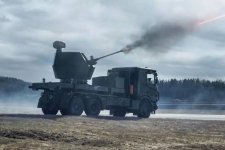
Perhaps there is a reason why the Norwegian buoy tenders, tugs, environmental response and law enforcement vessels, are crewed by the Navy, painted an unobtrusive white and supplied with a multipurpose deck gun. The Bofors 57 and 40 are popular. Even their 700 tonne inshore vessels are equipped with 12.7 mm HMGs. And a lot of the larger vessels are fitted for heavier weapons systems.

Where do you find the crew to defend themselves?

And what about teaching your Naval Reserve to crew platform independent podded weapons systems?
 
I suggest that this is what the Norwegians mean when they say as civilian as possible ans as military as necessary.

They don't make all their vessels military because even they, with one of the best balance sheets on the planet would find that expensive, but they give their crews something of a fighting chance in most situations they are likely to encounter.

...


in Canada we have skated, the international gray man.

I don't thimk we can skate anymore. We are being noticed.
 
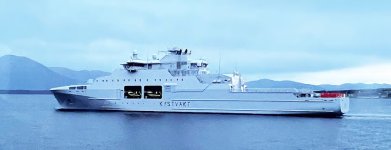
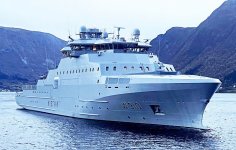
The latest Norwegian Coast Guard vessel

1775748448572.jpeg
1775748479576.jpeg


57mm and 12.7mm with CEROS and 9LV.

136m, 10,000 tonnes, 22 knots, endurance of 60 days with a crew of up to 100

Three are built at Vard's Langsten yard, the same yard that built the Svalbard, for 7.2 Billion NOK. At current exchange rates that is 1.05 BCAD or 350 MCAD apiece.

All three were ordered on 25 June 2018 and, despite Covid, the first was commissioned early in 2023 and the last was commissioned in November 2024. All three are in active service.
 
Back
Top