• Thanks for stopping by. Logging in to a registered account will remove all generic ads. Please reach out with any questions or concerns.

Continental Defence Corvette

Canada really doesn't need an expeditionary Army, a descent home guard is all we need. With some full timeSoF. Perhaps people are finally realizing that.

What Canada needs is a world class RCN and RCAF.
The stated foreign policy of Canada seems to disagree with you lol. You happen to see no value in European involvement haha. Ships and planes cant hold ground, no matter how many times we try to rehash that fallacy.
 
The stated foreign policy of Canada seems to disagree with you lol. You happen to see no value in European involvement haha. Ships and planes cant hold ground, no matter how many times we try to rehash that fallacy.
So the Canadian Marine Regiment then? copied off the Dutch Marines perhaps?
 
The stated foreign policy of Canada seems to disagree with you lol. You happen to see no value in European involvement haha. Ships and planes cant hold ground, no matter how many times we try to rehash that fallacy.
And if you cannot control the sea lines of communication then your army languishes without supplies.
Napoleon, Hitler, and the Soviet Union all learned that lesson as well.
 
And if you cannot control the sea lines of communication then your army languishes without supplies.
Napoleon, Hitler, and the Soviet Union all learned that lesson as well.
It isn't an either/or debate. The last time Canada considered seaborne operations was the CAST combat group and that basically soured DND on the concept. Afghanistan was supplied by an air bridge and IMHO you can't rely on that for MCO in Europe. So yeah. You need sea lanes and a system to make use of them. Canada doesn't have a system because logistics is left as an afterthought until the point where it becomes a problem. Neither the army nor the navy is putting any effort into developing a seal lane logistics system.

I'm not so sure that was a lesson for those three. It was an issue to an extent but the real lessons were all land and air related.

🍻
Re: Astan, I`d like to see how much of the air supplied logistics were prepositioned to a middle east port?
 
So once again the perpetual battle within the CAF regarding who is more important, the Army, the Air Force or the Navy.

I'm reading a Phd Thesis on the re-org of Canada's defence in the 1960's and one sentence really stood out "A Chief of the Defence Staff (CDS) would act as a single voice for the services, policy planning would be integrated, and reorganizers hoped that a unified military would foster a new singular loyalty above that of the individual services."

That was a fools errand in the 60's and nothing during my life in the CAF/MARCOM/RCN has ever shown me that loyalty to an individual service has been topped by loyalty to the CAF.

Gen Rouleau put it best in committee back in late Oct - 75% of all future capital spending into the 2030s is earmarked for the Navy and that that 25% for the Army and Air Force combined is completely unsustainable and will not enable a balanced force.
 
And the first one will be launched in 2035. Have we learnt nothing from Ukraine? Soon, simple and functional rather than a big honkin' dream.
The "corvette" will take longer, unless we build offshore and minimize Canadiizing it.

You are going to need big and well armed ships. The challenge with the GPF is that it almost cost as much as the RCD for maybe 50% of the capability and we still have not replaced the MCDV's.
 
Gen Rouleau put it best in committee back in late Oct - 75% of all future capital spending into the 2030s is earmarked for the Navy and that that 25% for the Army and Air Force combined is completely unsustainable and will not enable a balanced force.
But do we need a balanced force? This is not a bullshit question either.
 
But do we need a balanced force? This is not a bullshit question either.
That is something neither of us are qualified to answer. Id suggest yes, you seem to suggest no. All I know is you still need armies to win wars and that our foreign policy is to be able to defend our NATO allies. At the end of the day, that means dudes killing people. We'll see what comes out in the next defence policy. Maybe that changes.
 
The "corvette" will take longer, unless we build offshore and minimize Canadiizing it.

You are going to need big and well armed ships. The challenge with the GPF is that it almost cost as much as the RCD for maybe 50% of the capability and we still have not replaced the MCDV's.
Chatter of a 'GPF' sounds alot like prepping the table for a reduction in the # of Rivers the RCN will get.

Ghosts of past RCN fleet compositions enter the chat - 4 Rivers and 12 GPF and 2 JSS - with a dose of an unknown # of Type 212CD's......

1794600590561.png
 
Gen Rouleau put it best in committee back in late Oct - 75% of all future capital spending into the 2030s is earmarked for the Navy and that that 25% for the Army and Air Force combined is completely unsustainable and will not enable a balanced force.
And yet, going back to since the creation of the office in 1964, navy officers have held the post of CDS only 3 times for a total of less than 5 years (not counting VAdm Murray's acting role). That's against a total of 10 army (including 5 of 8 this century) and 7 air force officers.

Now from everything I've read on this forum it would seem that at least since the drawdown of CFE the army has been the service with the most challenges. Yes the RCN is facing issues with aging equipment and recruitment/retention but, again from what I read here, has concrete plans that are rolling out to address them. Ditto the RCAF. While the CA seems to be playing catch up and only now articulating a new structure and ambitious equipment plans.

Admittedly this is my superficial outsider's take, but it sure doesn't seem that it much matters what service the CDS comes from in terms of who gets what.

Don't get me wrong, I'm not for a moment suggesting that it should matter. The CDS should I assume be the leading force in achieving the balance originally envisaged with integration. But 75-25, again assuming that's true, doesn't sound like balance. And it looks like a lot of CA generals had the watch while it happened.
 
I'm reading a Phd Thesis on the re-org of Canada's defence in the 1960's and one sentence really stood out "A Chief of the Defence Staff (CDS) would act as a single voice for the services, policy planning would be integrated, and reorganizers hoped that a unified military would foster a new singular loyalty above that of the individual services."
It's an interesting issue. I won't try to pretend. I lived through unification and it was a dog's breakfast; I'll never miss an opportunity to slag it. Reading John Conrad's recent book I came across this statement vis-a-vis the effects of unification on the army's logistics system.

The warrior logistician is a minority shareholder in the contemporary logistics branch.

An emphasis on soldier skills for our own deployment clashed with the deeply ingrained bureaucratic culture of the logistics community. This culture has its origins in the unification of the Canadian military services in 1968, and regrettably, it is still very much in evidence. … “I also think,” wrote John Selkirk, “unification was the real beginning of the loss of field logistic capability in the Canadian Army. The purple trades strategically devolved to the lowest common denominator …”

I will not pretend to be an expert on the matter, but I also believe that for logisticians, unification was the beginning of our deep descent to the cellar. Unification was a death blow to the brave legacy of Bourgtheroulde and the logisticians of the First and Second World Wars.[1]


[1] Conrad, Our Dry Cellar, 22.
IMHO, rather than merging three services into one, unification created one service with the requisite three "sub-services" but also created one overarching fourth sub-service which was the purple corporate structure. Not only does this corporate structure waste precious resources which ought to go to the field, but it consumes precious time by way of calcified bureaucratic processes. It would have been far better to leave the three services each with their own budget and left to their own devices to manage it within the directions given to each by the government. As it is, major capital decisions are retained by cabinet anyway. All the CAF manages are how to shuffle PYs around. Jointness in force employment existed long before unification/integration. IMHO, unification did not increase operational capabilities; it just added distant bureaucratic layers - and as Selkirk said - strategically devolved the purple trades to the lowest common denominator.

$0.02

🍻
 
Gen Rouleau put it best in committee back in late Oct - 75% of all future capital spending into the 2030s is earmarked for the Navy and that that 25% for the Army and Air Force combined is completely unsustainable and will not enable a balanced force.
Yet most of the RCAF will be ReCapitilaized after 2034-35 so the RCN/CCG will drip, drip drip.

I can see future Fiscal stress giving us an RCN of 9 Rivers and 15 new Frigates but 6 will be CCG fitted for but not with
and 8 TKMS 212 CD's with a total of 3 AOR's. The 6/2 AOPS will compliment about 8 new Coastal defence vessels and about 20 FAAST-V .
Throw in the two Polar Ice Breakers and 6 12,000 tonne Program Icebreakers and add the 6 8.000 tonne Navaid 's leaves Canada with a serious afloat contribution.
RCN
9 Rivers
9 new Halifax GPF
6 new Halifax ( CCG LITE ARMED)
8 212 CD's Subs
8 Dewolfe/Donkjen AOPV
3 P class AOR's
8 New Kingston
20 FAAST-V
CCG
2 Polar I/B
6 Program I/B
6 Navaid I/B
10 Kingston CCG
95 Ship Security fleet
 
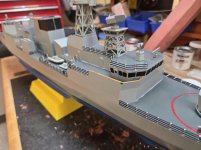
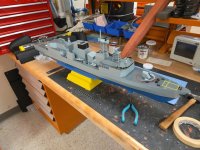
Should we just dust off the plans for the Halifax Class and build a few new hulls using the old plans?
 

Attachments

  • Halifax 1.jpg
    Halifax 1.jpg
    89.4 KB · Views: 1
  • Halifax 2.jpg
    Halifax 2.jpg
    103.1 KB · Views: 1
Back
Top