• Thanks for stopping by. Logging in to a registered account will remove all generic ads. Please reach out with any questions or concerns.

Indirect Fires Modernization Project - C3/M777 Replacement

Good lord, pictures don't do it justice. It's huge.

I'm sure it will work fine if you stick to only rolling it out on bone dry days like in that demonstration. And of course if it's completely confined to roads it'll be easier for mid-range drones to hunt down.

Im already seeing a roll over accident within 12 months in a training area. That turret is top heavy to the extreme
And I've also read the rest of the crew can't ride in it and the solution is to just have them follow along in another vehicle.

Not having even a gib is a massive safety liability.
 
And I've also read the rest of the crew can't ride in it and the solution is to just have them follow along in another vehicle.

Not having even a gib is a massive safety liability.

What "rest of the crew"? The crew is 2. The ammo numbers ride on the "limber".
 
And I've also read the rest of the crew can't ride in it and the solution is to just have them follow along in another vehicle.

Not having even a gib is a massive safety liability.
What "rest of the crew"? The crew is 2. The ammo numbers ride on the "limber".
The basic operation of the gun, once the turret is loaded with projectiles and MACS, is simply 2 people (a driver/rad op and a det comd/arty tech/rad op. Some automated SPs have a crew of 3 in the hull - a driver/rad op, an arty tech, a det commander/rad op.)

The question of what other personnel and equipment is needed will depend on tactics, techniques and procedures.

Ammo in the turret of any SP is limited and there needs to be a rearming process, either by way of an accompanying limber vehicle or through rearming points. Both those will take extra people and one could estimate at probably three per gun either in a limber or aggregated in battery rearming points. Just as important these days (with thoughts of dispersed operations) is the need for local security to stay with the gun - including cUAV coverage. I could see another vehicle for that role.

These TTPs are still under development. My own preference would involve each detachment being a three vehicle team. A recce vehicle (probably a WO plus four - a driver, a gunner, a two-man cUAV team) which precedes the vehicle by a few minutes to a designated firing position - clears it and secures it. Once secured, the gun moves forward to the firing platform, surveys itself in and engages the mission. The limber vehicle remains in the hide or - more probably - moves to a new hide, secures it and prepares to receive and rearm the gun. (Note that there would be additional ammo and sustainment and C2 vehicles in the battery and regiment that pull/push ammunition and supplies forward and which resupply the limber vehicles and coordinate/control deployments and - to some extent - missions.)

In short, I see the gunline portion of a battery to have six detachments (~9 pers each ~54 total); a CP and alternate (~10-12 pers); and echelon (~30 - BSM, ammo, maint, BQMS, POL) Total - ~95-100 all ranks (I'm excluding the tactical group which, IMHO, shouldn't be part of the battery but which per Aimpoint 1 will be returning to the field batteries)

🍻
 
I think it looks amazing. And meets the RFI.

Bunch of tracked simps over on this thread. (ducks for cover as rounds incoming expected... lol).

Seriously though, its friggin huge.
 
So many of the SP's I seen hit in Ukraine were on the move at the time. A battery on the move need Air Defense protection beyond it's own crews.
I think one has to treat combat videos with caution. A stationary gun that fires can also be quickly located and engaged. There are equally many videos of dug in targets being hit.

Air defence works in layers. The trend is towards cUAV teams at low levels with ever more capable VSHORAD, SHORAD and bigger systems covering ever expanding areas and altitudes. My expectation is that divisional air defence would continuously cover the division's AMAs.

The air defence coverage in Latvia is currently ad hoc (and of course here in Canada has been non existent for over a decade). Canadian artillery doctrine is in the process of being revised (or better yet, rewritten from scratch).

Seriously though, its friggin huge.
That's an unfortunate function of wheeled SPs.

Tracked SPs are generally built much closer to the ground and much of the gun's autoloader mechanism sits within the hull between the tracks rather than above the vehicle chassis. The RCH 155 has a particulalry large turret. One needs to remember as well that unlike tanks, SP guns needs to elevate the barrel (even when not at "high angle") and recoil back and downward. That takes space which can be accommodated in the lower portion of the tracked hull but is difficult to engineer into a wheeled hull.

🍻
 
If that is the case then there may need to be brigade level VSHORAD similar to the Polish
Back in the days of yore in the last century, Canada had brigade VSHORAD in the form of Blowpipe and then Javelin missiles. At first these were in the air defence batteries/troop of each RCHA/RALC close support regiment. Then VSHORAD moved into 4 AD regiment and three ARes AD regiments before the army decided it was too expensive to maintain and ash-canned air defence.

The current plan is to form a divisional VSHORAD regiment (4 AD Regt, RCA) and a divisional SHORAD regiment (8 AD Regt, RCA) both in Gagetown. The fact that these are divisional regiments does not prevent the assignment of AD assets to the brigades. Possibly one or more CMBGs could either have a 4 AD Regt's VSHORAD battery assigned to them or placed within their location while all of 8 AD Regt's SHORAD batteries provide coverage over the entire division. Latvia's MNB could conceivably receive both VSHORAD and SHORAD resources from multiple countries. AD doctrine provides a number of ways that air defence assets are deployed and managed.

🍻
 
I think one has to treat combat videos with caution. A stationary gun that fires can also be quickly located and engaged. There are equally many videos of dug in targets being hit.
Not just video though, I recall statements by gunners and drone operators that good concealment and not firing when recce drones are in the area helps greatly, but all movement was risky as movement is so much easier to detect, even without dust or engine smoke.

Speaking of concealment, this thing will be a bitch to hide, unless you paint it to look like a barn.
 
Not just video though, I recall statements by gunners and drone operators that good concealment and not firing when recce drones are in the area helps greatly,
That's only one part of the equation. Guns are without purpose unless they fire. We call that "unmasking." Once they do fire, radars and acoustic sensors and hidden drones can pick them up. That in and of itself results in counterfire. More likely is that a recce drone(s) followed by a loitering munition(s) are then quickly sent in to take a very close look at the unmasked position and hit it.
but all movement was risky as movement is so much easier to detect, even without dust or engine smoke.
Staying put is less and less an option. It's a bit safer to move from the AMAs from where artillery fires (especially the longer range ones) than the front lines as drone activity is lighter and more contested - not totally absent but lighter.

Also take into consideration that not all terrain is as open as that of much of Ukraine.

Last but not least is the issue of decoy positions and drone traps that can pull enemy ISR away from the valuable targets. This is why my napkin army has ARes hybrid engineer/EW units tasked solely with a physical and electronic deception role.

All-in-all, moving or static, a gunner's life has become much more dangerous. That's why I'm a firm believer in armor plate, tracks and organic cUAV defences.
Speaking of concealment, this thing will be a bitch to hide, unless you paint it to look like a barn.
One of my complaints about LAVs in general is that they are as big as a barn door.

This thing makes a LAV 6 look tiny by comparison. That's a complaint that I have about most wheeled SPs.

Our M109s were already quite large - this thing is about a half a metre higher, the chassis (without barrel) about 2 metres longer but very slightly narrower. In Shilo or Wainwright the M109s were nearly impossible to hide. The cam nets fooled no one. In Germany they hid well in dense forests, in barns or "attached" to buildings with cam nets to make them look like a part of the structure.

If there is one thing Ukraine is proving, it is that modern MCO is costly in equipment and people.

🍻
 
I recall earlier posts discussing the fact that Canada would have difficulty producing artillery systems domestically due to the difficulty of making the gun barrels. An Indian defence firm may have a solution...


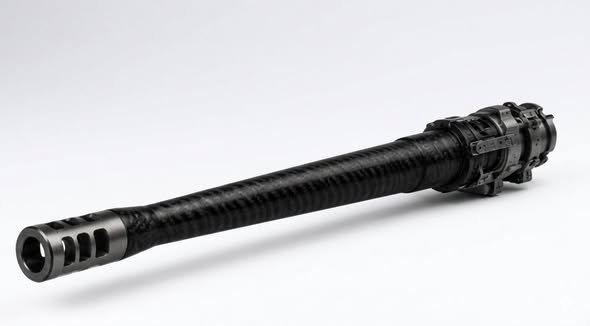
The conventional steel barrel has long been a limiting factor in artillery design. At 1,400 kg, it imposes significant logistical challenges, particularly in mountainous regions such as the Line of Actual Control, where every kilogram must be transported or airlifted.

Danta Innovations has addressed this critical issue by introducing a filament-wound composite barrel that slashes the weight to 420 kg, enabling faster repositioning and reducing vulnerability to counter-battery fire. The barrel is constructed from five precision-engineered layers, each serving a distinct purpose. An erosion-resistant inner liner is rated for over 3,000 Effective Full Charge cycles, ensuring durability under sustained use.

Carbon fibre hoop layers manage chamber pressures of up to 700 MPa working pressure and 1,050 MPa proof pressure, while a thermal barrier layer allows a sustained firing rate of 8–10 rounds per minute across extreme temperatures ranging from -40°C to +150°C. This combination delivers resilience, efficiency, and adaptability unmatched by traditional steel barrels.

A defining feature of this innovation is its integrated fibre optic sensor network, which provides real-time structural health monitoring. This system continuously detects strain and damage, offering predictive maintenance capabilities that steel barrels cannot match. Such intelligence enhances reliability and operational safety, ensuring that the barrel remains combat-ready under demanding conditions.


The barrel is designed for universal compatibility, making it suitable for self-propelled guns, towed artillery, wheeled platforms, naval gun systems, and even future hypersonic artillery concepts. Its compliance with AS9100D, MIL-STD, and ISO 9001:2015 standards underscore its readiness for integration into modern defence ecosystems. Importantly, it is Made in India, aligning with the nation’s Aatmanirbhar Bharat vision of defence self-reliance.

This development arrives at a time when India is actively modernising its artillery capabilities, with systems such as the ATAGS 155mm/52 calibre gun being inducted into service. The introduction of a composite barrel complements these efforts by enhancing mobility and reducing logistical burdens, thereby strengthening India’s ability to deploy firepower rapidly across diverse terrains.

The innovation also carries strategic implications. By reducing weight and improving efficiency, the barrel enables artillery platforms to be more agile, survivable, and sustainable. In modern warfare, where speed and adaptability are paramount, such advancements could redefine India’s artillery doctrine and provide a decisive edge in both conventional and asymmetric conflicts.

Danta Innovations’ achievement represents a landmark in defence engineering. It not only addresses long-standing limitations of steel barrels but also introduces a new paradigm of lightweight, intelligent, and durable artillery systems. This milestone reinforces India’s growing stature as a hub of advanced defence technology and precision engineering.

 
I recall earlier posts discussing the fact that Canada would have difficulty producing artillery systems domestically due to the difficulty of making the gun barrels. An Indian defence firm may have a solution...


That definitely something that should be explored, if anything for the weight reduction alone. That's 1000kg that could be used for other bells and whistles.
 
I recall earlier posts discussing the fact that Canada would have difficulty producing artillery systems domestically due to the difficulty of making the gun barrels. An Indian defence firm may have a solution...

I wish @Petard was still active because he knows this stuff cold.

Canada made barrels - Sorrel Industries built many of ours but that was back in the 1950s. After that we turned it over to buying other folks' kit.

After many decades being satisfied of the range pumped out by L39 barrels but with the advent of the L52 and more barrels the chamber pressures have increased dramatically. There are limited research and production facilities for these. Interestingly Canada had one of those. Gerald Bull's High Altitude Research Project (HARP) and Space Research Corporation (SRC) designed, tested and sold both guns - notably the GC-45 - and ammunition which offered significant range advantages over standard ammunition at the time. Bull dealt with both Austria and South Africa and several other countries including China. His work with Denel in South Africa got him in trouble and work for Arab nations got him assassinated (many blame Israel).

Denel in South Africa put into production many of Bull's ideas and is a good example of what a small country with only limited run of weapon systems can do if the support is put behind a vital national industry. Their systems, especially the Assegai family of artillery munitions (now linked with Rheinmetall) were and remain amongst the most impressive. Canada looked at them in the late 2000s but for various reasons decided to stay with the same old crap.

🍻
 
Back
Top