• Thanks for stopping by. Logging in to a registered account will remove all generic ads. Please reach out with any questions or concerns.

Infantry Vehicles

More details...


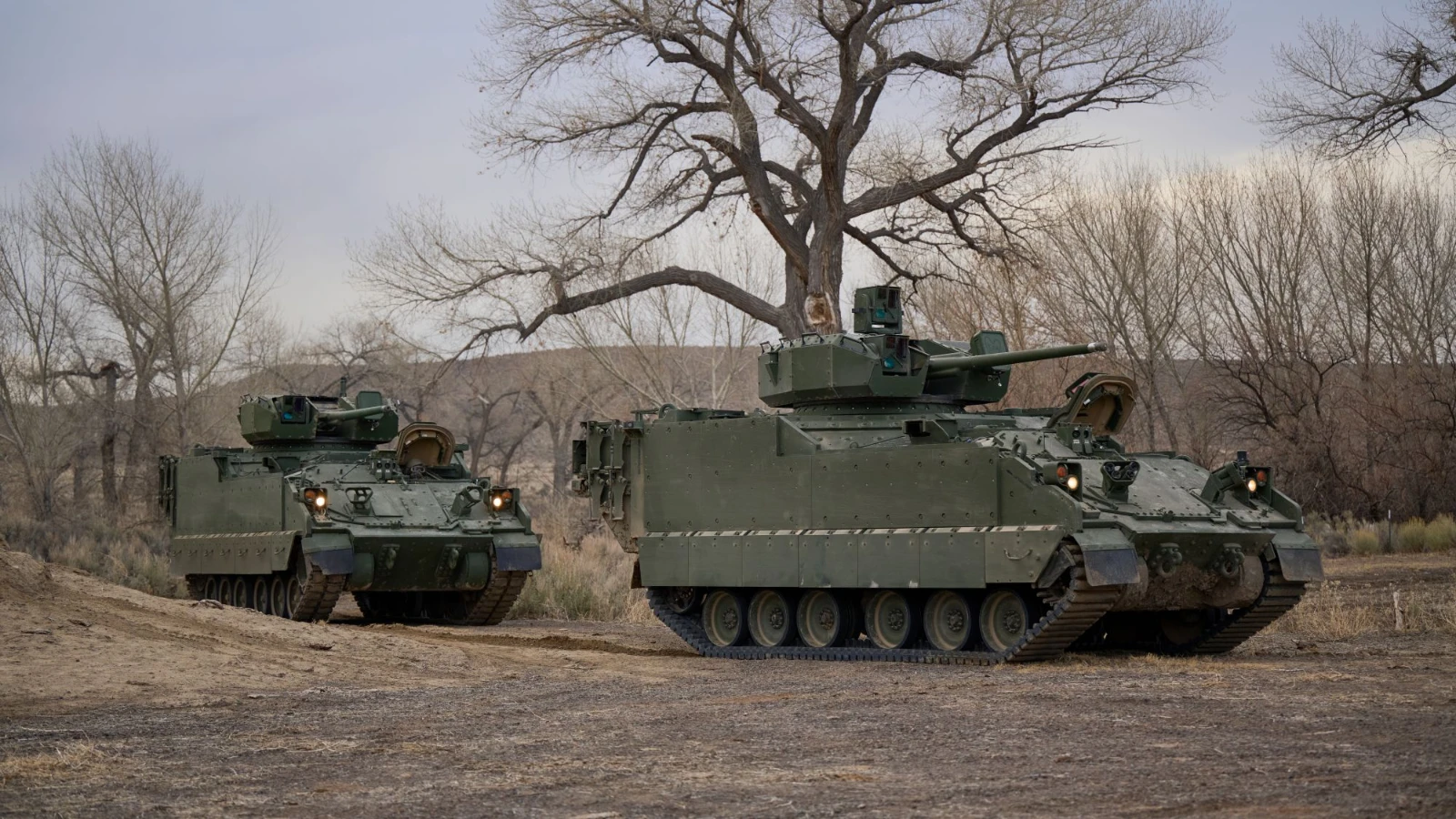
"The vehicle emerged from a deliberate decision by BAE to self-fund development after Secretary of War Pete Hegseth publicly challenged the defense industry to operate on a wartime footing and bring solutions to current battlefield threats without waiting for the traditional acquisition cycle."

"BAE Systems built an armored vehicle with drone-killing capabilities in ten months and put it in front of soldiers at Fort Hood, Texas, for training — without waiting for a government contract to fund it."
IMHO at least one but no more than two of the section carriers in each platoon ought to have this turret instead of the 25mm Bushmaster one. It reduces the crew to two - takes the turret mechanics out of the hull and leaves more room for dismounts and ammo. Big win all around.

We could do the same with ACSV troop carrier variants and replace one or two LAV6s in each rifle platoon which not only creates an organic air defence capability but fires up LAV ISCs to create a few more mech battalions or preposition a few battalions in Europe.

🍻
 
IMHO at least one but no more than two of the section carriers in each platoon ought to have this turret instead of the 25mm Bushmaster one. It reduces the crew to two - takes the turret mechanics out of the hull and leaves more room for dismounts and ammo. Big win all around.

We could do the same with ACSV troop carrier variants and replace one or two LAV6s in each rifle platoon which not only creates an organic air defence capability but fires up LAV ISCs to create a few more mech battalions or preposition a few battalions in Europe.

🍻
Two man AFV crews died in WW2 for a good reason. If we expect this thing to be up on the advance moving and shooting it needs a dedicated commander.
 
Then orbat the Bn X more people. Same difference as having a transport company at Bde, which I have to constantly request.
Your inconvenience means we have to exponentially increase how many pers are assigned to transport tasks. There's a tipping point when a unit having organic assets sitting unused a majority of time means they are more efficient and effective being brigaded. We pay adults big bucks to do those estimates.
 
Your inconvenience means we have to exponentially increase how many pers are assigned to transport tasks. There's a tipping point when a unit having organic assets sitting unused a majority of time means they are more efficient and effective being brigaded. We pay adults big bucks to do those estimates.

Exponentially? No. Firstly we are talking about two options that would involved, presumably, the same number of drivers - a transport company that can provided protected lift to a Bn. Since we already have structures thay assume drivers and crew within a Bn that doesnt seem logical. The assumption that they'd sit idle and not be used is also something dubious. Even if not "on the line" theres enough tasks to keep an adhoc Zulu platoon busy between resupplying positions and conducting security. We have paid "adults big bucks," the answers havent been transport companies.
 
Two man AFV crews died in WW2 for a good reason. If we expect this thing to be up on the advance moving and shooting it needs a dedicated commander.
I presume that it has a commander when moving but just needs a crew of two - driver and gunner - to operate the vehicle and weapon system when its dismounts have left. I'm presuming, but don't know for sure, that what it has is a one man weapon station. Overwatching for aircraft on a radar and engaging targets can be done by a single operator in a rules-based, linked-network AD environment.

I understand how tank systems went to commander/gunner sets during WW2 when all systems were manual and direct view optical and linkage between systems was voice communication. Those systems are changing dramatically and rapidly and with AI and digital links are getting even better. I wouldn't be surprised that the need for even a gunner in a given APC may no longer be necessary - just some guy to clear stoppages and toggle a few switches that remain manual. Its getting that science fictiony and the future is coming rapidly.

It's one of those things where you really need to get hands on with the equipment and see what level the technology has gotten to and how it works in a system of systems.

🍻
 
I presume that it has a commander when moving but just needs a crew of two - driver and gunner - to operate the vehicle and weapon system when its dismounts have left. I'm presuming, but don't know for sure, that what it has is a one man weapon station. Overwatching for aircraft on a radar and engaging targets can be done by a single operator in a rules-based, linked-network AD environment.

I understand how tank systems went to commander/gunner sets during WW2 when all systems were manual and direct view optical and linkage between systems was voice communication. Those systems are changing dramatically and rapidly and with AI and digital links are getting even better. I wouldn't be surprised that the need for even a gunner in a given APC may no longer be necessary - just some guy to clear stoppages and toggle a few switches that remain manual. Its getting that science fictiony and the future is coming rapidly.

It's one of those things where you really need to get hands on with the equipment and see what level the technology has gotten to and how it works in a system of systems.

🍻

I dont look at IFV / APCs as having to fight solely while "full" and in close proximity. Im coloured by our own doctrine in that regard. I expect them to move and fight while the section is out of them, especially if we are in the defensive.
 
Ive commanded one of our 2-man crewed ACSVs tactically and it is not easy to gun and command simultaneously. Add in two nets and it gets to be too much. There needs to be a CC and a gunner, especially in an IFV. APC might be able to get away with it, but not ideally in my opinion.
 
I dont look at IFV / APCs as having to fight solely while "full" and in close proximity. Im coloured by our own doctrine in that regard. I expect them to move and fight while the section is out of them, especially if we are in the defensive.
Ive commanded one of our 2-man crewed ACSVs tactically and it is not easy to gun and command simultaneously. Add in two nets and it gets to be too much. There needs to be a CC and a gunner, especially in an IFV. APC might be able to get away with it, but not ideally in my opinion.
I won't double down on this. My experience is with M113s-which are about as two-man crewed as it gets-and Marders-which weren't. One was battlefield taxis the other as IFV. And yes, doctrine. Even for the M113 the doctrine in my day was ridiculously permissive:

APC gunner's (sic) cover the dismount by firing between the tanks, concentrating on the closest enemy positions. Once the platoon is clear, zulu APCs move to their new tasks (intimate support, flank security, additional firebase or zulu harbour) . . .

Yes, the doctrine stated folks could be required to stand in open hatches and give covering fire with their GPMGs or .50s. The combat team commanders' course taught that this was a really poor idea - off to the zulu harbour with them.

I tend to follow the school of thought that when it comes to manoeuvre elements there are those that are required to fight mounted - tanks and cavalry - and those required to fight dismounted - infantry. Each should be optimized for their respective fight. IFVs aren't that. They are being used as poorly armoured light tanks - and dying accordingly.

When it comes to IFVs, Ukraine has been teaching that:

Infantry Fighting Vehicles (IFVs) consistently sustain the highest machinery and personnel casualty rates among all armored assets in modern mechanized warfare. Unlike Main Battle Tanks (MBTs)—which feature heavy breakthrough armor—or Armored Personnel Carriers (APCs)—which function as basic "battlefield taxis" that retreat after dropping off infantry—IFVs are designed to stay and fight in high-intensity direct-fire zones

Most IFVs, unlike specialty heavily armoured ones like the Namer, are simply too large, attractive and vulnerable to stay to support the dismounted fight with direct fire. That's what the tanks are there for. While it appears useful to have the infantry's carriers support the dismounted fight with their weaponry - and let's be honest, a whole industry has grown around IFVs because folks have bought into the idea - that may only be a concept that is actually viable against less than peer opponents. Dismounted dug-in peers equipped with the equivalent of Javelins and loitering munitions will eat IFVs in quantity. And at $10 million a pop, that's uneconomical and unsustainable.

I tend to subscribe to the battlefield taxi view of the infantry carrier. Yes, it should come with remote weapon systems but these are for self defence and/or capable of being operated from turret down positions. CUAV defence is one role. ATGM or loitering munition launchers providing a heavier munition which can be called in from a dismounted fighter with eyes on target or your own drones is another. The Afghanistan IFV role model of stand off and pound the objective while the dismounts manoeuvre for a half hour simply won't work.

Moreover, once you take the "IFV" out of the direct fire engagement role then you can start rethinking the role and armament of the "APC" or "ACSV" and how it best supports or protects its company. There are many possibilities.

🍻
 
I won't double down on this. My experience is with M113s-which are about as two-man crewed as it gets-and Marders-which weren't. One was battlefield taxis the other as IFV. And yes, doctrine. Even for the M113 the doctrine in my day was ridiculously permissive:


Yes, the doctrine stated folks could be required to stand in open hatches and give covering fire with their GPMGs or .50s. The combat team commanders' course taught that this was a really poor idea - off to the zulu harbour with them.

Zulu harbour, is a waste of an asset. Flank security is a better use. When we work dismounted the LAVs are expected to be doing other tasks. Be that flank security, a feint, or part of counter moves. I expect any future IFV or APC to do the same vs being wasted in harbours.

I tend to follow the school of thought that when it comes to manoeuvre elements there are those that are required to fight mounted - tanks and cavalry - and those required to fight dismounted - infantry. Each should be optimized for their respective fight. IFVs aren't that. They are being used as poorly armoured light tanks - and dying accordingly.

When it comes to IFVs, Ukraine has been teaching that:


Most IFVs, unlike specialty heavily armoured ones like the Namer, are simply too large, attractive and vulnerable to stay to support the dismounted fight with direct fire. That's what the tanks are there for. While it appears useful to have the infantry's carriers support the dismounted fight with their weaponry - and let's be honest, a whole industry has grown around IFVs because folks have bought into the idea - that may only be a concept that is actually viable against less than peer opponents. Dismounted dug-in peers equipped with the equivalent of Javelins and loitering munitions will eat IFVs in quantity. And at $10 million a pop, that's uneconomical and unsustainable.

And yet in Ukraine when they are attacking defensive positions they are doing in IFVs, and Ukraine is actively buying Lynx IFVs now. In early days of the war the autocannons were showing their value. We get into the same cyclic argument that happens about tube artillery vs drones on other threads.

I tend to subscribe to the battlefield taxi view of the infantry carrier. Yes, it should come with remote weapon systems but these are for self defence and/or capable of being operated from turret down positions. CUAV defence is one role. ATGM or loitering munition launchers providing a heavier munition which can be called in from a dismounted fighter with eyes on target or your own drones is another. The Afghanistan IFV role model of stand off and pound the objective while the dismounts manoeuvre for a half hour simply won't work.

Moreover, once you take the "IFV" out of the direct fire engagement role then you can start rethinking the role and armament of the "APC" or "ACSV" and how it best supports or protects its company. There are many possibilities.

🍻

So this os contradictory. If we are arming a lav / whatever per platoon to do CUAS are we then going to expect it to stop doing that job as soon as the infantry dismounts? Do we expect it to stop moving while it does that as well? Id rather that CUAS vehicle, ans the atgm carriers, be optimized to shoot and move as effectively as possible.
 
So this os contradictory. If we are arming a lav / whatever per platoon to do CUAS are we then going to expect it to stop doing that job as soon as the infantry dismounts?
I didn't say that. I said it would not do a direct fire support role after dismount. I didn't say it would stop doing its job.
Do we expect it to stop moving while it does that as well?
No. I expect that while it has troops on board and is moving that it uses its systems in self defence. Where the line is drawn is its positioning in defence or the place where it conducts dismounts in an attack and what it does after dismounts. It would dismount its infantry under cover or to move rapidly to under cover or in dead ground or turret down ground from which it can provide CUAS or loitering munition support with minimal exposure of the vehicle to enemy fire.
Id rather that CUAS vehicle, ans the atgm carriers, be optimized to shoot and move as effectively as possible.
There's the difference. I see the vehicle as a means of transport whereby it gives armoured protection from artillery fragmentation as well as precision munitions while moving. I see an infantry carrier that is first and foremost optimized to carry dismounts which are the real fighting power of any infantry organization. Secondly it should be equipped with systems that are optimized so as to provide support against both ground and air targets from firing positions that are under cover from the enemy's line of sight weapons. Finally its weapons systems should also provide defence of the dismounts while moving.

The key is in the order of priorities. 1) Maximize number of dismounts; 2) support dismounts with NLOS systems; 3) protect and defend mounted troops with LOS systems when necessary.

I expect we'll never see eye to eye on that.

🍻
 
Zulu harbour, is a waste of an asset. Flank security is a better use. When we work dismounted the LAVs are expected to be doing other tasks. Be that flank security, a feint, or part of counter moves. I expect any future IFV or APC to do the same vs being wasted in harbours.


And yet in Ukraine when they are attacking defensive positions they are doing in IFVs, and Ukraine is actively buying Lynx IFVs now. In early days of the war the autocannons were showing their value. We get into the same cyclic argument that happens about tube artillery vs drones on other threads.


So this os contradictory. If we are arming a lav / whatever per platoon to do CUAS are we then going to expect it to stop doing that job as soon as the infantry dismounts? Do we expect it to stop moving while it does that as well? Id rather that CUAS vehicle, ans the atgm carriers, be optimized to shoot and move as effectively as possible.


How about if the vehicle is a soft skin or open frame vehicle?

Do you assign them to the section and use one of the section to drive? To command? Is the VC the Section Ldr?
You can't effectively use the vehicle for fire support, it has no guns, or flank security.
US doctrine appears to be abandoning the vehicles at a disembarkation point and then hoping the enemy leaves them there for them when they come back.

If the vehicle is strictly for transport then it can get by with one person committed per vehicle, the driver. If the vehicle needs to be defended in transit then a co-driver/gunner makes sense. Both those assumptions can be questioned in a world of AI CUAS turrets and Follow-The-Leader trucks.

A platoon of security guards travelling to take up a position at a Vital Point could travel in a packet with three unmanned protected mobility trucks travelling with a pair of crewed escorts mounted in an armed and armoured vehicle. The security guards get dropped of and take up residence for the duration. The vehicles get reassigned.

....

I understand the rationale for the 3 man crew in a fighting vehicle, regardless of whether it carries people in the back or not.

I put is to you that a fighting vehicle that does not carry passengers can be smaller while still being effective and, in being smaller and lighter, is more easily deployable.
 
Back
Top