• Thanks for stopping by. Logging in to a registered account will remove all generic ads. Please reach out with any questions or concerns.

Iran Super Thread- Merged

Closed minded, inward looking thinking.
Why would an Albertan oil/gas company subsidize the people of Alberta by offering them lower gas prices than what they can get by selling to the open market at a higher price? Are those same ‘no HST/PST’ folks thinking that they are going to legislate companies to sell to the people of Alberta gas at a cheaper price?
Ah, the irony of PEP.
 
This is a useful experiment in oil and product prices.

One of the goals of environmental advocates ("climate change" alarmists) - at least in early days - was to push price-at-the-pump up to EU levels to discourage fossil fuel consumption.

What are some prices in other developed countries that people are putting up with?

Fuel prices in Europe.

Factor for convering Euro to CAD right now: 1.57

GB price 1.51 EUR -> 2.38 CAD
FR price 1.76 EUR -> 2.77 CAD
DE price 1.89 EUR -> 2.97 CAD

What will Canadian prices be like at the pump if oil hits $150 (bbl)?

Depending on one's priors, either the resulting prices are an economic catastrophe waiting to happen and the climate mitigation goal would be somewhat insane, or the resulting prices are obviously bearable and the climate mitigation goal not so unreasonable.

Note also that almost all governments have control of a slider which partly determines price-at-the-pump (taxation).

The prices to which we have become accustomed are not necessarily the highest bearable. (Obviously the cheaper the better, economically.)

 
I can't speak for the East coast, but for the West coast, as the price goes up demand drops and there is only so much storage, the last thing they want is to stop refining as that causes all sorts of issues, so as supply builds here, they will be forced to bring down the price to get people to buy more.
 
If this was sustained it would be good for Alberta, no ? My understanding is Alberta needs a high barrel price to be profitable. Standing by for correction.

hort term high prices is a nice windfall but should minimally impact production volume. consistently higher prices are a demand signal and will generally cause more production. In Alberta’s case it would make wells profitable that at lower prices are not. At least for Alberta’s case they have how a fair bit of production ready to ‘turn on’ pretty quickly if prices support it, rather than needing new exploration.

There's 16 mpbd shut in. To put this in context, the drop in demand during Covid was 30 mbpd. From that you can gauge the kind of reduction in activity it would take to match supply and demand.

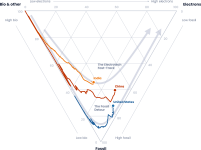
Oil prices were in the $60s before the war. The global economy was already weakening. If the shock is sustained, the recession won't actually sustain those prices even when the shock has passed. And if oil prices are permanently close to $100, you will see the deployment of renewables and EVs on an unprecedented scale globally. Most countries are oil importers. Places like India spend 5% of their GDP on oil and gas imports. Doubling that to 10% is not sustainable long term in the least. Good for Alberta for the next few years. Disastrous in the out years. I imagine, every oil importing country will be doing this after this shock (graph is 1900 - 2023):

download.png


This war has made the best argument to invest in renewables and nuclear and EVs than any environmental activist could ever have made. High nuclear countries like France or high renewables like UK are sitting a lot prettier right now than say Germany with high LNG imports. China will sell PV panels and EVs by the literal boatload after this.
 
There's 16 mpbd shut in. To put this in context, the drop in demand during Covid was 30 mbpd. From that you can gauge the kind of reduction in activity it would take to match supply and demand.

Oil prices were in the $60s before the war. The global economy was already weakening. If the shock is sustained, the recession won't actually sustain those prices even when the shock has passed. And if oil prices are permanently close to $100, you will see the deployment of renewables and EVs on an unprecedented scale globally. Most countries are oil importers. Places like India spend 5% of their GDP on oil and gas imports. Doubling that to 10% is not sustainable long term in the least. Good for Alberta for the next few years. Disastrous in the out years. I imagine, every oil importing country will be doing this after this shock (graph is 1900 - 2023):

View attachment 98869


This war has made the best argument to invest in renewables and nuclear and EVs than any environmental activist could ever have made. High nuclear countries like France or high renewables like UK are sitting a lot prettier right now than say Germany with high LNG imports. China will sell PV panels and EVs by the literal boatload after this.
Freakenomics.
 
This is a useful experiment in oil and product prices.

One of the goals of environmental advocates ("climate change" alarmists) - at least in early days - was to push price-at-the-pump up to EU levels to discourage fossil fuel consumption.

What are some prices in other developed countries that people are putting up with?

Fuel prices in Europe.

Factor for convering Euro to CAD right now: 1.57

GB price 1.51 EUR -> 2.38 CAD
FR price 1.76 EUR -> 2.77 CAD
DE price 1.89 EUR -> 2.97 CAD

What will Canadian prices be like at the pump if oil hits $150 (bbl)?

Depending on one's priors, either the resulting prices are an economic catastrophe waiting to happen and the climate mitigation goal would be somewhat insane, or the resulting prices are obviously bearable and the climate mitigation goal not so unreasonable.

Note also that almost all governments have control of a slider which partly determines price-at-the-pump (taxation).

The prices to which we have become accustomed are not necessarily the highest bearable. (Obviously the cheaper the better, economically.)

Was that the GBP into EUR or was that the GBP price?
 
India's solar cell production has exceeded domestic demand. India is generally well placed for solar as it has a lot of sun in the south. Their national grid is only 13 years old and is still maturing. One of the challenges is how store power when there is no sun or wind. This is one of the advantages we have with all the hydro power plants.
 
India's solar cell production has exceeded domestic demand. India is generally well placed for solar as it has a lot of sun in the south. Their national grid is only 13 years old and is still maturing. One of the challenges is how store power when there is no sun or wind. This is one of the advantages we have with all the hydro power plants.

India today is where China was in 2012. Musk literally laughed at Chinese EVs then.

But forget India. This should absolutely light a fire in the EU to replace as much of gas exports as they can. Who the heck wants to be subject to the whims of the US, Israel, Russia, and the rest of the Middle East for simple stable electricity pricing? And on top of everything, they might now have to start take LNG from Russia. Imagine having to pay your abuser.
 
India today is where China was in 2012. Musk literally laughed at Chinese EVs then.

But forget India. This should absolutely light a fire in the EU to replace as much of gas exports as they can. Who the heck wants to be subject to the whims of the US, Israel, Russia, and the rest of the Middle East for simple stable electricity pricing?
Well Germany kneecapped itself by ditching nuclear, so don't hold your breath.
 
There's 16 mpbd shut in. To put this in context, the drop in demand during Covid was 30 mbpd. From that you can gauge the kind of reduction in activity it would take to match supply and demand.

Oil prices were in the $60s before the war. The global economy was already weakening. If the shock is sustained, the recession won't actually sustain those prices even when the shock has passed. And if oil prices are permanently close to $100, you will see the deployment of renewables and EVs on an unprecedented scale globally. Most countries are oil importers. Places like India spend 5% of their GDP on oil and gas imports. Doubling that to 10% is not sustainable long term in the least. Good for Alberta for the next few years. Disastrous in the out years. I imagine, every oil importing country will be doing this after this shock (graph is 1900 - 2023):

View attachment 98869


This war has made the best argument to invest in renewables and nuclear and EVs than any environmental activist could ever have made. High nuclear countries like France or high renewables like UK are sitting a lot prettier right now than say Germany with high LNG imports. China will sell PV panels and EVs by the literal boatload after this.

And guess what? Neither I nor millions of other Albertans will complain. Because we get to choose how to react. We are not told how to react.

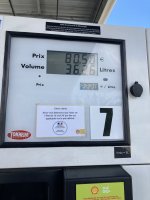
WRT the price at the pump

Alberta collects 13 c per litre as a fuel tax.

It also collects 3.3 cents per litre at the demand of Carney's Trudeaupians as a carbon tax.


The Trudeaupians also collect 10 c per litre as an excise tax

Further, they collect 5% of those taxes on top of the 5% of the price of the fuel itself.

Currently that means that 26.3 cents of every litre purchased goes to the governments, split roughly 50:50.

With 5% of the sale on top of that.

As I understand it, come April 1, the end of this month the Trudeaupian Carbon Tax will increase from 3.3 c per litre to 24.2 c per litre.

The governments will take 47.2 cents per litre come April Fools Day.

With 5% on top of that.

....

Given that all of those costs are in the hands of our politicians then I suggest they have got considerable latitude to mitigate market fluctuations.
 
And guess what? Neither I nor millions of other Albertans will complain. Because we get to choose how to react. We are not told how to react.

WRT the price at the pump

Alberta collects 13 c per litre as a fuel tax.

It also collects 3.3 cents per litre at the demand of Carney's Trudeaupians as a carbon tax.


The Trudeaupians also collect 10 c per litre as an excise tax

Further, they collect 5% of those taxes on top of the 5% of the price of the fuel itself.

Currently that means that 26.3 cents of every litre purchased goes to the governments, split roughly 50:50.

With 5% of the sale on top of that.

As I understand it, come April 1, the end of this month the Trudeaupian Carbon Tax will increase from 3.3 c per litre to 24.2 c per litre.

The governments will take 47.2 cents per litre come April Fools Day.

With 5% on top of that.

....

Given that all of those costs are in the hands of our politicians then I suggest they have got considerable latitude to mitigate market fluctuations.
There is no carbon tax increase on April 1 - zero.
 
If only there was a stable, secure, and democratic nation with high environmental standards and loads of O&G it could export...

Stability of supply is half the equation. This war proves that any large power can wreak havoc on price at a whim. The Europeans are literally watching integer values of percentage GDP going to import oil and gas right now. The faster they get off that merry go round the better for them.

Oh and now that the US is an oil and gas exporter? They are heavily incentivized to behave exactly like all the authoritarian petrostates did in the past. They literally get paid more to do it. And heck, throw in some insider trading on top:

 
Last edited:
If only there was a stable, secure, and democratic nation with high environmental standards and loads of O&G it could export...
You can't possibly be talking about Canada...
 
There is no carbon tax increase on April 1 - zero.

Swings and roundabouts

You are correct and I forgot the Carney announcement last year.

But I also forgot the 7 cents per litre the oil companies are paying before it gets to the pump.

The good news is the current government take is only 33.3 cents per litre.

With 5% of the entire sale on top of that.

The bad news is that by 2030 it is scheduled to rise to a cumulative 43 cents per litre with the industry taxes increasing.

With 5% on top.

....

Either way the government's actions can either amplify or diminish market volatility.
 
Back
Top