• Thanks for stopping by. Logging in to a registered account will remove all generic ads. Please reach out with any questions or concerns.

Legendary British warship 'found' - BBC News

Is HMS Victory a grave? Absolutely.... however, so are the battlefields of the first world war in which thousands of artifacts have been unearthed, cleaned up and sent to museums. Men have been dug up from the soil of France and Belgium for decades, and re-buried in places of honour. We seem to have no objections to this, so why the big deal with a warship? Not to sound cold and callous, but it's the same thing painted with a different brush that we accept with digging up WWI trench sections. As long as the people involved with the ship handle the remains of any crewmen found with dignity and respect, it shouldn't be a major issue. My .02 anyway.
 
recce
The fields of France and Flanders - where most of the digging has taken place... are not considered cemetaries or wargraves.... the bodies found are MIAs presumed KIA.

WRT sunken warships - they are considered a war grave... a cemetary of sorts.... and we have not been in the habbit of digging up cemetaries - have we ?
 
Actually yes we have. Several graveyards were moved due to flooding by dams. London UK has a policy to turm old graveyards into other uses after a period of time from the burial. In fact HMCS Discovery was an old Indian burial ground.
 
Colin, I would not compare the moving a cemetary, from one location to another, to the selective looting of a maritive grave site.
 
You might if the cemetery was being flooded without warning as happened with the Williston lake project or have it washing away as with the Ootsa lake project. The details are different, but the lack of respect was heavily felt by the residents and still is a sore spot.
 
Same company :

Spain awarded shipwreck treasure

_45867818_44170952.jpg


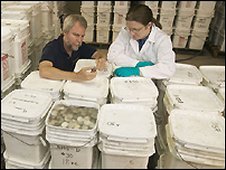
A deep sea treasure-hunting company has been ordered by a US judge to hand over
half a million gold and silver coins to the government of Spain.

The company, Odyssey Marine Exploration, raised the haul from a shipwreck in the
Atlantic, suspected to be that of a Spanish naval vessel. The Spanish government
argued that the treasure formed part of the country's national heritage. But Odyssey
intends to appeal, saying it has a claim to the treasure.

This is just the latest round of a long-running and sometimes murky dispute, says the
BBC's Steve Kingstone in Madrid. The haul of coins - thought to be worth some $500m
(£308m) - came to light in 2007, when Odyssey announced the recovery of artefacts
from a wreck in the Atlantic.

It kept the location of the wreck secret, in what it said was an attempt to deter looters.

The haul was brought ashore in Gibraltar and quickly flown to Miami - enraging the
Spanish government, our correspondent says, which says the wreck is that of the
Mercedes, a naval frigate destroyed by the British in 1804.

'Private property'

Just over a year ago, the Spanish government filed a suit with a federal court in Florida
- where Odyssey is based - demanding the haul be handed over. Late on Wednesday, a
judge ruled that the court lacked jurisdiction over the case, and that the property should
be returned to Spain under a principle known as "sovereign immunity".

Spain's Culture Minister Angeles Gonzalez-Sinde expressed joy at the decision. "It's a very
positive decision for the Spanish government and for all the Spanish citizens because it
guarantees that this ship and the remains of this ship will come back to Spain, which was
originally the owner of this ship," he told the BBC. "I am pretty sure that Spaniards will
have the opportunity to travel back in time and to have a chance to see this treasure."

But in a statement, Odyssey said it would appeal against the ruling. The Nasdaq-listed
company argues that there is no conclusive proof that the wreck is that of the Mercedes
and that even if it is, much of the cargo on board the ship belonged to private individuals
and not the Spanish state.

"I'm confident that ultimately the judge or the appellate court will see the legal and
evidentiary flaws in Spain's claim, and we'll be back to argue the merits of the case,"
said the firm's CEO, Greg Stemm.
 
Delving the secrets of HMS Victory

HMS Victory bucket is auctioned

In pictures: Channel shipwrecks
Picture 1 : German U-boat
Pictures 2,4,5 : HMS Victory
Pictures 3, 6, 7, 8, 9: Unidentified shipwrecks


HMS Victory tour:

Quarter Deck
Lower Gun Deck
Sketch of Battle Plan


Speaking of shipwreck :
China to excavate cabins on 800-year-old recovered merchant wreck, The Daily Star

Chinese archaeologists have won permission to start an "excavation" into
the cabins of the 800-year-old shipwrecked merchant vessel Nanhai No. 1,
the local government said Sunday.

The municipal government of Yangjiang, Guangdong Province, where the
Nanhai No.1 boat has been preserved since it was hoisted from a depth of
30 meters below the South China Sea at the end of 2007, won permission
from the State Administration of Cultural Heritage in May for the "excavation",
Feng Shaowen, director with the municipal publicity bureau, told Xinhua.

The 30-meter-long vessel ship has been soaked in a sealed pool in the "Crystal
Palace" at the Marine Silk Road Museum in Yangjiang. The glass pool - 64 meters
long, 40 meters wide, 23 meters high and about 12 meters in depth - was filled
with sea water and silt to replicate the water temperature, pressure and other
environmental conditions of the seabed where the vessel had lain for centuries.

The details of the excavation have not been released so far but it could last three
to five years.

Construction of the Marine Silk Road Museum began in early 2006,costing 170 million
yuan (24.9 million U.S. dollars). Discovered in mid 1987 off the coast near Yangjiang,
Nanhai No.1 was recognized as one of the oldest and biggest merchant boats sunk
in Chinese waters. Archaeologists have already recovered more than 4,000 artifacts
including gold, silver and porcelain, as well as about 6,000 copper coins from the
Song Dynasty (960-1279) boat. Among the 1,000 delicate porcelain wares, many were
made by handicraftsmen to feature foreign porcelain patterns and styles, said Feng.

The well-preserved vessel might confirm the existence of an ancient maritime trade
route linking China and the West. As early as 2,000 years ago, ancient Chinese traders
began taking china, silk and cloth textiles and other commodities to foreign countries
along the trading route. It started from ports at today's Guangdong and Fujian provinces
to countries in southeast Asia, Africa and Europe.

The 'Marine Silk Road', like the ancient Silk Road that connected China with south, west
and central Asia and Europe, was also a bridge for connecting Eastern and Western cultures,
but evidence for the existence of the route is rare, said Huang Zongwei, professor with
the Guangdong-based Sun Yat-Sen University.

 
I'll use the following article (which may not warrant its own thread?),
to bump that up :).

Ancient Roman shipwrecks found

_46111276_007697195-1.jpg

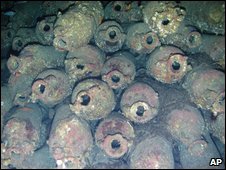
Much of the cargo is still intact

Underwater archaeologists in Italy have discovered the wrecks of five ancient Roman ships
in the Mediterranean, with their cargo still largely intact. The ships are lying in up to 150
metres (500 feet) of water off the tiny island of Ventotene, between Rome and Naples. They
are between 1,600 and 1,900 years old, and were laden with - among other things - jars
for carrying wine, olive oil and fish sauce.

One expert said: "It is like an underwater museum."

Also on board were kitchen tools, and certain metal and glass objects which have not yet
been identified. The discovery of wrecked ships is not unusual - there are said to be
thousands dotted around the Mediterranean.

But Annalisa Zarattini, from the Italian Culture Ministry, said the latest to be found are
much better preserved than usual because they sank in deeper water, which protected
them from destructive currents. The ships also sank without capsizing, she said, allowing
examination of the cargo in almost the form it had been loaded.

Officials say the latest finds are the result of a new drive by archaeologists to scan deeper
waters, organised by the culture ministry and the Aurora Trust, a maritime research group.
The plan was prompted in part by a desire to prevent the looting of treasures.

Because of improving technology, looters are now able to dive to greater depths than in the
past. "It's important that we arrive there first," said Ms Zarattini. The team of archaeologists
and deep sea divers used sonar technology and miniature robotic submarines in their latest
operation.

The biggest of the ships discovered is about 20 metres long (60 feet). The area they were
found in was on a major route for trade between Rome and its North African territories.
Some of the objects are being put on display on Ventotene.

_46111278_007697215-1.jpg

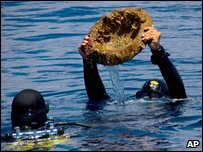
Italian authorities are trying
to stay ahead of looters
 
Back
Top