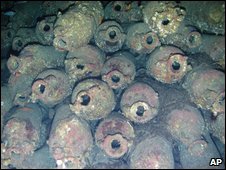
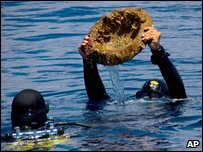
Delving the secrets of HMS Victory
HMS Victory bucket is auctioned
In pictures: Channel shipwrecks
Picture 1 : German U-boat
Pictures 2,4,5 : HMS Victory
Pictures 3, 6, 7, 8, 9: Unidentified shipwrecks
HMS Victory tour:
Quarter Deck
Lower Gun Deck
Sketch of Battle Plan
Speaking of shipwreck :
China to excavate cabins on 800-year-old recovered merchant wreck, The Daily Star
Chinese archaeologists have won permission to start an "excavation" into
the cabins of the 800-year-old shipwrecked merchant vessel Nanhai No. 1,
the local government said Sunday.
The municipal government of Yangjiang, Guangdong Province, where the
Nanhai No.1 boat has been preserved since it was hoisted from a depth of
30 meters below the South China Sea at the end of 2007, won permission
from the State Administration of Cultural Heritage in May for the "excavation",
Feng Shaowen, director with the municipal publicity bureau, told Xinhua.
The 30-meter-long vessel ship has been soaked in a sealed pool in the "Crystal
Palace" at the Marine Silk Road Museum in Yangjiang. The glass pool - 64 meters
long, 40 meters wide, 23 meters high and about 12 meters in depth - was filled
with sea water and silt to replicate the water temperature, pressure and other
environmental conditions of the seabed where the vessel had lain for centuries.
The details of the excavation have not been released so far but it could last three
to five years.
Construction of the Marine Silk Road Museum began in early 2006,costing 170 million
yuan (24.9 million U.S. dollars). Discovered in mid 1987 off the coast near Yangjiang,
Nanhai No.1 was recognized as one of the oldest and biggest merchant boats sunk
in Chinese waters. Archaeologists have already recovered more than 4,000 artifacts
including gold, silver and porcelain, as well as about 6,000 copper coins from the
Song Dynasty (960-1279) boat. Among the 1,000 delicate porcelain wares, many were
made by handicraftsmen to feature foreign porcelain patterns and styles, said Feng.
The well-preserved vessel might confirm the existence of an ancient maritime trade
route linking China and the West. As early as 2,000 years ago, ancient Chinese traders
began taking china, silk and cloth textiles and other commodities to foreign countries
along the trading route. It started from ports at today's Guangdong and Fujian provinces
to countries in southeast Asia, Africa and Europe.
The 'Marine Silk Road', like the ancient Silk Road that connected China with south, west
and central Asia and Europe, was also a bridge for connecting Eastern and Western cultures,
but evidence for the existence of the route is rare, said Huang Zongwei, professor with
the Guangdong-based Sun Yat-Sen University.




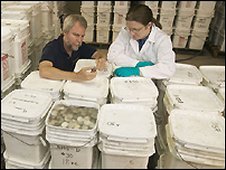
 .
.